


الدولة السلجوقية | التاريخ الإسلامي للدولة السلجوقية للدكتور علي محمد الصلابي
الدولة السلجوقية | التاريخ الإسلامي للدولة السلجوقية للدكتور علي محمد الصلابي
Publisher:
Dar Al Maarifah
Author:
د. علي محمد الصلابي
Language:
العربية
Binding:
غلاف مقوى
Pages: 704
Size: ١٧x٢٤ سم
لم نتمكن من تحميل توفر الاستلام


محتوى قابل للطي
وصف كتاب إسلامي
دولة السلاجقة | التاريخ الإسلامي للدولة السلجوقية بقلم الدكتور علي محمد الصلابي
دولة السلاجقة بقلم الدكتور علي محمد الصلابي هو عمل عربي شامل يستعرض تاريخ ونشأة الدولة السلجوقية ودورها الهام في التاريخ الإسلامي. يتناول الكتاب التحديات السياسية والفكرية والعسكرية التي واجهت العالم الإسلامي خلال تلك الفترة، بما في ذلك الصراع ضد الحركات الباطنية الداخلية والتوسع الصليبي. ومن خلال الأحداث التاريخية وتجارب القادة المسلمين المؤثرين، يسلط المؤلف الضوء على الدروس والعبر الهامة التي يمكن استخلاصها من الماضي. يؤكد الكتاب على قيمة دراسة التاريخ الإسلامي ليس باعتباره مجرد سجل للأحداث، بل كمصدر للدروس والهداية والفهم. وبفضل معالجته التاريخية المفصلة وحجمه الكبير، يعد الكتاب مرجعاً قيماً للقراء المهتمين بـ التاريخ الإسلامي، والحضارات الإسلامية، وحكام السلاجقة، والتطور التاريخي للعالم الإسلامي.
من المؤلف:
دولة السلاجقة
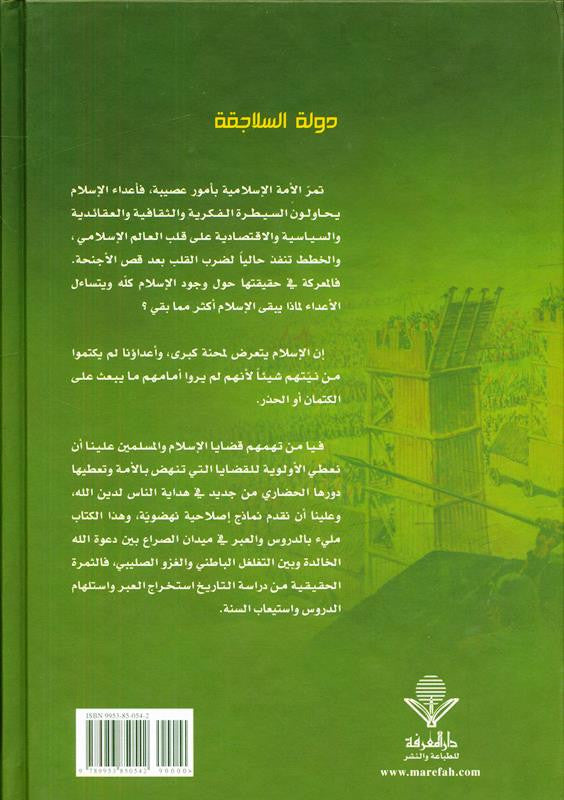
تمرّ الأمة الإسلامية بأمور عصيبة، فأعداء الإسلام يحاولون السيطرة الفكرية والثقافية والعقائدية والسياسية والاقتصادية على قلب العالم الإسلامي، والخطط تنفذ لضرب القلب بعد قص الأجنحة. فالمعركة في حقيقتها حول وجود الإسلام كله ويتساءل الأعداء لماذا يبقى الإسلام أكثر مما بقي؟
إن الإسلام يتعرض لمحنة كبرى، وأعداؤنا لم يكتموا من نيّتهم شيئاً لأنهم لم يروا أمامهم ما يبعث على الكتمان أو الحذر.
فيا من تهمهم قضايا الإسلام والمسلمين علينا أن نعطي الأولوية للقضايا التي تنهض بالأمة وتعطيها دورها الحضاري من جديد في هداية الناس لدين الله، وعلينا أن نقدم نماذج إصلاحية نهضوية، وهذا الكتاب مليء بالدروس والعبر في ميدان الصراع بين دعوة الله الخالدة وبين التغلغل الباطني والغزو الصليبي، فالثمرة الحقيقية من دراسة التاريخ استخراج العبر واستلهام الدروس واستيعاب السنن.
Page:01
Encyclopedia of the Crusades
The Seljuk State
And the emergence of an Islamic project to resist Batinite infiltration and the Crusader invasion
Dr. Ali Muhammad al-Sallabi
Dar al-Ma'rifa
Beirut - Lebanon
Page:02
Chapter One
The Seljuks, their origins and their sultans
Section One
Their origins, homelands, and the beginning of their emergence
The Seljuks descend from the "Qinik" Turkmen tribe, which, along with twenty-three other tribes, represents the group of Turkmen tribes known as the "Oghuz," in the region beyond the river (Transoxiana), which is called Turkestan today. This region extends from the Mongolian plateau and northern China in the east to the Khazar Sea (Caspian Sea) in the west, and from the Siberian plains in the north to the Indian subcontinent and Persia in the south.
The Oghuz clans and their major tribes settled in those regions and were known as the Turks. Then, in the second half of the sixth century AD, these tribes began moving from their original homeland toward Asia Minor in massive migrations. Historians have mentioned a number of reasons that contributed to their migration; some believe it was due to economic factors, as severe drought and high birth rates made these tribes unable to bear living in their original homelands, so they migrated in search of fodder, pastures, and a comfortable life. Others attribute these migrations to political reasons, as these tribes were subjected to great pressure from other tribes and were forced to leave their lands in search of the blessings of security and stability. Dr. Abd al-Latif Abdullah bin Duhaish subscribed to this opinion, and those...
(1) Akhbar al-Dawla al-Saljuqiyya by al-Husayn, pp. 2, 3; Nizam al-Wizara by al-Zahrani, p. 31. (2) History of the Turks in Central Asia, translated by Ahmed al-Eid, p. 106; The Ottoman Empire, p. 23. (3) Akhbar al-Umara' wa al-Muluk al-Saljuqiyya, edited by Dr. Muhammad Nur al-Din, pp. 2-4.
(4) Kitab al-Suluk, Ahmad al-Maqrizi, Vol. 1, Part 1, p. 3.
(5) The Rise of the Ottoman Empire, p. 8.
(6) Al-Kamil fi al-Tarikh (22/8).
Page:03
Section Three / Weapons and Military Fortifications
Section Three: Weapons and Military Fortifications
First: Individual Light Weapons:
1 - Offensive weapons, the most important of which are:
a - The bow, b - The sword, c - The spear, d - The mace, e - The knife, f - The battle-axe, g - Slings.
2 - Personal protection and self-defense weapons:
a - The shield (turs), which is a protective weapon for the face and surrounding areas, called: al-jannah. It is made of iron and leather and has multiple types, each suitable for a specific use.
b - The coat of mail (dir'), which is a tunic made of woven chainmail worn by the fighter for protection against swords and arrows, and it has multiple types.
c - The helmet (baydah): It is a helmet made of iron or steel, lined with soft materials such as cotton and others to protect the head.
(1) Ibn Sallam's chapter on the bow, its types, and the names of its parts in Kitab al-Silah, pp. 22-28. (2) Ibn Sallam mentioned the types of swords, their names, and their parts in detail. (3) The spear: Ibn Sallam mentioned the spears, their types, and their names in detail in Kitab al-Silah. (4) The axe: It is called the madyah, and its conditions vary according to the need for it.
(5) Military Systems of the Seljuks, p. 248.
(6) Military Systems of the Seljuks, p. 249. (7) Ibid., p. 250.
(8) Ibid., War Among the Arabs, p. 74.
Page:04
Chapter Three / Military Systems of the Seljuks
Second: Heavy Collective Weapons:
1 - The Trebuchet (Manjaniq) and the 'Arada:
The trebuchet is one of the most effective and destructive siege engines for the Seljuks.
The trebuchet: An engine made of wood that has two upright planks between which is a long arrow with a heavy head and a light tail, in which the trebuchet cup is placed, which holds the stone. It is pulled until its lower parts are raised above its upper parts, then released; its column containing the cup rises, and the stone is thrown from it, destroying whatever it hits. It is one of the most effective and destructive siege engines, having multiple types and sizes, and is used to throw stones, naphtha, and other things. The trebuchet is similar to heavy field artillery in our present era, and the Seljuk army used it. As for the 'arada, it is a small trebuchet, smaller in size than the trebuchet. What throws heavy stones is called the trebuchet, and what throws relatively light stones is called the 'arada.
Subh al-A'sha (152/2); Military Systems, p.
(2) Military Systems of the Seljuks, p.
(3) Ibid., p. 256.
(4) Ibid., p. 256.
الناشر
Dar Al Maarifah
مؤلف
- د. علي محمد الصلابي
الشحن والتوصيل
نقوم بشحن الطلبات مباشرة من مستودعاتنا في المملكة المتحدة والولايات المتحدة الأمريكية، ونقدم خيارات شحن متعددة لتناسب احتياجاتك. نحن نشحن بفخر إلى جميع أنحاء العالم.
عمليات التسليم في المملكة المتحدة (من مستودع المملكة المتحدة):
يصل الشحن القياسي عادةً في غضون 3-4 أيام عمل. يستغرق التسليم السريع 2-3 أيام عمل. نهدف إلى شحن الطلبات في نفس اليوم أو يوم العمل التالي، مع توفر خيارات التوصيل في اليوم التالي حيثما ينطبق ذلك.
عمليات التسليم في الولايات المتحدة الأمريكية (من مستودع الولايات المتحدة الأمريكية):
تصل الطلبات عادةً في غضون 4-7 أيام عمل.
أوروبا (يتم الشحن من المملكة المتحدة):
يستغرق التسليم القياسي حوالي 6-10 أيام عمل، مع توفر خدمات الشحن السريع في غضون 3-5 أيام عمل.
كندا:
الوقت المقدر للتسليم هو 5-10 أيام عمل.
الشحن في جميع أنحاء العالم:
تصل الطلبات الدولية بشكل عام في غضون 5-20 يوم عمل، اعتمادًا على الوجهة وطريقة الشحن المختارة.
للحصول على جداول زمنية دقيقة للتسليم بناءً على موقعك، يرجى الاتصال بنا عبر البريد الإلكتروني وسيقدم فريقنا معلومات مفصلة ومخصصة لعنوانك.
صفحات العينة - المحتوى
Page:01
Encyclopedia of the Crusades
The Seljuk State
And the emergence of an Islamic project to resist Batinite infiltration and the Crusader invasion
Dr. Ali Muhammad al-Sallabi
Dar al-Ma'rifa
Beirut - Lebanon
Page:02
Chapter One
The Seljuks, their origins and their sultans
Section One
Their origins, homelands, and the beginning of their emergence
The Seljuks descend from the "Qinik" Turkmen tribe, which, along with twenty-three other tribes, represents the group of Turkmen tribes known as the "Oghuz," in the region beyond the river (Transoxiana), which is called Turkestan today. This region extends from the Mongolian plateau and northern China in the east to the Khazar Sea (Caspian Sea) in the west, and from the Siberian plains in the north to the Indian subcontinent and Persia in the south.
The Oghuz clans and their major tribes settled in those regions and were known as the Turks. Then, in the second half of the sixth century AD, these tribes began moving from their original homeland toward Asia Minor in massive migrations. Historians have mentioned a number of reasons that contributed to their migration; some believe it was due to economic factors, as severe drought and high birth rates made these tribes unable to bear living in their original homelands, so they migrated in search of fodder, pastures, and a comfortable life. Others attribute these migrations to political reasons, as these tribes were subjected to great pressure from other tribes and were forced to leave their lands in search of the blessings of security and stability. Dr. Abd al-Latif Abdullah bin Duhaish subscribed to this opinion, and those...
(1) Akhbar al-Dawla al-Saljuqiyya by al-Husayn, pp. 2, 3; Nizam al-Wizara by al-Zahrani, p. 31. (2) History of the Turks in Central Asia, translated by Ahmed al-Eid, p. 106; The Ottoman Empire, p. 23. (3) Akhbar al-Umara' wa al-Muluk al-Saljuqiyya, edited by Dr. Muhammad Nur al-Din, pp. 2-4.
(4) Kitab al-Suluk, Ahmad al-Maqrizi, Vol. 1, Part 1, p. 3.
(5) The Rise of the Ottoman Empire, p. 8.
(6) Al-Kamil fi al-Tarikh (22/8).
Page:03
Section Three / Weapons and Military Fortifications
Section Three: Weapons and Military Fortifications
First: Individual Light Weapons:
1 - Offensive weapons, the most important of which are:
a - The bow, b - The sword, c - The spear, d - The mace, e - The knife, f - The battle-axe, g - Slings.
2 - Personal protection and self-defense weapons:
a - The shield (turs), which is a protective weapon for the face and surrounding areas, called: al-jannah. It is made of iron and leather and has multiple types, each suitable for a specific use.
b - The coat of mail (dir'), which is a tunic made of woven chainmail worn by the fighter for protection against swords and arrows, and it has multiple types.
c - The helmet (baydah): It is a helmet made of iron or steel, lined with soft materials such as cotton and others to protect the head.
(1) Ibn Sallam's chapter on the bow, its types, and the names of its parts in Kitab al-Silah, pp. 22-28. (2) Ibn Sallam mentioned the types of swords, their names, and their parts in detail. (3) The spear: Ibn Sallam mentioned the spears, their types, and their names in detail in Kitab al-Silah. (4) The axe: It is called the madyah, and its conditions vary according to the need for it.
(5) Military Systems of the Seljuks, p. 248.
(6) Military Systems of the Seljuks, p. 249. (7) Ibid., p. 250.
(8) Ibid., War Among the Arabs, p. 74.
Page:04
Chapter Three / Military Systems of the Seljuks
Second: Heavy Collective Weapons:
1 - The Trebuchet (Manjaniq) and the 'Arada:
The trebuchet is one of the most effective and destructive siege engines for the Seljuks.
The trebuchet: An engine made of wood that has two upright planks between which is a long arrow with a heavy head and a light tail, in which the trebuchet cup is placed, which holds the stone. It is pulled until its lower parts are raised above its upper parts, then released; its column containing the cup rises, and the stone is thrown from it, destroying whatever it hits. It is one of the most effective and destructive siege engines, having multiple types and sizes, and is used to throw stones, naphtha, and other things. The trebuchet is similar to heavy field artillery in our present era, and the Seljuk army used it. As for the 'arada, it is a small trebuchet, smaller in size than the trebuchet. What throws heavy stones is called the trebuchet, and what throws relatively light stones is called the 'arada.
Subh al-A'sha (152/2); Military Systems, p.
(2) Military Systems of the Seljuks, p.
(3) Ibid., p. 256.
(4) Ibid., p. 256.
من هو الدكتور علي م. الصلابي؟
الدكتور علي محمد الصلابي عالمٌ ومؤلفٌ شهير، يُعرف بفهمه العميق لأصول الدين والعقيدة الإسلامية. تُركّز أعماله على تقديم تفسيراتٍ واضحةٍ للمفاهيم الإسلامية الأساسية، مثل التوحيد والإيمان والعبادة.