


Salah ad-Deen al-Ayubi (Arabic) | Complete Biography of Sultan Salahuddin by Dr. Ali M. Sallabi
Salah ad-Deen al-Ayubi (Arabic) | Complete Biography of Sultan Salahuddin by Dr. Ali M. Sallabi
Publisher:
Dar Al Maarifah
Author:
د. علي محمد الصلابي
Language:
العربية
Binding:
غلاف مقوى
Pages: 702
Size: ١٧x٢٤ سم
لم نتمكن من تحميل توفر الاستلام


محتوى قابل للطي
وصف كتاب إسلامي
Salah ad-Deen al-Ayubi (Arabic) | Complete Biography of Sultan Salahuddin by Dr. Ali M. Sallabi
Salah ad-Deen al-Ayubi (صلاح الدين الأيوبي) by Dr. Ali M. Sallabi is a comprehensive Arabic biography of the legendary Muslim leader Sultan Salahuddin Al-Ayyubi. Drawing upon authentic historical sources, the author examines the political and military landscape preceding the rise of the Ayyubid State, the Crusades, the Battle of Hattin, the liberation of Jerusalem, and the Third Crusade. The book also highlights Salahuddin's exemplary leadership, justice, devotion, support for Islamic scholarship, and lasting legacy in Islamic history. Written in eloquent Arabic, this work is an invaluable resource for students of Islamic history, Arabic readers, and anyone seeking an in-depth understanding of one of Islam's greatest leaders and his contributions to the Muslim Ummah.
From Author:
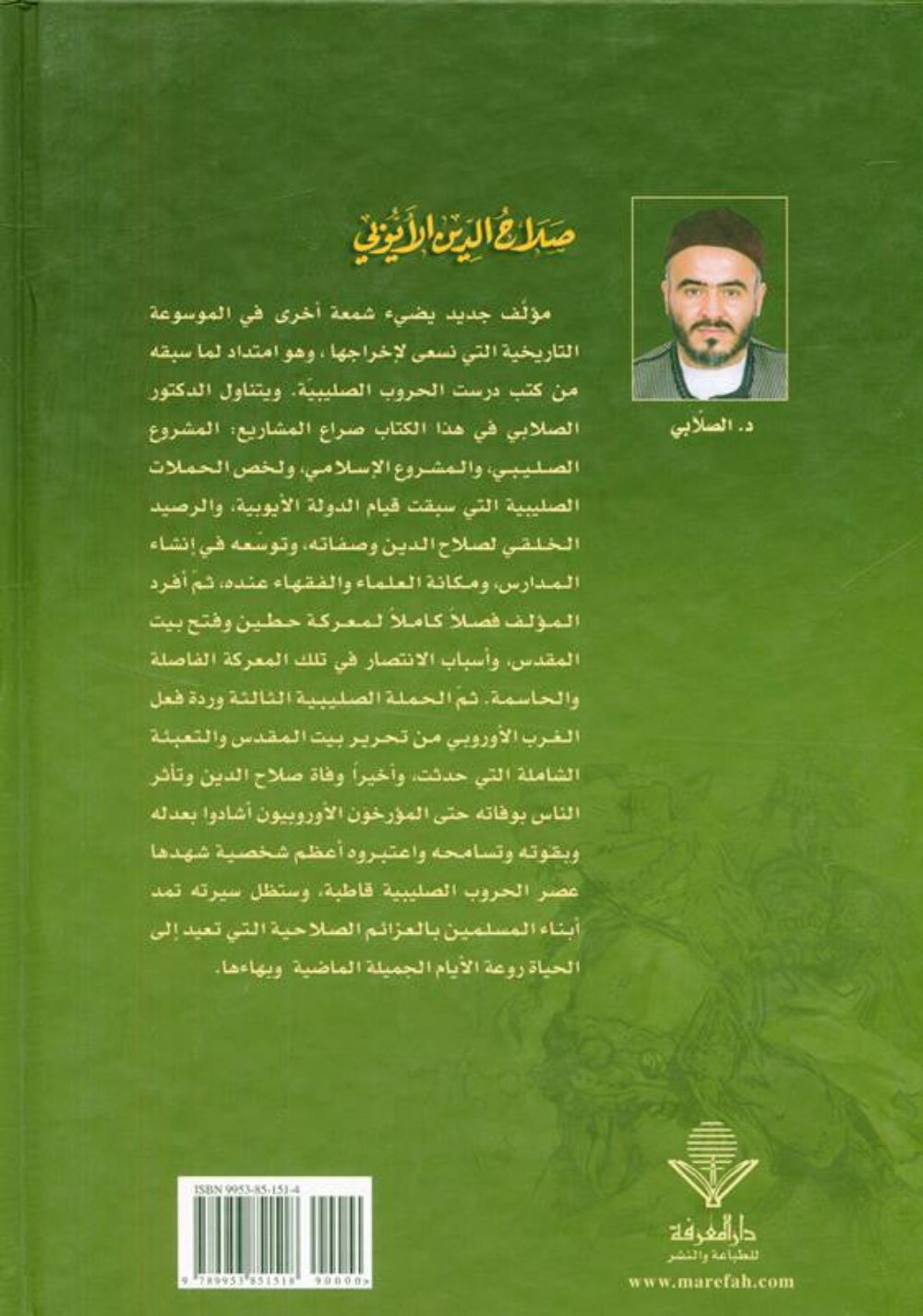
مؤلَّـف جديد يضيء شمعة أخرى في الموسوعة التاريخية التي نسعى لإخراجها ، وهو امتداد لما سبقه من كتب درست الحروب الصليبيّة . ويتناول الدكتور الصلابي في هذا الكتاب صراع المشاريع: المشروع الصليبي، والمشروع الإسلامي، ولخص الحملات الصليبية التي سبقت قيام الدولة الأيوبية، والرصيد الخلقي لصلاح الدين وصفاته، وتوسّعه في إنشاء المدارس، ومكانة العلماء والفقهاء عنده، ثمّ أفرد المؤلف فصلاً كاملاً لمعركة حطين وفتح بيت المقدس، وأسباب الانتصار في تلك المعركة الفاصلة والحاسمة. ثمّ الحملة الصليبية الثالثة وردة فعل الغرب الأوروبي من تحرير بيت المقدس والتعبئة الشاملة التي حدثت، وأخيراً وفاة صلاح الدين وتأثر الناس بوفاته حتى المؤرخون الأوروبيون أشادوا بعدله وبقوته وتسامحه واعتبروه أعظم شخصية شهدها عصر الحروب الصليبية قاطبة، وستظل سيرته تمد أبناء المسلمين بالعزائم الصلاحية التي تعيد إلى الحياة روعة الأيام الجميلة الماضية وبهاءها .
Content:
A Timeless Chronicle of the Crusades
Discover the remarkable story of the Crusades through the life and leadership of Salah ad-Din al-Ayyubi (Saladin). This volume explores the historical roots of the Crusades, the political landscape before the rise of the Ayyubid State, and the struggles that shaped one of the most significant periods in Islamic history.
Explore the Origins of the Crusades
The book begins by tracing the historical background of the Crusades, explaining that the conflict between the Muslim world and Western Christian powers was part of a much longer historical struggle. It examines the early Byzantine response to the emergence of Islam and the events that laid the foundation for later Crusader campaigns.
The Rise of Salah ad-Din and Islamic Unity
Following the death of Nur ad-Din Zangi, the Muslim world faced political uncertainty and internal rivalries. The author highlights how Salah ad-Din emerged as a visionary leader who gradually united the divided Muslim territories, strengthened the Islamic front, and prepared the Ummah to confront the Crusader threat.
The Liberation of Jerusalem
One of the book's most inspiring sections recounts the conquest of Jerusalem. It includes classical poetry celebrating Salah ad-Din's historic victory, portraying the liberation of Al-Quds as a moment of faith, courage, justice, and divine support that restored hope to the Muslim world.
Battles, Strategy, and Leadership
The narrative also covers Salah ad-Din's military brilliance in dealing with powerful Crusader forces, including the German Crusade led by Emperor Frederick Barbarossa. Through careful planning, diplomacy, intelligence gathering, and strategic defense, Salah ad-Din demonstrated exceptional leadership in protecting the Muslim lands.
Rich Historical Analysis
Drawing from classical Islamic historical sources, the book presents a detailed account of political developments, military campaigns, alliances, and the personalities who shaped the Crusader era. It provides readers with a deeper understanding of the challenges and achievements of the Ayyubid period.
Page:01
Encyclopedia of the Crusades
Salah ad-Din al-Ayyubi
And his role in eliminating the Fatimid Caliphate and liberating Jerusalem
By: Ali Muhammad al-Sallabi
Dar al-Ma'rifah
Page:02
Chapter One
The Crusades that preceded the establishment of the Ayyubid State
Section One
Historical roots of the Crusades
It is worth noting that the Crusades between Muslims and Western Christians, among others, did not begin at the end of the fifth century AH, nor did they end in the seventh century AH; rather, these campaigns are a series within this long conflict that began with the emergence of Islam and continued in successive, periodic forms.
They almost covered the entire timeline from the emergence of Islam to the modern era. This conflict can be divided into six axes along which it continued. The cycles of conflict on each of these axes would hardly lull before erupting again on a new axis no less fierce, violent, and draining to Islamic energies across vast stretches of land(2). These axes are:
First: The Byzantines:
The beginnings of the Byzantine counter-movement against Islam date back to the era of the Prophethood itself. From the fifth year of the Hijrah, through the battles of Dumat al-Jandal, Dhat al-Salasil, Mu'tah, and Tabuk, and ending with the campaign of Zayd (may Allah be pleased with all the Companions), the Byzantine camp was sensitive to the new Islamic threat coming from the south, especially after the nascent state was able to break the ties of many Arab tribes in the north of the Peninsula from their old masters, the Romans. Whether the Byzantines moved against the Islamic forces of their own volition or as a reaction to an Islamic move, the conclusion is that this camp began to realize more and more the scale of the new challenge and began preparing to stop it. It is true that this preparation was—at times—not of the required magnitude, perhaps due to inaccurate information upon which the Byzantine leadership based its positions, but the result... that fire was ignited across...
(1) Lessons and Reflections on the Crusades by Abu Faris, p. 30. (2) Counter-attacks in Islamic History, Dr. Imad al-Din, p. 26.
Page:03
Chapter Two/ Establishment of the Ayyubid State
Section Seven
Salah ad-Din al-Ayyubi's efforts to unify the Islamic front
The death of Nur ad-Din was a surprise that no one expected. While Damascus was celebrating the circumcision of his son with him during Eid al-Fitr in the year (569 AH), the entire Islamic world found itself mourning him two weeks later. Once the news spread, all greeds were unleashed—not only among Nur ad-Din's closest family, but also among his emirs, military commanders, and the occupying Franks alike. Everyone sought to benefit from the absence of the man who, until his death, held the fate of the region and the Franks in his hands with prestige, courage, piety, and foresight. Nur ad-Din left behind a sprawling state extending from Barqa in Yemen to the Levant, the Jazira, and Mosul. If we review the sequence of events immediately following his death, we find that the conflict between the powers had begun, and that each group of powers acted according to...
The Zangid family in Mosul, whose representative and Nur ad-Din's deputy there was Sayf ad-Din Ghazi—his nephew—had gathered his army to assist him in the war against the Franks, only for him to turn towards "Nusaybin," own it, and send supplies to the "Khabur," taking possession of it. Then he marched to "Harran," besieged it, and took it after its governor, Qaymaz al-Harrani (a mamluk of Nur ad-Din), surrendered. Then he besieged Edessa and took it from the eunuch servant of Nur ad-Din, then sent someone to take possession of Raqqa on the Euphrates and Saruj. Thus, the cities of the Jazira became under his control, except for "Qal'at Ja'bar," and he brought back the taxes and became indulgent in matters of leisure and wine(2).
The emirs in Damascus adhered to the child King al-Salih, who succeeded Salah ad-Din at the age of one, and agreed to be of one mind, making Emir Ibn al-Muqaddam the leader of their group, as he assumed the Atabegate of the child, i.e., overseeing his upbringing.
- And Emir Shams ad-Din ibn al-Dayah, along with his two brothers, was ruling Aleppo, so he remained cut off between the Zangids in the east and the Damascus group, even though he was a friend of Salah ad-Din and leaned towards him.
Salah ad-Din the Mujahid Knight and Ascetic King, p. 145.
Salah ad-Din the Mujahid Knight, p. 46, Kitab al-Rawdatayn (2/327).
Salah ad-Din the Mujahid Knight and Ascetic King, p. 146.
Ibid, p. 146.
Page:04
Section Two: The Conquest of Jerusalem
2 - Abu Ali al-Hasan ibn Ali al-Juwayni on the Conquest of Jerusalem:
Heaven's soldiers are the supporters of this King, whoever doubts them.
This conquest is proof whenever people see what we narrate.
In a time when years and ages have passed, these conquests are the conquests of the Prophets.
And they have no price other than gratitude through deeds.
The noble Frankish kings became prey in his hand,
And they were never weak, and they were never humbled.
How many champions and kings were left behind,
While they, in fear of the Franks, were like children.
This, and how many kings after him looked,
At Islam being folded and encompassed while he was drunk.
For ninety years, the lands of Allah were crying out,
And Islam's splendor was deaf and blind.
So now Salah ad-Din answered their call,
By the command of the One who is the helper to the helper.
For the Victor, these conquests were reserved,
And no kings desired them since they were created.
He was greeted by the Lord of the Throne with a mighty victory,
So people said, is this David or Solomon?
In half a month, he became a destroyer of polytheism,
So the regions and lands were purified of it.
So where are Muslimah and his brothers, where is their father?
Where is Marwan?
Forget all else, for the Franks were not destroyed by them,
By any human king on earth.
If this conquest were in the Prophet's era,
Verses and a Quran would have been revealed about it.
How ugly are the faces of the worshippers of the Cross,
Now that they are veiled by doom and defeat.
Stored with the Lord of the Throne is all that he possessed,
And the kings of the earth are treasurers.
May Allah keep you for Islam, guarding it,
From being wronged or left bewildered.
And this is a Sunnah, honor this Sunnah,
For disbelief is in slumber and victory is awake.
O gatherer of the word of faith, suppressor,
Of whoever worships crosses instead of the Lord of the Throne.
If Allah folds the scroll of the servants,
The scroll of Salah ad-Din's reward shall not be folded.(1)
(1) Wa Qudsa (1/344).
Page:05
Chapter Three: The Battle of Hattin and the Conquest of Jerusalem
4 - Salah ad-Din's position on the German Crusade:
Salah ad-Din did not neglect the matter of the German Crusade since he learned of its march towards him. He mobilized the people for Jihad, sending a messenger in Ramadan of the year (585 AH / 1189 AD) on his behalf, namely Judge Baha ad-Din ibn Shaddad, to the Abbasid Caliph at that time, an-Nasir li-Din Allah Abu al-Abbas Ahmad ibn al-Mustadi, to inform him of the Germans' march to the Levant. Salah ad-Din ordered Judge Ibn Shaddad to travel on his way to the emirs of Mosul, Sinjar, the Jazira, and Irbil to summon them for Jihad, and they responded to that and prepared to march to Salah ad-Din, as the Abbasid Caliph had promised everything good(1) and supported Salah ad-Din with money and equipment(2). At the same time, Salah ad-Din continued to track the progress of the Germans towards him by sending scouts (spies) to uncover their news. He also sent his deputies in the Levantine lands with their troops to uncover the enemy's news and intercept his path. They encountered a detachment of the German army that had gone out to seek fodder for the animals, and they killed and captured about five hundred of them. When Salah ad-Din confirmed the arrival of the Germans to the lands of the Armenians and their proximity to the Islamic lands, he gathered the emirs of his state and consulted them on what to do. Their opinion agreed on sending a large army to meet the enemy on his way and protect some cities. Those Islamic crowds marched, led by a number of Muslim emirs, and inflicted heavy losses on the German enemy along his path(3). Salah ad-Din also ordered the demolition of the walls of Tiberias, Jaffa, Arsuf, Caesarea, Sidon, and Byblos, because he feared the Crusaders would seize them and use those walls to fight the Muslims(4). In truth, the German Crusade failed when its leader, Emperor Frederick Barbarossa, drowned in one of the rivers of Asia Minor, and the German crowds in the Levant were scattered, which prevented them from reaching Jerusalem and achieving their goal of reclaiming it from the hands of the Muslims. Finally, if Frederick Barbarossa had rushed to the East at the head of his Crusader campaign and chose the land route to the Levant, then Philip Augustus, King of France, and Richard the Lionheart, King of England, did not leave Western Europe in a Crusader campaign until the summer of 586 AH / 1190 AD, and they chose to go to Acre by sea(5).
(1) Al-Nawadir al-Sultaniyya, p. 115; Salah ad-Din and the Crusaders, p. 247. (2) Mufarrij al-Kurub (3232); Salah ad-Din and the Crusaders, p. 247.
(3) Salah ad-Din and the Crusaders, p. 247.
(4) Ibid, p. 247.
(5) Ibid.
الناشر
Dar Al Maarifah
مؤلف
- د. علي محمد الصلابي
الشحن والتوصيل
نقوم بشحن الطلبات مباشرة من مستودعاتنا في المملكة المتحدة والولايات المتحدة الأمريكية، ونقدم خيارات شحن متعددة لتناسب احتياجاتك. نحن نشحن بفخر إلى جميع أنحاء العالم.
عمليات التسليم في المملكة المتحدة (من مستودع المملكة المتحدة):
يصل الشحن القياسي عادةً في غضون 3-4 أيام عمل. يستغرق التسليم السريع 2-3 أيام عمل. نهدف إلى شحن الطلبات في نفس اليوم أو يوم العمل التالي، مع توفر خيارات التوصيل في اليوم التالي حيثما ينطبق ذلك.
عمليات التسليم في الولايات المتحدة الأمريكية (من مستودع الولايات المتحدة الأمريكية):
تصل الطلبات عادةً في غضون 4-7 أيام عمل.
أوروبا (يتم الشحن من المملكة المتحدة):
يستغرق التسليم القياسي حوالي 6-10 أيام عمل، مع توفر خدمات الشحن السريع في غضون 3-5 أيام عمل.
كندا:
الوقت المقدر للتسليم هو 5-10 أيام عمل.
الشحن في جميع أنحاء العالم:
تصل الطلبات الدولية بشكل عام في غضون 5-20 يوم عمل، اعتمادًا على الوجهة وطريقة الشحن المختارة.
للحصول على جداول زمنية دقيقة للتسليم بناءً على موقعك، يرجى الاتصال بنا عبر البريد الإلكتروني وسيقدم فريقنا معلومات مفصلة ومخصصة لعنوانك.
صفحات العينة - المحتوى
Page:01
Encyclopedia of the Crusades
Salah ad-Din al-Ayyubi
And his role in eliminating the Fatimid Caliphate and liberating Jerusalem
By: Ali Muhammad al-Sallabi
Dar al-Ma'rifah
Page:02
Chapter One
The Crusades that preceded the establishment of the Ayyubid State
Section One
Historical roots of the Crusades
It is worth noting that the Crusades between Muslims and Western Christians, among others, did not begin at the end of the fifth century AH, nor did they end in the seventh century AH; rather, these campaigns are a series within this long conflict that began with the emergence of Islam and continued in successive, periodic forms.
They almost covered the entire timeline from the emergence of Islam to the modern era. This conflict can be divided into six axes along which it continued. The cycles of conflict on each of these axes would hardly lull before erupting again on a new axis no less fierce, violent, and draining to Islamic energies across vast stretches of land(2). These axes are:
First: The Byzantines:
The beginnings of the Byzantine counter-movement against Islam date back to the era of the Prophethood itself. From the fifth year of the Hijrah, through the battles of Dumat al-Jandal, Dhat al-Salasil, Mu'tah, and Tabuk, and ending with the campaign of Zayd (may Allah be pleased with all the Companions), the Byzantine camp was sensitive to the new Islamic threat coming from the south, especially after the nascent state was able to break the ties of many Arab tribes in the north of the Peninsula from their old masters, the Romans. Whether the Byzantines moved against the Islamic forces of their own volition or as a reaction to an Islamic move, the conclusion is that this camp began to realize more and more the scale of the new challenge and began preparing to stop it. It is true that this preparation was—at times—not of the required magnitude, perhaps due to inaccurate information upon which the Byzantine leadership based its positions, but the result... that fire was ignited across...
(1) Lessons and Reflections on the Crusades by Abu Faris, p. 30. (2) Counter-attacks in Islamic History, Dr. Imad al-Din, p. 26.
Page:03
Chapter Two/ Establishment of the Ayyubid State
Section Seven
Salah ad-Din al-Ayyubi's efforts to unify the Islamic front
The death of Nur ad-Din was a surprise that no one expected. While Damascus was celebrating the circumcision of his son with him during Eid al-Fitr in the year (569 AH), the entire Islamic world found itself mourning him two weeks later. Once the news spread, all greeds were unleashed—not only among Nur ad-Din's closest family, but also among his emirs, military commanders, and the occupying Franks alike. Everyone sought to benefit from the absence of the man who, until his death, held the fate of the region and the Franks in his hands with prestige, courage, piety, and foresight. Nur ad-Din left behind a sprawling state extending from Barqa in Yemen to the Levant, the Jazira, and Mosul. If we review the sequence of events immediately following his death, we find that the conflict between the powers had begun, and that each group of powers acted according to...
The Zangid family in Mosul, whose representative and Nur ad-Din's deputy there was Sayf ad-Din Ghazi—his nephew—had gathered his army to assist him in the war against the Franks, only for him to turn towards "Nusaybin," own it, and send supplies to the "Khabur," taking possession of it. Then he marched to "Harran," besieged it, and took it after its governor, Qaymaz al-Harrani (a mamluk of Nur ad-Din), surrendered. Then he besieged Edessa and took it from the eunuch servant of Nur ad-Din, then sent someone to take possession of Raqqa on the Euphrates and Saruj. Thus, the cities of the Jazira became under his control, except for "Qal'at Ja'bar," and he brought back the taxes and became indulgent in matters of leisure and wine(2).
The emirs in Damascus adhered to the child King al-Salih, who succeeded Salah ad-Din at the age of one, and agreed to be of one mind, making Emir Ibn al-Muqaddam the leader of their group, as he assumed the Atabegate of the child, i.e., overseeing his upbringing.
- And Emir Shams ad-Din ibn al-Dayah, along with his two brothers, was ruling Aleppo, so he remained cut off between the Zangids in the east and the Damascus group, even though he was a friend of Salah ad-Din and leaned towards him.
Salah ad-Din the Mujahid Knight and Ascetic King, p. 145.
Salah ad-Din the Mujahid Knight, p. 46, Kitab al-Rawdatayn (2/327).
Salah ad-Din the Mujahid Knight and Ascetic King, p. 146.
Ibid, p. 146.
Page:04
Section Two: The Conquest of Jerusalem
2 - Abu Ali al-Hasan ibn Ali al-Juwayni on the Conquest of Jerusalem:
Heaven's soldiers are the supporters of this King, whoever doubts them.
This conquest is proof whenever people see what we narrate.
In a time when years and ages have passed, these conquests are the conquests of the Prophets.
And they have no price other than gratitude through deeds.
The noble Frankish kings became prey in his hand,
And they were never weak, and they were never humbled.
How many champions and kings were left behind,
While they, in fear of the Franks, were like children.
This, and how many kings after him looked,
At Islam being folded and encompassed while he was drunk.
For ninety years, the lands of Allah were crying out,
And Islam's splendor was deaf and blind.
So now Salah ad-Din answered their call,
By the command of the One who is the helper to the helper.
For the Victor, these conquests were reserved,
And no kings desired them since they were created.
He was greeted by the Lord of the Throne with a mighty victory,
So people said, is this David or Solomon?
In half a month, he became a destroyer of polytheism,
So the regions and lands were purified of it.
So where are Muslimah and his brothers, where is their father?
Where is Marwan?
Forget all else, for the Franks were not destroyed by them,
By any human king on earth.
If this conquest were in the Prophet's era,
Verses and a Quran would have been revealed about it.
How ugly are the faces of the worshippers of the Cross,
Now that they are veiled by doom and defeat.
Stored with the Lord of the Throne is all that he possessed,
And the kings of the earth are treasurers.
May Allah keep you for Islam, guarding it,
From being wronged or left bewildered.
And this is a Sunnah, honor this Sunnah,
For disbelief is in slumber and victory is awake.
O gatherer of the word of faith, suppressor,
Of whoever worships crosses instead of the Lord of the Throne.
If Allah folds the scroll of the servants,
The scroll of Salah ad-Din's reward shall not be folded.(1)
(1) Wa Qudsa (1/344).
Page:05
Chapter Three: The Battle of Hattin and the Conquest of Jerusalem
4 - Salah ad-Din's position on the German Crusade:
Salah ad-Din did not neglect the matter of the German Crusade since he learned of its march towards him. He mobilized the people for Jihad, sending a messenger in Ramadan of the year (585 AH / 1189 AD) on his behalf, namely Judge Baha ad-Din ibn Shaddad, to the Abbasid Caliph at that time, an-Nasir li-Din Allah Abu al-Abbas Ahmad ibn al-Mustadi, to inform him of the Germans' march to the Levant. Salah ad-Din ordered Judge Ibn Shaddad to travel on his way to the emirs of Mosul, Sinjar, the Jazira, and Irbil to summon them for Jihad, and they responded to that and prepared to march to Salah ad-Din, as the Abbasid Caliph had promised everything good(1) and supported Salah ad-Din with money and equipment(2). At the same time, Salah ad-Din continued to track the progress of the Germans towards him by sending scouts (spies) to uncover their news. He also sent his deputies in the Levantine lands with their troops to uncover the enemy's news and intercept his path. They encountered a detachment of the German army that had gone out to seek fodder for the animals, and they killed and captured about five hundred of them. When Salah ad-Din confirmed the arrival of the Germans to the lands of the Armenians and their proximity to the Islamic lands, he gathered the emirs of his state and consulted them on what to do. Their opinion agreed on sending a large army to meet the enemy on his way and protect some cities. Those Islamic crowds marched, led by a number of Muslim emirs, and inflicted heavy losses on the German enemy along his path(3). Salah ad-Din also ordered the demolition of the walls of Tiberias, Jaffa, Arsuf, Caesarea, Sidon, and Byblos, because he feared the Crusaders would seize them and use those walls to fight the Muslims(4). In truth, the German Crusade failed when its leader, Emperor Frederick Barbarossa, drowned in one of the rivers of Asia Minor, and the German crowds in the Levant were scattered, which prevented them from reaching Jerusalem and achieving their goal of reclaiming it from the hands of the Muslims. Finally, if Frederick Barbarossa had rushed to the East at the head of his Crusader campaign and chose the land route to the Levant, then Philip Augustus, King of France, and Richard the Lionheart, King of England, did not leave Western Europe in a Crusader campaign until the summer of 586 AH / 1190 AD, and they chose to go to Acre by sea(5).
(1) Al-Nawadir al-Sultaniyya, p. 115; Salah ad-Din and the Crusaders, p. 247. (2) Mufarrij al-Kurub (3232); Salah ad-Din and the Crusaders, p. 247.
(3) Salah ad-Din and the Crusaders, p. 247.
(4) Ibid, p. 247.
(5) Ibid.
من هو الدكتور علي م. الصلابي؟
الدكتور علي محمد الصلابي عالمٌ ومؤلفٌ شهير، يُعرف بفهمه العميق لأصول الدين والعقيدة الإسلامية. تُركّز أعماله على تقديم تفسيراتٍ واضحةٍ للمفاهيم الإسلامية الأساسية، مثل التوحيد والإيمان والعبادة.