


Pursuing the Straight Path & Defying the People of Hellfire | Islamic Book
Pursuing the Straight Path & Defying the People of Hellfire | Islamic Book
Publisher:
Dakwah Corner Publisher
Author:
Ibn Taymiyyah
Binding:
Hard Cover
Pages: 693
Size: 23 × 16 × 4 cm
لم نتمكن من تحميل توفر الاستلام


محتوى قابل للطي
وصف كتاب إسلامي
Distinctive Guides on Pursuing the Straight Path and Defying the Path of the People of Hellfire is a timeless masterpiece by Shaykh al-Islam Ibn Taymiyyah. This comprehensive work explains the significance of following the Straight Path through the Qur'an and Sunnah while avoiding beliefs, customs, and practices that contradict authentic Islamic teachings. Supported by scholarly evidence, historical examples, and the understanding of the righteous predecessors, this book is an essential resource for students of knowledge and every Muslim seeking clarity and steadfastness in faith.Distinctive Guides on Pursuing the Straight Path and Defying the Path of the People of Hellfire is a timeless masterpiece by Shaykh al-Islam Ibn Taymiyyah. This comprehensive work explains the significance of following the Straight Path through the Qur'an and Sunnah while avoiding beliefs, customs, and practices that contradict authentic Islamic teachings. Supported by scholarly evidence, historical examples, and the understanding of the righteous predecessors, this book is an essential resource for students of knowledge and every Muslim seeking clarity and steadfastness in faithDiscover Distinctive Guides on Pursuing the Straight Path and Defying the Path of the People of Hellfire by Ibn Taymiyyah. A profound Islamic work exploring the importance of adhering to the Qur'an and Sunnah, preserving Muslim identity, and avoiding imitation of practices contrary to Islam. Hardcover, 693 pages.
الناشر
Dakwah Corner Publisher
مؤلف
- Ibn Taymiyyah
الشحن والتوصيل
نقوم بشحن الطلبات مباشرة من مستودعاتنا في المملكة المتحدة والولايات المتحدة الأمريكية، ونقدم خيارات شحن متعددة لتناسب احتياجاتك. نحن نشحن بفخر إلى جميع أنحاء العالم.
عمليات التسليم في المملكة المتحدة (من مستودع المملكة المتحدة):
يصل الشحن القياسي عادةً في غضون 3-4 أيام عمل. يستغرق التسليم السريع 2-3 أيام عمل. نهدف إلى شحن الطلبات في نفس اليوم أو يوم العمل التالي، مع توفر خيارات التوصيل في اليوم التالي حيثما ينطبق ذلك.
عمليات التسليم في الولايات المتحدة الأمريكية (من مستودع الولايات المتحدة الأمريكية):
تصل الطلبات عادةً في غضون 4-7 أيام عمل.
أوروبا (يتم الشحن من المملكة المتحدة):
يستغرق التسليم القياسي حوالي 6-10 أيام عمل، مع توفر خدمات الشحن السريع في غضون 3-5 أيام عمل.
كندا:
الوقت المقدر للتسليم هو 5-10 أيام عمل.
الشحن في جميع أنحاء العالم:
تصل الطلبات الدولية بشكل عام في غضون 5-20 يوم عمل، اعتمادًا على الوجهة وطريقة الشحن المختارة.
للحصول على جداول زمنية دقيقة للتسليم بناءً على موقعك، يرجى الاتصال بنا عبر البريد الإلكتروني وسيقدم فريقنا معلومات مفصلة ومخصصة لعنوانك.
صفحات العينة - المحتوى
Page 01
المستقيم
أصحاب الجَحِيمِ
Distinctive Guides on
PURSUING THE STRAIGHT PATH
and Defying the Path of the People of Hellfire
Shaykh al-Islam Ibn Taymiyyah
Translated by
Abu 'Aaisha Murtadha
Page 02
Published by: Dakwah Corner Bookstore (M) Sdn. Bhd. No. 5, Jalan Dato Abdul Aziz, Section 14, 46100 Petaling Jaya, Selangor Darul Ehsan,
MALAYSIA
Pursuing the Straight Path
DAKWAH CORNER BOOKSTORE-
Translator by:
Distinctive Guides on
Abu 'Aaisha Murtadha
Pursuing the Straight Path
and Defying the Path of the Cover Design:
People of Hellfire
Muhammad
ibn Saeed
Author:
Shaykh al-Islam Ibn Taymiyyah
Showroom Outlets:
Typesetting:
Penerbit Begawan
Printed by:
Firdaus Press Sdn. Bhd.
For suggestions and comments:
dakwahcornerpublications
@gmail.com
Contents
MALAYSIA
Dakwah Corner Bookstore
Section 14, Petaling Jaya,
Selangor DE
Distributors:
Darussalam Australia Australia
Dakwah Corner Bookstore Makkah Commercial Centre, Holy Makkah
NIGERIA
Dakwah Islamic Bookshop UAC Building, Abuja Tel: +234 805 603 7779
PHILIPPINES
Dakwah Corner Bookstore Falcatan Street Tetuan
Zamboanga City
Darusalam Publishers
USA
CONTENTS
PUBLISHER'S NOTE
TRANSLATOR'S NOTE
INTRODUCTION
The State of People Prior to Islam
Cagung in Publication
ALL RIGHTS RESERVED
No part of this publication may be produced, stored in a retrieval system, or transmitted, in any form or by any means, electronic, mechanical, photocopying, recording or otherwise, without the prior permission of the Publisher.
• Some Practices of the Non-Muslim Influenced Certain Muslims
• Directives to Differentiate from Those Who Deviated from Clear Guidance
Illuminating Prohibitions on Emulating Unbelievers: Insights From Qur'an, Sunnah, and Scholarly Consensus 42 • Illuminating the Benefits of Divergence from Disbelievers and the Dangers of Imitation
• Evidence from the Qur'an on the Prohibition of Following the Disbelievers
• Evidence from the Sunnah on the Prohibition of Following the Disbelievers
The Differences as Informed by the Prophet
Types of Dissension
Returning to Quranic Evidence on the Prohibition of Emulating Disbelievers
Page 03
CONTENTS
XV All Newfangled Religious Holidays and
M
Festivals are Forbidden
Characteristics of Innovated Seasons and Festivals: Their Dual Reprehensibility
The First Reason: Categorizing All Innovated Celebrations and Seasons as Religious Novelties
• The Second Reason: Recognizing their Detrimental Impact
on Matters of Faith
XVI Innovations in Festivals with Regards to Times and
Practices
Pursuing the Straight Path
Refuting the Notion of the Merit of Supplicating at Tombs
• Innovations Related to Tombs
XX Establishing the Prohibition of All Other Innovations Done at Graveyards
XXI Acts at Graves: I'tikaf (Seclusion), Devotion, Custodianship, and Display of Tapestrie
.Types of Innovated Temporal Festivals
XVII Innovations in Festivals with Regards to Places and the
Practices Involved
XVIII Innovations in Festivals with Regards to Places are of Three Categories
XXII About Visiting the Stations of the Prophets and Saints and Relating with them in Matters of Du'a' • The Correct Opinion and its Evidence
• Locations Where the Prophet Would Pray or Supplicate Seeking Intercession with Allah Through Righteous Deeds Seeking Intercession Through Prophets and the Righteous: By Obedience, Following, Supplication, and Intercession • Mosques Prescribed for Travelers in Islam
• The First Type: Places Devoid of Legal Foundation • Certain Sites and Tombs Fabricated by Individuals
XXIII About al-Aqsa Mosque
XIX The Three Celebrated Locations: Significant in Shari'a,
Yet not Sites of Worship
The Second Category: What Does Not Require Being Designated as a Celebration
.
• Applying the Term 'Celebration' to a Location Gathered
Matters Associated with Graves, Such as Visiting, Praying
XXIV Mosques and Other Places People Took for Worship, a Muslim's Concern
People's Views on Intercession and the Correct Stance • The Central Tenet of Monotheism in the Revelations
• The Core Unity of Prophetic Faith (Monotheism) Amidst Diverse Laws
Misinterpretations about Monotheis
.
for Meetings
Near Them, Converting Them into Places of Worship, and Constructing on Them
• Various Forms of Prohibitions Related to Graves
•
Supplicating at
Tombs
•
Refutation of the False Claim Regarding Supplicating at Tombs
The Impact of Worship and Supplication at Tombs is Not a Justification for Approval
Types of Associating Partners with Allah
Supplication After Greeting the Prophet at His Tomb
Page 04
REFUTING THE ARGUMENT ENSUED
Pursuing the Straight Path
263
ثُمَّ أَوْحَيْنَا إِلَيْكَ أَنِ اتَّبِعْ مِلَّةَ إِبْرَاهِيمَ )
Then We revealed to you (O Muhammad) that you follow the way
(creed) of 'Ibrahim (Abraham),
Allah's address of the Torah:
VII
Refuting the Argument Ensued from the Principle: "What Applied to Those Before Us Applies to Us."
يَحْكُمُ مَا النَّبِيُّونَ الَّذِينَ أَسْلَمُوا )
By which the Prophets, those who submitted (themselves to Allah's Wills), gave judgment."
And other similar passages of the Qur'an, though you acknowledge this principle, which is also the general view of the Salaf and the majority of the scholars.
It works also against you the report of Ibn 'Abbas:
SOMEBODY MAY INVEIGH: many counter-arguments can be advanced against what you have said so far about the prohibition of imitating the people of the Books, among the Jews and the Christians, and other people before the advent of Islam, among the non-Arabs and the Bedouins. Some of these bases could give rise to such arguments The principle: "The laws binding upon the people before us is
binding on us, except those rejected by our own laws.
The passage of the Qur'an:
So follow their guidance."
The verse:
لهُدَهُمُ اقْتَدِةٌ )
Surah al-An' im, 6:90. The guidance meant is that of the people before us
أَنَّ رَسُولَ اللهِ صَلَّى اللهُ عَلَيْهِ وَسَلَّمَ قَدِمَ الْمَدِينَةَ فَوَجَدَ الْيَهُودَ صِيَامًا، يَوْمَ عَاشُورَاءَ، فَقَالَ لَهُمْ رَسُولُ اللهِ صَلَّى اللهُ عَلَيْهِ وَسَلَّمَ: مَا هَذَا الْيَوْمُ الَّذِي تَصُومُونَهُ فَقَالُوا: هَذَا يَوْمٌ عَظِيمٌ، أَنْجَى اللَّهُ فِيهِ مُوسَى وَقَوْمَهُ، وَغَرَّقَ فِرْعَوْنَ وَقَوْمَهُ، فَصَامَهُ مُوسَى شُكْرًا، فَنَحْنُ نَصُومُهُ، فَقَالَ رَسُولُ اللهِ صَلَّى اللهُ عَلَيْهِ وَسَلَّمَ: " فَنَحْنُ أَحَقُّ وَأَوْلَى بِمُوسَى مِنْكُمْ فَصَامَهُ رَسُولُ اللهِ صَلَّى اللهُ عَلَيْهِ وَسَلَّمَ، وَأَمَرَ بِصِيَامِهِ"
The Prophet arrived in Madinah and found the Jews observing fast of Ashura'. So, the Prophet asked them, "What is this day that you are observing by fasting?" They replied, "It is a great day, the day on which Allah delivered Müsă (Moses) and his people and drowned Fir'aun (Pharaoh) and his people, so Moses observed it as a fast out of gratitude, and we do so out of respect for him." The Prophet then said, "We are more entitled to Moses than
Page 05
ACTS AT GRAVES
understanding, sweetness, and blessings, among other great benefits that he could never gain from ordinary speeches, whether poetry or prose. Furthermore, whoever is cognizant of making invocations with prescribed prayers and at prescribed times (at dawn, towards the end of the daily prayers, during prostration, etc.) finds relief and succor in them, either in essence or description. Therefore, it is up to a wise to follow that which he could not find in any prayer that involves innovation, the Sunnah of the Prophet in all of this and substitute any benefi he may claim to be deriving from his involvement in the innovation with its kind of the Sunnah, for he who seeks good is given, and he who is wary of evil is saved.
Pursuing the Straight Path TITY 557
XXII
About Visiting the Stations of the Prophets and Saints and Relating with them in Matters of Du'a'
The Correct Opinion and its Evidence
CONCERNING THE MAQAMAT (stations) of prophets and saints: These are the places where they were born, resided, or worshipped Allah, the Most Glorified these places were not turned into sanctuaries. I discovered that renowned scholars have two views on the matter.
First view: The first view finds the turning of these into sanctuaries unfavorably. It is not commendable to visit a location for worship unless that location is favored by the Shari for such purpose, e.g., a place which the Prophet had visited for worship-such as Magam Ibrahim (the Station of 'Ibrahim) or Istiwanah (the column near which he always strove to offer prayer), or simply mosques where
Page 06
COMPANIONS' AND SALAF'S
CONSENSUS
Companions' and Salaf's Consensus on Differing from Unbelievers Practices
The First Aspect of Evidence for Consensus
TO ARGUE THE issue from point of view of the Consensus of the Companions and the Salaf after them, this also reveals several aspects Among the Prophet Companions, 'Umar, the Commander of the Faithful, and subsequently the Islamic leaders-d'imma in general, and all the Islamic jurists had stipulated that the dhimmis (the free non-Muslims under Muslim rule), undertake to pledge the following "We shall respect the Muslims; stand up for them in our assemblies
our
garments-whether
caps,
should they choose to sit therein; we shall not imitate them in any of parting the hair; nor shall we imitate them in their speech; nor shall we , turbans, sandals, or in the manner of adopt the same surnames as they do; nor take or carry arms; nor r
Pursuing the Straight Path
on saddlebacks; nor gird ourselves with swords; nor engrave our rings with inscriptions in Arabic; nor sell wine. We shall clip the forepart of our heads, preserve our old garb, and wear our belts; we shall not expose the cross over our churches; nor display a cross or any of our religious books in streets and markets frequented by Muslims; and when using bells, we shall sound them softly in our churches. We shall not raise our voices at our funerals, nor kindle fire while carrying our dead along Muslim streets." Harb reported it with a sound chain of transmitters.
In another version reported by al-Khallal: "That we shall muffle the sound of knockers inside our churches; we shall not display the cross over the churches, nor shall we raise our voices while praying or reciting in our churches should Muslims be present around, nor expose the cross or a book in a Muslim market, nor go out into the open celebrating Ba'uth (Easter)-on Ba'uth they used to go en masse as we do on the Day of Adha and on the Day of Fitr-and Sha'anin (Palm Sunday), nor raise our voices while escorting our dead, nor kindle fire while carrying them along Muslim markets, nor let our funeral processions pass through a Muslim quarter, nor sell wines.... We shall preserve our old garb and shall not imitate Muslims by wearing caps, turbans or sandals, or by parting hair, or in riding beasts. We shall clip the forepart of our heads and shall not part our forelocks, and shall wear belts on our waists."
These stipulations are well-known in books of jurisprudence and canonic scholarship, and agreed upon by all the religious scholars, such as the leading Imams from the past and present. If it were not for the fact that these stipulations are so well known among the students of jurisprudence, we would mention the wordings of each group. These stipulations are of different kinds.
The first kind seeks to set the infidels apart from the Muslims in hairstyle, garb, names, usage of riding animals, speech, etc., so that Muslims and non- Muslims do not resemble one another in outward appearance. "Umar and the Muslim community as a whole were dissatisfied with this differentiation and sought a more comprehensive one, the details of which are discussed elsewhere.
Page 07
INNOVATIONS IN FESTIVALS
Innovations in Festivals with Regards to Times and Practices
Types of Innovated Temporal Festivals
AS PRESENTED EARLIER, the term "'id (festival)" represents location, time, and congregation. These three elements have spawned certain practices. There are three types of time, which comprise a number of innovations of festivals pertaining to the components of
place and actions.
The first: A day has never been venerated in Shari'a, was unknown throughout the time of the Salaf, and has no cause to be venerated. For instance, the first Thursday and subsequent Friday night of Rajab (ar-Ragha'ib). In Islam, veneration of this day and night began after the fourth century. According to the learned, fabricated traditions were reported in this connection, professing to glorify the observation of a fast on that Thursday and the execution of this ignorant call Salat ar-Ragha'ib.
sprayer,
which the
The correct
JAVE Pursuing the Straight Path
t opinion of true scholars is that it is forbidden of single
out this day for fast and to perform this newfangled prayer. Forbidden also is everything that aims at venerating this day, such as preparing foods, display of finery, etc., so that this day is treated as any other day and has no significance. The same holds true for another day mid-Rajab on which the prayer known as the prayer of Umm Dawid is offered. The second: A day on which an event takes place, just as it may take place on any other day, without it being necessary to turn that day into a festival, which the Salaf were not in the habit of celebrating Thus, on the 18th of Dhu'l-Hijja, the Prophet delivered a sermon at Ghadir Khumm while returning from the Farewell Pilgrimage. On that day, as reported by Muslim in his Sahib, the Prophet commanded adherence to the Qur'an and respect for his family.
But certain heretics added to it, eventually claiming that the Prophet had designated 'Ali as his successor by a clear public statement and by placing him prominently on a rug. They thus mention false words and an obviously nonexistent actions. They claim that the Companions, with the exception of a very small number, conspired to conceal this mass (designation) and deprived the heir of his rights, so acting against Islam.
Human nature, what we know about the integrity and piety of the people in question, and their religious obligation to uphold the truth- all of these indicate that such a matter could not have been concealed. The purpose of this article is not to discuss imama (leadership). Instead, we seek to demonstrate that turning such a day into a festival is a recent development with no basis. Neither among the Salaf not yet among the Prophet's family who observed this day as a festival by doing a particular act. Festivals are a part of Shari'a, and ittiba' (compliance). rather than ibrida (innovation) should be the rule within. Numerous sermons, covenants, and events that took place on different days in the life of the Prophet, among them the days of the battle of Badr, Hunain, Khandaq, conquest of Makkah, the day he migrated from Makkah, and the day of his arrival into Madinah. Numerous also are his sermons that recapitulate the principles of faith. Despite this, it was not deemed necessary to turn these days into festivals. It is rather
Page 08
اقتضاءُ الصِّرَاطِ الْمُسْتَقِيمِ لمُخَالَفَةِ أَصْحَابِ الجَحِيمِ شيخ الْإِسْلَامِ بن تيمية =
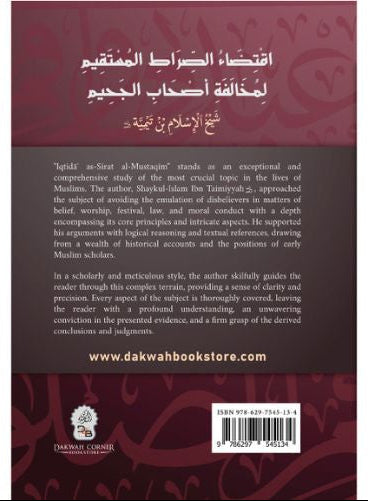
"lqtida as-Sirat al-Mustaqim stands as an exceptional and comprehensive study of the most crucial topic in the lives of Muslims. The author, Shaykul-Islam Ibn Taimiyyah, approached the subject of avoiding the emalation of disbelievers in matters of belief, worship, festival, law, and moral conduct with a depth encompassing its core principles and intricate aspects. He supported his arguments with logical reasoning and textual references, drawing from a wealth of historical accounts and the positions of early Muslim scholars
In a scholarly and meticulous style, the author skilfully guides the reader through this complex terrain, providing a sense of clarity and precision. Every aspect of the subject is thoroughly covered, leaving the reader with a profound understanding, an unwavering conviction in the presented evidence, and a firm grasp of the derived conclusions and judgment
من هو ابن تيمية؟
كان ابن تيمية (١٢٦٣-١٣٢٨) عالمًا إسلاميًا وفقيهًا ذا تأثير كبير، عُرف بتفانيه في دراسة القرآن والسنة. نشأ ابن تيمية في حران، وأصبح شخصيةً بارزةً في المذهب الحنبلي. دعا إلى اتباع نهجٍ واضحٍ ومباشرٍ في التعاليم الإسلامية، وحثّ المسلمين على تجنب الممارسات التي اعتبرها بدعةً، مثل عبادة الأولياء وتبجيل الأضرحة. شملت كتاباته الفقه والشريعة والفلسفة، وتركت أثرًا باقٍ على الفكر الإسلامي، وألهمت المصلحين اللاحقين. ورغم أن تفسيراته تُثير الجدل أحيانًا، إلا أن أبحاثه لا تزال تحظى باحترامٍ كبيرٍ في جميع أنحاء العالم الإسلامي.