


Important Fatawa for the Muslim Ummah | Islamic Rulings, Scholarly Answers
Important Fatawa for the Muslim Ummah | Islamic Rulings, Scholarly Answers
Publisher:
Authentic Statements Publications
Author:
Shaykh Ubad Al-Jabiri
Language:
English
Binding:
Paper back
Pages: 214
Size: 9.0 X 6.0 X 0.7 in
لم نتمكن من تحميل توفر الاستلام

محتوى قابل للطي
وصف كتاب إسلامي
Important Fatawa for the Muslim Ummah | Islamic Rulings, Scholarly Answers
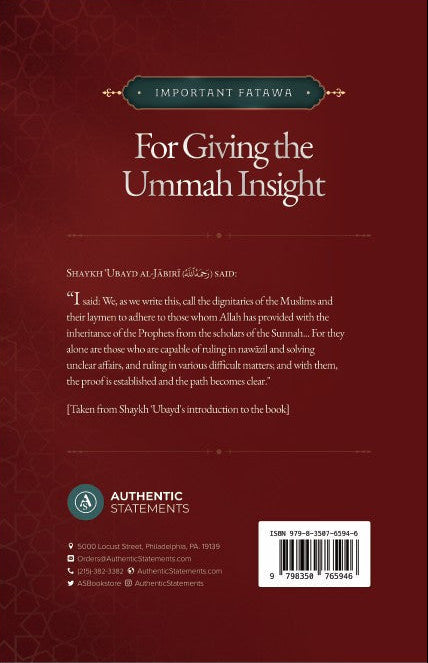
Important Fatawa for Giving the Ummah Insight brings together scholarly Islamic rulings and guidance on important matters affecting the Muslim Ummah. Compiled and annotated by Shaykh Jamal al-Harithi, with an introduction by Shaykh Ubayd al-Jabiri, this English-language book presents answers and explanations from a number of senior Islamic scholars.
Scholarly Guidance on Important Islamic Issues
The collection addresses subjects including Aqeedah, religious methodology, relations with scholars, allegiance and covenants, and community affairs. It includes discussions and fatawa from scholars such as Shaykh Abdul Aziz ibn Baz, Shaykh Muhammad Nasir al-Din al-Albani, Shaykh Muhammad ibn Salih al-Uthaymin, and Shaykh Salih al-Fawzan.
A Reference for Islamic Study
Presented in a question-and-answer format, the book includes Arabic quotations, English translations, and references to source material. Its subject-based organisation makes it useful for readers studying Islamic rulings, Salafi methodology, and issues concerning the Muslim community.
From Author:
Important Fatawa for Giving the Ummah Insight brings together Islamic scholarly rulings on belief, religious methodology, leadership, and community affairs. Compiled and annotated by Shaykh Jamal al-Harithi, with an introduction by Shaykh Ubayd al-Jabiri, this English-language collection addresses questions affecting the Muslim community through the explanations of scholars.
The volume includes fatwas from Shaykh Abdul Aziz ibn Baz, Shaykh Muhammad Nasir al-Din al-Albani, Shaykh Muhammad ibn Salih al-Uthaymin, Shaykh Salih al-Fawzan, and other scholars. Presented in a question-and-answer format, it includes Arabic quotations, English translations, and references to source material.
Readers will explore:
-
Takfir and religious judgment: Scholarly discussions concerning declarations of disbelief, including those directed at rulers, and the importance of knowledge and evidence.
-
Respect for scholars: Guidance on avoiding slander, unsupported accusations, and speaking about religious matters without knowledge.
-
Allegiance and covenants: Explanations of agreements, protection, and related responsibilities in Islamic jurisprudence.
-
Community and public affairs: Fatwas addressing protests, boycotts, suicide bombings, and assassinations.
-
Salafiyyah and religious methodology: Explanations of following the early Muslim generations and understanding the methodology of the Salaf.
-
Islamic groups and religious claims: Discussions concerning Tablighi Jamaat, the Muslim Brotherhood, claims of martyrdom, and general advice for Muslims.
Throughout the collection, readers encounter an emphasis on consulting qualified scholars and approaching sensitive religious questions with care. Its organization by subject allows readers to study individual topics and return to relevant answers.
For those studying Islamic fatwas, Salafi methodology, and issues affecting the Ummah, this book offers a collection of scholarly responses for focused reading and reference.
Page:01
IMPORTANT FATAWA
For Giving the Ummah Insight
Compiled from the fatawa of a number of scholars, including: Shaykh Abdul
'Aziz ibn Baz (ul), Shaykh Muhammad Nasir al-Din al-Albāni (), Shaykh Muhammad ibn Ṣälih al-'Uthaymin (), Shaykh Rabi' al-Madkhali (ul), Shaykh Abdul Aziz Al al-Shaykh (l), Shaykh Ṣāliḥ al-Fawzan (ú), Shaykh 'Abdul Muhsin al-'Abbād (), Shaykh Ṣāliḥ Al al-Shaykh (all)
WITH AN INTRODUCTION BY
Shaykh 'Ubayd al-Jābiri (ú)
COMPILED AND ANNOTATED BY
Shaykh Jamal al-Ḥārithi (ĺ)
Page:02
IMPORTANT FATAWA FOR GIVING THE UMMAH INSIGHT
Table of Contents
Introduction..
The Production of the noble Shaykh, the Eminent
Tscholar, Ubayd ibn Abdullah al-Jābrī
Declaring the Rulers to be Disbelievers.
Slandering the Scholars
Allegiance.
Suicide bombings.
Assassinations
Protests
Boycotting.
So and so is a martyr.
Groups.
Salafiyyah
The Tabligh Sect..
The Muslim Brotherhood Sect..
General Advice...
Appendix
Page:03
IMPORTANT FATAWA FOR GIVING THE UMMAH INSIGHT
Declaring the Rulers to be Disbelievers
The Fatawa of the Eminent Grand Mufti of the Kingdom of Saudi Arabia, The Imam, the Eminent Scholar, Shaykh 'Abdul
Aziz ibn 'Abdullah ibn Baz (5):[]
QUESTION:
These youth, they have an opinion about the affair of the rulers, and declaring the rulers to be disbelievers unrestrictedly, and speech and incitement upon the pulpits and in admonishments. Always (saying) "The rulers are such and such, and the rulers are such and such," and they mention the faults of the rulers. We do not defend what occurs from them, but is this the correct method in cultivating the Muslims?
THE ANSWER:
This is not the correct method; the correct method is supplicating for the rulers with success, guidance, and rectification, and obeying them in
[1] From the tape: The Fatawa of the Scholars About Assassinations and Bombings,
Minhai as-Sunnah recordings - Rivadh.
what agrees with the Legislation. As for the one who is commanded with disobedience (to Allah) then he is not to obey them in disobedience; obedience is only in good. However, our advice to all of the students and other than them is that they supplicate for the rulers with success, guidance, and that their intention and actions be rectified, and that they aid them upon good and help them in it, and that they hold back from trials and fighting, and cooperation upon sin and transgression and causing division; because this harms everyone. However, we advise them to unite upon good, and to cooperate with the rulers in obedience of Allah and His Messenger, and to supplicate for them with success and advise them without revolting, nor fighting, nor trials, so that they not cause division or be a reason for the people splitting.
QUESTION:
Some of the brothers (may Allah guide them) do not believe in theic Bookk obligation of the oath of allegiance to the rulers in these lands - "the lands of the two Harams" -. What is your advice?[1]
ANSWER:
We advise everyone to adhere to listening and obeying, and to beware of splitting the ranks and revolting against the rulers due to what they see from great evils; because this is from the religion of the Khawarij. This is the religion of the Khawarij. This is an error; this is contrary to what
( صَلَّى اللَّهُ عَلَيْهِ وَسَلَّم) commanded with. The Prophet (صَلَّى اللَّهُ عَلَيْهِ وَسَلَّمَ) the Messenger
commanded with hearing and obeying in good:
مَن رَأَى مِنْ أَمِيرِهِ شَيْئًا مِنْ مَعْصِيَةِ اللَّهِ، فَلْيَكْرَهُ مَا يَأْتِي مِنْ مَعْصِيَةِ
[1] The oath of allegiance to the Imam occurs when it comes from the people of authority and decision makers, and it is not a condition in it that everyone give the oath of allegiance to the leader.
Page:04
IMPORTANT FATAWA FOR GIVING THE UMMAH INSIGHT
اللهِ وَلَا يَنْزِعُ يَدًا مِنْ طَاعَةٍ
"Whoever sees something from disobedience of Allah from od his leader, then let him hate what he does from disobedience per of Allah and not remove his hand from obedience."[1]
مَنْ أَتَاكُمْ وَأَمْرُكُمْ جَمِيعٌ عَلَى رَجُل وَاحِدٍ يُرِيدُ أَنْ يَشُقَّ عَصَاكُمْ أَوْ يُفَرِّقَ جَمَاعَتِكُمْ فَاقْتُلُوه
"Whoever comes to you while you are all united upon one man, desiring to split your ranks or divide your congregation then kill him."[2]Se it is not permissible for anyone to split the ranks or revolt against the rulers, or to call to that; because this is from the means of trials and enmity, and the one who calls to that, then this is the religion of the Khawarij (which he is upon).
The ruling in the Legislation is that he be killed, because he divided the congregation and split the ranks. So, it is obligatory to be highly weary of this, and it is obligatory upon the rulers if they know of those who call to this, that they restrain him forcefully so that a trial not occur between the Muslims.
QUESTION:[3]
What is the methodology of the Pious Predecessors concerning criticizing the rulers from atop the pulpits? And what is the methodology of the pious predecessors concerning advising the rulers?
ANSWER:
It is not from the methodology of the Pious Predecessors to defame the rulers with (their) faults, and to mention that upon the pulpits; because that leads to chaos, and a lack of hearing and obeying in good, and it leads to delving (into that) which harms and does not benefit. However, the methodology which was followed amongst the pious predecessors is sincerely advising between them and between the ruler, and writing to him, or calling the scholars who call him so that they direct him to good. Rebuking the evil is done without mention of the one who did it, and it is sufficient to rebuke the sins and warn against them without mentioning that so and so does them nota ruler other than a ruler-.
When the trial occurred in the era of 'Uthman (), some of the people said to Usamah ibn Zayd (c): "Shall you not criticize 'Uthman?!" he said: "(You want me to) criticize 'Uthman amongst the people?! Rather, I criticize him between me and him, and I don't open the door of evil upon the people."[1]
bas
When they opened the (door of) evil in the era of 'Uthman, and criticized 'Uthman publicly, the trial, fighting, and corruption which the people are still in its effects until today became complete, until the trial between 'Ali and Mu'awiyah () occurred. 'Uthman and 'Ali (c) were killed due to that, and a large number of the Companions (A) and other than them were killed due to public criticism and mentioning faults publicly, until the most hated of the people is their
[1] Reported by Muslim 1855.
[2] Reported by Muslim 1852.
[3] From the book: The Rights of the Ruler and the Subiects. Dos 27-28.
[1] Reported by Muslim 2989.
Page:05
IMPORTANT FATAWA FOR GIVING THE UMMAH INSIGHT
ruler, and until they kill him - we ask Allah for safety -. QUESTION:[]
There are those who hold that some of the rulers committing acts of disobedience and major sins obligate revolting against them, and trying to change (them) even if harm occurs for the Muslims in the land due to that, and the events which our Islamic world suffer from are many, so what is your opinion?
ANSWER:
woll
All praise and thanks be to Allah, the Lord of all that exists, and may Allah send salutations upon His Messenger and upon his family, his Companions, and those who follow his guidance.
Conpations
As for what follows: then Allah the Mighty and Majestic said:
Sunnah from the Messenger of Allah () has come clarifying that this obedience is binding, and it is obligatory in good. The texts from the Sunnah clarify the meaning, and the verse indicates that the intent is obeying them in good. So, it is obligatory upon the Muslims to obey the rulers in good, not in disobedience; for if they command with disobedience then they are not obeyed in sin; however, it is not permissible to revolt against them due to it. This is due to his statement
: ( صَلَّى اللَّهُ عَلَيْهِ وَسَلَّمَ )
«أَلَا مَنْ وَلِيَ عَلَيْهِ وَالِ، فَرَاهُ يَأْتِي شَيْئًا مِنْ مَعْصِيَةِ اللَّهِ، فَلْيَكْرَهُ مَا يَأْتِي مِنْ مَعْصِيَةِ اللهِ، وَلَا يَنْزِعَنَّ يَدًا مِنْ طَاعَةٍ aghban
him do B
"Whoever has a leader placed over him and sees him something from disobedience of Allah, then let him hate what he does from disobedience of Allah and not removermic Book his h hand from obedience."[1]
:said ( صَلَّى اللَّهُ عَلَيْهِ وَسَلَّمَ) And he
the
مَنْ خَرَجَ مِنَ الطَّاعَةِ، وَفَارَقَ الْجَمَاعَةَ، مَاتَ مِيتَةً جَاهِلِيَّة ) aa
يَأَيُّهَا الَّذِينَ ءَامَنُوا أَطِيعُوا اللَّهَ وَأَطِيعُوا الرَّسُولَ وَأُولِي الْأَمْرِ مِنكُمْ فَإِن تَتَزَعْتُمْ فِي شَيْءٍ فَرُدُّوهُ
إلَى اللَّهِ وَالرَّسُولِ إِن كُنتُمْ تُؤْمِنُونَ بِاللَّهِ وَالْيَوْمِ الْآخِرِ ذَلِكَ خَيْرٌ وَأَحْسَنُ تَأْوِيلًا )
"O you who believe! Obey Allah, and Obey the Messenger, and those in authority from amongst you. So if you differ about anything then return it to Allah and the Messenger, if you truly believe in Allah and the Last Day. That is the best (way) and has the best outcome." [Surah an-Nisa' 4:59]
So, this verse is a blatant text on the obligation of obeying the people of authority, and they are the rulers and the scholars. The authentic
"Whoever abandons obedience and separates from the congregation dies a death of the pre Islamic state of ignorance."[2]
hodaus
:said ( صَلَّى اللَّهُ عَلَيْهِ وَسَلَّمَ) And he
[1] From the book: That Which is Known from the Obligation of the Connection
Between the Ruler and the One Ruled Over, nos 7-10.8mm)
[1] Reported by Muslim 1855.
[2] Reported by Ibn Abi 'Asim in as-Sunnah 93. 1064.
الناشر
Authentic Statements Publications
مؤلف
- Shaykh Ubad Al-Jabiri
الشحن والتوصيل
نقوم بشحن الطلبات مباشرة من مستودعاتنا في المملكة المتحدة والولايات المتحدة الأمريكية، ونقدم خيارات شحن متعددة لتناسب احتياجاتك. نحن نشحن بفخر إلى جميع أنحاء العالم.
عمليات التسليم في المملكة المتحدة (من مستودع المملكة المتحدة):
يصل الشحن القياسي عادةً في غضون 3-4 أيام عمل. يستغرق التسليم السريع 2-3 أيام عمل. نهدف إلى شحن الطلبات في نفس اليوم أو يوم العمل التالي، مع توفر خيارات التوصيل في اليوم التالي حيثما ينطبق ذلك.
عمليات التسليم في الولايات المتحدة الأمريكية (من مستودع الولايات المتحدة الأمريكية):
تصل الطلبات عادةً في غضون 4-7 أيام عمل.
أوروبا (يتم الشحن من المملكة المتحدة):
يستغرق التسليم القياسي حوالي 6-10 أيام عمل، مع توفر خدمات الشحن السريع في غضون 3-5 أيام عمل.
كندا:
الوقت المقدر للتسليم هو 5-10 أيام عمل.
الشحن في جميع أنحاء العالم:
تصل الطلبات الدولية بشكل عام في غضون 5-20 يوم عمل، اعتمادًا على الوجهة وطريقة الشحن المختارة.
للحصول على جداول زمنية دقيقة للتسليم بناءً على موقعك، يرجى الاتصال بنا عبر البريد الإلكتروني وسيقدم فريقنا معلومات مفصلة ومخصصة لعنوانك.
صفحات العينة - المحتوى
Page:01
IMPORTANT FATAWA
For Giving the Ummah Insight
Compiled from the fatawa of a number of scholars, including: Shaykh Abdul
'Aziz ibn Baz (ul), Shaykh Muhammad Nasir al-Din al-Albāni (), Shaykh Muhammad ibn Ṣälih al-'Uthaymin (), Shaykh Rabi' al-Madkhali (ul), Shaykh Abdul Aziz Al al-Shaykh (l), Shaykh Ṣāliḥ al-Fawzan (ú), Shaykh 'Abdul Muhsin al-'Abbād (), Shaykh Ṣāliḥ Al al-Shaykh (all)
WITH AN INTRODUCTION BY
Shaykh 'Ubayd al-Jābiri (ú)
COMPILED AND ANNOTATED BY
Shaykh Jamal al-Ḥārithi (ĺ)
Page:02
IMPORTANT FATAWA FOR GIVING THE UMMAH INSIGHT
Table of Contents
Introduction..
The Production of the noble Shaykh, the Eminent
Tscholar, Ubayd ibn Abdullah al-Jābrī
Declaring the Rulers to be Disbelievers.
Slandering the Scholars
Allegiance.
Suicide bombings.
Assassinations
Protests
Boycotting.
So and so is a martyr.
Groups.
Salafiyyah
The Tabligh Sect..
The Muslim Brotherhood Sect..
General Advice...
Appendix
Page:03
IMPORTANT FATAWA FOR GIVING THE UMMAH INSIGHT
Declaring the Rulers to be Disbelievers
The Fatawa of the Eminent Grand Mufti of the Kingdom of Saudi Arabia, The Imam, the Eminent Scholar, Shaykh 'Abdul
Aziz ibn 'Abdullah ibn Baz (5):[]
QUESTION:
These youth, they have an opinion about the affair of the rulers, and declaring the rulers to be disbelievers unrestrictedly, and speech and incitement upon the pulpits and in admonishments. Always (saying) "The rulers are such and such, and the rulers are such and such," and they mention the faults of the rulers. We do not defend what occurs from them, but is this the correct method in cultivating the Muslims?
THE ANSWER:
This is not the correct method; the correct method is supplicating for the rulers with success, guidance, and rectification, and obeying them in
[1] From the tape: The Fatawa of the Scholars About Assassinations and Bombings,
Minhai as-Sunnah recordings - Rivadh.
what agrees with the Legislation. As for the one who is commanded with disobedience (to Allah) then he is not to obey them in disobedience; obedience is only in good. However, our advice to all of the students and other than them is that they supplicate for the rulers with success, guidance, and that their intention and actions be rectified, and that they aid them upon good and help them in it, and that they hold back from trials and fighting, and cooperation upon sin and transgression and causing division; because this harms everyone. However, we advise them to unite upon good, and to cooperate with the rulers in obedience of Allah and His Messenger, and to supplicate for them with success and advise them without revolting, nor fighting, nor trials, so that they not cause division or be a reason for the people splitting.
QUESTION:
Some of the brothers (may Allah guide them) do not believe in theic Bookk obligation of the oath of allegiance to the rulers in these lands - "the lands of the two Harams" -. What is your advice?[1]
ANSWER:
We advise everyone to adhere to listening and obeying, and to beware of splitting the ranks and revolting against the rulers due to what they see from great evils; because this is from the religion of the Khawarij. This is the religion of the Khawarij. This is an error; this is contrary to what
( صَلَّى اللَّهُ عَلَيْهِ وَسَلَّم) commanded with. The Prophet (صَلَّى اللَّهُ عَلَيْهِ وَسَلَّمَ) the Messenger
commanded with hearing and obeying in good:
مَن رَأَى مِنْ أَمِيرِهِ شَيْئًا مِنْ مَعْصِيَةِ اللَّهِ، فَلْيَكْرَهُ مَا يَأْتِي مِنْ مَعْصِيَةِ
[1] The oath of allegiance to the Imam occurs when it comes from the people of authority and decision makers, and it is not a condition in it that everyone give the oath of allegiance to the leader.
Page:04
IMPORTANT FATAWA FOR GIVING THE UMMAH INSIGHT
اللهِ وَلَا يَنْزِعُ يَدًا مِنْ طَاعَةٍ
"Whoever sees something from disobedience of Allah from od his leader, then let him hate what he does from disobedience per of Allah and not remove his hand from obedience."[1]
مَنْ أَتَاكُمْ وَأَمْرُكُمْ جَمِيعٌ عَلَى رَجُل وَاحِدٍ يُرِيدُ أَنْ يَشُقَّ عَصَاكُمْ أَوْ يُفَرِّقَ جَمَاعَتِكُمْ فَاقْتُلُوه
"Whoever comes to you while you are all united upon one man, desiring to split your ranks or divide your congregation then kill him."[2]Se it is not permissible for anyone to split the ranks or revolt against the rulers, or to call to that; because this is from the means of trials and enmity, and the one who calls to that, then this is the religion of the Khawarij (which he is upon).
The ruling in the Legislation is that he be killed, because he divided the congregation and split the ranks. So, it is obligatory to be highly weary of this, and it is obligatory upon the rulers if they know of those who call to this, that they restrain him forcefully so that a trial not occur between the Muslims.
QUESTION:[3]
What is the methodology of the Pious Predecessors concerning criticizing the rulers from atop the pulpits? And what is the methodology of the pious predecessors concerning advising the rulers?
ANSWER:
It is not from the methodology of the Pious Predecessors to defame the rulers with (their) faults, and to mention that upon the pulpits; because that leads to chaos, and a lack of hearing and obeying in good, and it leads to delving (into that) which harms and does not benefit. However, the methodology which was followed amongst the pious predecessors is sincerely advising between them and between the ruler, and writing to him, or calling the scholars who call him so that they direct him to good. Rebuking the evil is done without mention of the one who did it, and it is sufficient to rebuke the sins and warn against them without mentioning that so and so does them nota ruler other than a ruler-.
When the trial occurred in the era of 'Uthman (), some of the people said to Usamah ibn Zayd (c): "Shall you not criticize 'Uthman?!" he said: "(You want me to) criticize 'Uthman amongst the people?! Rather, I criticize him between me and him, and I don't open the door of evil upon the people."[1]
bas
When they opened the (door of) evil in the era of 'Uthman, and criticized 'Uthman publicly, the trial, fighting, and corruption which the people are still in its effects until today became complete, until the trial between 'Ali and Mu'awiyah () occurred. 'Uthman and 'Ali (c) were killed due to that, and a large number of the Companions (A) and other than them were killed due to public criticism and mentioning faults publicly, until the most hated of the people is their
[1] Reported by Muslim 1855.
[2] Reported by Muslim 1852.
[3] From the book: The Rights of the Ruler and the Subiects. Dos 27-28.
[1] Reported by Muslim 2989.
Page:05
IMPORTANT FATAWA FOR GIVING THE UMMAH INSIGHT
ruler, and until they kill him - we ask Allah for safety -. QUESTION:[]
There are those who hold that some of the rulers committing acts of disobedience and major sins obligate revolting against them, and trying to change (them) even if harm occurs for the Muslims in the land due to that, and the events which our Islamic world suffer from are many, so what is your opinion?
ANSWER:
woll
All praise and thanks be to Allah, the Lord of all that exists, and may Allah send salutations upon His Messenger and upon his family, his Companions, and those who follow his guidance.
Conpations
As for what follows: then Allah the Mighty and Majestic said:
Sunnah from the Messenger of Allah () has come clarifying that this obedience is binding, and it is obligatory in good. The texts from the Sunnah clarify the meaning, and the verse indicates that the intent is obeying them in good. So, it is obligatory upon the Muslims to obey the rulers in good, not in disobedience; for if they command with disobedience then they are not obeyed in sin; however, it is not permissible to revolt against them due to it. This is due to his statement
: ( صَلَّى اللَّهُ عَلَيْهِ وَسَلَّمَ )
«أَلَا مَنْ وَلِيَ عَلَيْهِ وَالِ، فَرَاهُ يَأْتِي شَيْئًا مِنْ مَعْصِيَةِ اللَّهِ، فَلْيَكْرَهُ مَا يَأْتِي مِنْ مَعْصِيَةِ اللهِ، وَلَا يَنْزِعَنَّ يَدًا مِنْ طَاعَةٍ aghban
him do B
"Whoever has a leader placed over him and sees him something from disobedience of Allah, then let him hate what he does from disobedience of Allah and not removermic Book his h hand from obedience."[1]
:said ( صَلَّى اللَّهُ عَلَيْهِ وَسَلَّمَ) And he
the
مَنْ خَرَجَ مِنَ الطَّاعَةِ، وَفَارَقَ الْجَمَاعَةَ، مَاتَ مِيتَةً جَاهِلِيَّة ) aa
يَأَيُّهَا الَّذِينَ ءَامَنُوا أَطِيعُوا اللَّهَ وَأَطِيعُوا الرَّسُولَ وَأُولِي الْأَمْرِ مِنكُمْ فَإِن تَتَزَعْتُمْ فِي شَيْءٍ فَرُدُّوهُ
إلَى اللَّهِ وَالرَّسُولِ إِن كُنتُمْ تُؤْمِنُونَ بِاللَّهِ وَالْيَوْمِ الْآخِرِ ذَلِكَ خَيْرٌ وَأَحْسَنُ تَأْوِيلًا )
"O you who believe! Obey Allah, and Obey the Messenger, and those in authority from amongst you. So if you differ about anything then return it to Allah and the Messenger, if you truly believe in Allah and the Last Day. That is the best (way) and has the best outcome." [Surah an-Nisa' 4:59]
So, this verse is a blatant text on the obligation of obeying the people of authority, and they are the rulers and the scholars. The authentic
"Whoever abandons obedience and separates from the congregation dies a death of the pre Islamic state of ignorance."[2]
hodaus
:said ( صَلَّى اللَّهُ عَلَيْهِ وَسَلَّمَ) And he
[1] From the book: That Which is Known from the Obligation of the Connection
Between the Ruler and the One Ruled Over, nos 7-10.8mm)
[1] Reported by Muslim 1855.
[2] Reported by Ibn Abi 'Asim in as-Sunnah 93. 1064.
من هو Shaykh Ubayd Al-Jabiri؟
Shaykh Ubayd Al-Jabiri is recognized for his scholarly work on Salafee creed and methodology. In this book, he breaks down the Salafee approach into principles accessible to both new and experienced students of knowledge, helping them follow the way of the Salaf — that is, the path of the companions of Prophet Muhammad ﷺ and the next generations — by grounding their belief and actions in authentic Islamic sources.