


Fiqh us-Sunnah by As-Sayyid Sabiq | Islamic Fiqh, Jurisprudence & Sunnah Guide
Fiqh us-Sunnah by As-Sayyid Sabiq | Islamic Fiqh, Jurisprudence & Sunnah Guide
Publisher:
IIPH (International Islamic Publishing House)
Author:
As-Sayyid Sabiq
Language:
English
Binding:
Hard Cover
Pages: 155
Size: 14x21cm
لم نتمكن من تحميل توفر الاستلام


محتوى قابل للطي
وصف كتاب إسلامي
Fiqh us-Sunnah by As-Sayyid Sabiq | Islamic Fiqh, Jurisprudence & Sunnah Guide
Fiqh us-Sunnah by As-Sayyid Sabiq is a comprehensive English reference on Islamic jurisprudence, presenting important rulings and their supporting evidence from the Qur’an and authentic Sunnah. This edition combines five volumes into one convenient hardback, covering essential areas of worship and daily Muslim practice.
What You’ll Learn
The book discusses Taharah (purification), Salah (prayer), Zakah, Sawm (fasting), funerals, dhikr, supplications, Hajj and ‘Umrah. Where differences of scholarly opinion exist, the work presents relevant viewpoints and their evidence for readers to study.
Ideal for Students of Fiqh
With its detailed coverage and evidence-based approach, this 880-page reference is suitable for students of Islamic studies, researchers, teachers, and Muslims seeking a deeper understanding of Islamic law and Sunnah-based practices.
From Author:
Fiqh us-Sunnah (Funerals and Dhikr) - Are you looking for a book that explains the basic practices of Islam in a comprehensive, detailed manner? This series of translations provides valuable information concretely based on Qur'an and Sunnah. The author presents and discusses a variety of viewpoints on the various matters of practice
Page:01
لادراك لا ينشرت من يسيرك
FIQH us-SUNNAH
Funerals and Dhikr
As-Sayyid Sabiq
Page:02
TABLE OF CONTENTS
Chapter One SICKNESS
Patience During Illness
To Complain of One's Illness
A Sick Person is Rewarded for All the Good Deeds that He
Would (usually) Perform in a State of Health
Visiting the Sick
Reward for Visiting the Sick
The Etiquette of Visiting the Sick
Women Visiting (Sick) Men
A Muslim Visiting a Non-Muslim Patient
Visiting an Eye Patient
Asking the Sick for a Prayer
Seeking Medical Treatment
Using Prohibited Things as Medicine
Treatment by a Non-Muslim Physician
Permission for a Woman to Seek Medical
Treatment from Men
The Use of Incantation and Supplications in
the Treatment
Some Supplications Found in Hadith
Prohibition of Using Amulets
Pendants With Words from the Qur'an or Hadith
Prohibition of Someone with a Contagious Disease
Living Among the Healthy
Prohibition of Entering Or Leaving
a Plague-Stricken Area
Chapter Two
CONTEMPLATION OF DEATH AND PREPARATION FOR IT BY
GOOD DEEDS
It is Not Proper for a Person to Wish for Death
Page:03
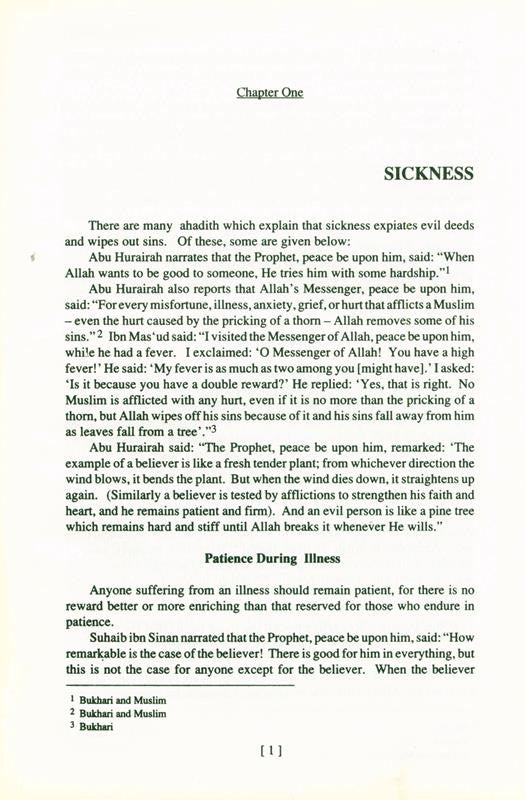
Chapter One
SICKNESS
There are many ahadith which explain that sickness expiates evil deeds and wipes out sins. Of these, some are given below:
Abu Hurairah narrates that the Prophet, peace be upon him, said: "When Allah wants to be good to someone, He tries him with some hardship."1
Abu Hurairah also reports that Allah's Messenger, peace be upon him, said: "For every misfortune, illness, anxiety, grief, or hurt that afflicts a Muslim -even the hurt caused by the pricking of a thorn - Allah removes some of his sins."2 Ibn Mas'ud said: "I visited the Messenger of Allah, peace be upon him, while he had a fever. I exclaimed: 'O Messenger of Allah! You have a high fever!' He said: 'My fever is as much as two among you [might have].' I asked: 'Is it because you have a double reward?' He replied: 'Yes, that is right. No Muslim is afflicted with any hurt, even if it is no more than the pricking of a thorn, but Allah wipes off his sins because of it and his sins fall away from him as leaves fall from a tree"."3
Abu Hurairah said: "The Prophet, peace be upon him, remarked: "The example of a believer is like a fresh tender plant; from whichever direction the wind blows, it bends the plant. But when the wind dies down, it straightens up again. (Similarly a believer is tested by afflictions to strengthen his faith and heart, and he remains patient and firm). And an evil person is like a pine tree which remains hard and stiff until Allah breaks it whenever He wills."
Patience During Illness
Anyone suffering from an illness should remain patient, for there is no reward better or more enriching than that reserved for those who endure in patience.
Suhaib ibn Sinan narrated that the Prophet, peace be upon him, said: "How remarkable is the case of the believer! There is good for him in everything, but this is not the case for anyone except for the believer. When the believer
1 Bukhari and Muslim
2 Bukhari and Muslim
3 Bukhari
الناشر
IIPH (International Islamic Publishing House)
مؤلف
- As-Sayyid Sabiq
الشحن والتوصيل
نقوم بشحن الطلبات مباشرة من مستودعاتنا في المملكة المتحدة والولايات المتحدة الأمريكية، ونقدم خيارات شحن متعددة لتناسب احتياجاتك. نحن نشحن بفخر إلى جميع أنحاء العالم.
عمليات التسليم في المملكة المتحدة (من مستودع المملكة المتحدة):
يصل الشحن القياسي عادةً في غضون 3-4 أيام عمل. يستغرق التسليم السريع 2-3 أيام عمل. نهدف إلى شحن الطلبات في نفس اليوم أو يوم العمل التالي، مع توفر خيارات التوصيل في اليوم التالي حيثما ينطبق ذلك.
عمليات التسليم في الولايات المتحدة الأمريكية (من مستودع الولايات المتحدة الأمريكية):
تصل الطلبات عادةً في غضون 4-7 أيام عمل.
أوروبا (يتم الشحن من المملكة المتحدة):
يستغرق التسليم القياسي حوالي 6-10 أيام عمل، مع توفر خدمات الشحن السريع في غضون 3-5 أيام عمل.
كندا:
الوقت المقدر للتسليم هو 5-10 أيام عمل.
الشحن في جميع أنحاء العالم:
تصل الطلبات الدولية بشكل عام في غضون 5-20 يوم عمل، اعتمادًا على الوجهة وطريقة الشحن المختارة.
للحصول على جداول زمنية دقيقة للتسليم بناءً على موقعك، يرجى الاتصال بنا عبر البريد الإلكتروني وسيقدم فريقنا معلومات مفصلة ومخصصة لعنوانك.
صفحات العينة - المحتوى
Page:01
لادراك لا ينشرت من يسيرك
FIQH us-SUNNAH
Funerals and Dhikr
As-Sayyid Sabiq
Page:02
TABLE OF CONTENTS
Chapter One SICKNESS
Patience During Illness
To Complain of One's Illness
A Sick Person is Rewarded for All the Good Deeds that He
Would (usually) Perform in a State of Health
Visiting the Sick
Reward for Visiting the Sick
The Etiquette of Visiting the Sick
Women Visiting (Sick) Men
A Muslim Visiting a Non-Muslim Patient
Visiting an Eye Patient
Asking the Sick for a Prayer
Seeking Medical Treatment
Using Prohibited Things as Medicine
Treatment by a Non-Muslim Physician
Permission for a Woman to Seek Medical
Treatment from Men
The Use of Incantation and Supplications in
the Treatment
Some Supplications Found in Hadith
Prohibition of Using Amulets
Pendants With Words from the Qur'an or Hadith
Prohibition of Someone with a Contagious Disease
Living Among the Healthy
Prohibition of Entering Or Leaving
a Plague-Stricken Area
Chapter Two
CONTEMPLATION OF DEATH AND PREPARATION FOR IT BY
GOOD DEEDS
It is Not Proper for a Person to Wish for Death
Page:03
Chapter One
SICKNESS
There are many ahadith which explain that sickness expiates evil deeds and wipes out sins. Of these, some are given below:
Abu Hurairah narrates that the Prophet, peace be upon him, said: "When Allah wants to be good to someone, He tries him with some hardship."1
Abu Hurairah also reports that Allah's Messenger, peace be upon him, said: "For every misfortune, illness, anxiety, grief, or hurt that afflicts a Muslim -even the hurt caused by the pricking of a thorn - Allah removes some of his sins."2 Ibn Mas'ud said: "I visited the Messenger of Allah, peace be upon him, while he had a fever. I exclaimed: 'O Messenger of Allah! You have a high fever!' He said: 'My fever is as much as two among you [might have].' I asked: 'Is it because you have a double reward?' He replied: 'Yes, that is right. No Muslim is afflicted with any hurt, even if it is no more than the pricking of a thorn, but Allah wipes off his sins because of it and his sins fall away from him as leaves fall from a tree"."3
Abu Hurairah said: "The Prophet, peace be upon him, remarked: "The example of a believer is like a fresh tender plant; from whichever direction the wind blows, it bends the plant. But when the wind dies down, it straightens up again. (Similarly a believer is tested by afflictions to strengthen his faith and heart, and he remains patient and firm). And an evil person is like a pine tree which remains hard and stiff until Allah breaks it whenever He wills."
Patience During Illness
Anyone suffering from an illness should remain patient, for there is no reward better or more enriching than that reserved for those who endure in patience.
Suhaib ibn Sinan narrated that the Prophet, peace be upon him, said: "How remarkable is the case of the believer! There is good for him in everything, but this is not the case for anyone except for the believer. When the believer
1 Bukhari and Muslim
2 Bukhari and Muslim
3 Bukhari
من هو AL sayyad Sabiq؟
Sayyid Sabiq (1915–2000) was a renowned Egyptian Islamic scholar best known for his monumental work Fiqh us-Sunnah. Educated at Al-Azhar University, he dedicated his scholarship to presenting Islamic rulings based on the Qur’an and authentic Hadith in a practical and accessible format. His writings have been widely studied across the Muslim world and remain among the most influential contemporary references on Islamic jurisprudence. Fiqh us-Sunnah is considered one of his most significant contributions, valued for its evidence-based approach and comprehensive treatment of Islamic legal issues.