


Ar-Raheeq Al-Makhtum Arabic (الرحيق المختوم) – Seerah of Prophet Muhammad ﷺ | Safiur Rahman Mubarakpuri
Ar-Raheeq Al-Makhtum Arabic (الرحيق المختوم) – Seerah of Prophet Muhammad ﷺ | Safiur Rahman Mubarakpuri
Publisher:
Dar Ibn Katheer
Author:
الشيخ صفي الرحمن المباركفوري
Language:
العربية
Binding:
غلاف مقوى
Pages: 536
Size: 17×24 سم
لم نتمكن من تحميل توفر الاستلام


محتوى قابل للطي
وصف كتاب إسلامي
Ar-Raheeq Al-Makhtum Arabic (الرحيق المختوم) – Seerah of Prophet Muhammad ﷺ | Safiur Rahman Mubarakpuri
Ar-Raheeq Al-Makhtum (The Sealed Nectar) is a world-famous Seerah book that beautifully presents the complete life of Prophet Muhammad ﷺ, from his birth to his final days. It is written with authentic sources, historical accuracy, and deep insight into his mission, struggles, and character.
From Author:
يُعد كتاب الرحيق المختوم من أشهر وأفضل الكتب في السيرة النبوية، حيث يقدّم عرضًا موثقًا وشاملًا لحياة النبي محمد ﷺ بأسلوب سهل وواضح يجمع بين الدقة التاريخية وجمال السرد.
يتناول الكتاب أحوال العرب قبل الإسلام، وبداية الدعوة الإسلامية، وأحداث الهجرة والغزوات، إلى جانب المواقف العظيمة في حياة الرسول ﷺ مثل الإسراء والمعراج، مع الاستناد إلى المصادر والمراجع الموثوقة.
وقد نال هذا الكتاب الجائزة الأولى في مسابقة السيرة النبوية التي نظمتها رابطة العالم الإسلامي، لما يتميز به من تحقيق علمي وترتيب دقيق للأحداث وسرد ممتع يقرّب السيرة النبوية إلى القارئ بأسلوب مؤثر وشيق.
Page no:01
Sheikh Safi-ur-Rahman Al-Mubarakpuri
Ar-Raheeq Al-Makhtum (The Sealed Nectar)
A Study of the Prophetic Biography
Upon its possessor be the best of prayers and peace
Dar-Ibn-Kathir
Page no:02
The Location of the Arabs and their Tribes
The Prophetic Biography—upon its possessor be prayers and peace—is, in reality, the message that the Messenger of Allah (peace be upon him) carried to human society, through which he brought people out of darkness into light, and from the worship of servants to the worship of Allah. Therefore, its magnificent image cannot be fully grasped except by comparing the background of this message with its impacts. In light of this, we present a chapter on the Arab tribes and their development before Islam, and the circumstances in which Muhammad (peace be upon him) was sent.
The Location of the Arabs:
"Arab" linguistically means deserts, wilderness, and barren land that has neither water nor vegetation. This term has been applied since ancient times to the Arabian Peninsula, as well as to the people who inhabited that land and adopted it as their home.
The Arabian Peninsula is bordered on the west by the Red Sea and the Sinai Peninsula; on the east by the Arabian Gulf and a large part of southern Iraq; on the south by the Arabian Sea, which is an extension of the Indian Ocean; and on the north by the Levant and part of Iraq, though there is some disagreement regarding these boundaries. Its area is estimated to be between one million square miles and one million three hundred thousand square miles.
The Peninsula holds extreme importance due to its natural and geographical position. Regarding its internal state, it is surrounded by deserts and sands on all sides. Because of this, the Peninsula became an impenetrable fortress that did not allow foreigners to occupy it or extend their control and influence over it. Thus, we see the inhabitants of the Peninsula as free in all affairs since ancient times, even though they were neighbors to two great empires whose attacks they would not have been able to repel if not for this impenetrable barrier.
Page no:03
Al-Isra and Al-Mi'raj (The Night Journey and the Ascension)
While the Prophet (peace be upon him) was in this phase, where his call was carving a path between success and persecution, and faint stars were visible in the distant horizons, the event of Al-Isra and Al-Mi'raj occurred.
There is a difference of opinion regarding its timing:
(1) It is said: The Isra occurred in the year in which Allah honored him with Prophethood; this was chosen by Al-Tabari.
(2) It is said: It occurred five years after the mission; this was favored by Al-Nawawi and Al-Qurtubi. (3) It is said: It occurred on the night of the 27th of Rajab in the 10th year of Prophethood; this was chosen by the scholar Mansoorpuri.
(4) It is said: Sixteen months before the Hijrah, i.e., in Ramadan of the 12th year of Prophethood. (5) It is said: One year and two months before the Hijrah, i.e., in Muharram of the 13th year of Prophethood.
(6) It is said: One year before the Hijrah, i.e., in Rabi' al-Awwal of the 13th year of Prophethood. The first three opinions have been refuted by the fact that Khadija (may Allah be pleased with her) died in Ramadan of the 10th year of Prophethood, and her death occurred before the five daily prayers were made obligatory, and there is no disagreement that the five daily prayers were made obligatory on the night of Al-Isra (1). As for the remaining three opinions, I have not found anything to favor one over the other, except that the context of Surah Al-Isra indicates that the Isra occurred very late.
(1) See these opinions in Zad al-Ma'ad 2/49, Mukhtasar Sirat al-Rasul by Sheikh Abdullah al-Najdi, 148-149, Rahmat-ul-lil-Alameen 1/76, and Tarikh-e-Islam by Najeebabadi 1/124.
Page no:04
The Battle of Banu al-Mustaliq or the Battle of Al-Muraysi'
(In Sha'ban, 6 AH)
Although this battle was not extensive in terms of military scale, events occurred during it that caused confusion and turmoil in the Islamic society, resulting in the exposure of the hypocrites and the enactment of penal legislations that gave the Islamic society a unique image of nobility, dignity, and purity of soul. We will first recount the battle, then mention those events.
This battle took place in Sha'ban of the sixth year of the Hijrah according to the most correct opinion (1). Its cause was that news reached him that the leader of Banu al-Mustaliq, Al-Harith ibn Abi Dirar, had marched with his people and whoever he could gather from the Arabs, intending to wage war against the Messenger of Allah (peace be upon him), so he sent Buraydah ibn al-Hasib...
(1) The evidence for this is established in the Hadith of the Ifk (the Slander), that the incident occurred after the Hijab was revealed, and the verse of the Hijab was revealed regarding Zaynab, and Zaynab at that time was his wife. When he asked her about Aisha, she said: "I guard my hearing and my sight." Aisha said, "And she was the one who used to rival me among the wives of the Prophet (peace be upon him)." As for what occurred in the Hadith of the Ifk that Sa'd ibn Mu'adh and Sa'd ibn Ubadah argued regarding the slanderers, it is known that Sa'd ibn Mu'adh died after the Battle of Banu Qurayzah, so it is apparent that this is an error by the narrator. Ibn Ishaq narrated the Hadith of the Ifk from Al-Zuhri, from Ubaydullah ibn Abdullah ibn Utbah, from Aisha, and he did not mention Sa'd ibn Mu'adh but mentioned Usayd ibn Hudayr. Abu Muhammad ibn Hazm said: "This is the correct [version] about which there is no doubt, and mentioning Sa'd ibn Mu'adh is an error." See Zad al-Ma'ad (2/115). It is surprising that Muhammad al-Ghazali attributed to Ibn al-Qayyim that he considers this battle to be among the events of the fifth year (Fiqh al-Sirah, p. 223), even though his words in Al-Hadi (2/115) reject this.
Page no:05
Bibliography
1. Akhbar al-Kiram bi-Akhbar al-Masjid al-Haram, Shihab al-Din Ahmad ibn Muhammad al-Asadi al-Makki (d. 1066 AH), Al-Matba'a al-Salafiyyah, Benares, India, 1396 AH / 1976 AD. 2. Al-Adab al-Mufrad, Muhammad ibn Ismail al-Bukhari (d. 356 AH), Istanbul, 1304 AH. 3. Al-A'lam, Khair al-Din al-Zirikli, Second Edition, Cairo, 1954 AD.
4. Al-Bidayah wa al-Nihayah, Ismail ibn Kathir al-Dimashqi, Matba'at al-Sa'adah, Egypt, 1932 AD. 5. Bulugh al-Maram min Adillat al-Ahkam, Ahmad ibn Hajar al-Asqalani (773-853 AH), Al-Matba'a al-Qayyumiyyah, Kanpur, India, 1323 AH.
6. Tarikh-e-Ard al-Qur'an, Sayyid Sulaiman Nadvi (d. 1373 AH), Ma'arif Press, Azamgarh, India, 1955 AD (Fourth Edition).
7. Tarikh-e-Islam, Shah Akbar Khan Najeebabadi, Maktabat Rahmat, Deoband, UP, India.
8. Tarikh al-Umam wa al-Muluk, Ibn Jarir al-Tabari, Al-Matba'a al-Husayniyyah, Egypt. 9. Tarikh Umar ibn al-Khattab, Abu al-Faraj Abd al-Rahman ibn al-Jawzi, Matba'at al-Tawfiq al-Adabiyyah, Egypt. 10. Tuhfat al-Ahwadhi, Abu al-'Ula Abd al-Rahman al-Mubarakfuri (d. 1353 AH / 1935 AD), Jayyad Barqi Press, Delhi, India, 1346-1353 AH.
11. Tafsir Ibn Kathir, Ismail ibn Kathir al-Dimashqi, Dar al-Andalus, Beirut. 12. Tafhim al-Qur'an, Sayyid Abul A'la Maududi, Markazi Maktabah Jamaat-e-Islami, India.
Page no:06
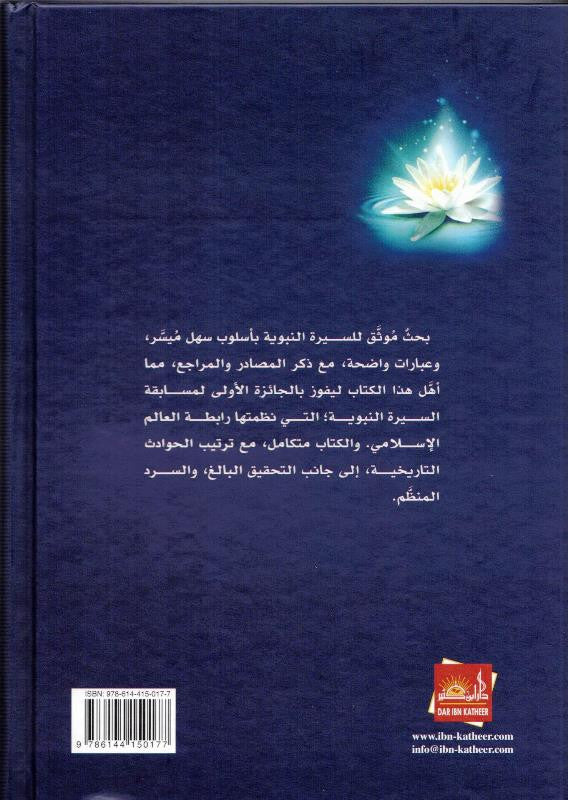
A documented study of the Prophetic Biography in an easy, accessible style, with clear wording and the mention of sources and references, which qualified this book to win the first prize in the Prophetic Biography competition organized by the Muslim World League. The book is comprehensive, with a chronological arrangement of historical events, in addition to deep verification and narrative...
الناشر
Dar Ibn Katheer
مؤلف
- الشيخ صفي الرحمن المباركفوري
الشحن والتوصيل
نقوم بشحن الطلبات مباشرة من مستودعاتنا في المملكة المتحدة والولايات المتحدة الأمريكية، ونقدم خيارات شحن متعددة لتناسب احتياجاتك. نحن نشحن بفخر إلى جميع أنحاء العالم.
عمليات التسليم في المملكة المتحدة (من مستودع المملكة المتحدة):
يصل الشحن القياسي عادةً في غضون 3-4 أيام عمل. يستغرق التسليم السريع 2-3 أيام عمل. نهدف إلى شحن الطلبات في نفس اليوم أو يوم العمل التالي، مع توفر خيارات التوصيل في اليوم التالي حيثما ينطبق ذلك.
عمليات التسليم في الولايات المتحدة الأمريكية (من مستودع الولايات المتحدة الأمريكية):
تصل الطلبات عادةً في غضون 4-7 أيام عمل.
أوروبا (يتم الشحن من المملكة المتحدة):
يستغرق التسليم القياسي حوالي 6-10 أيام عمل، مع توفر خدمات الشحن السريع في غضون 3-5 أيام عمل.
كندا:
الوقت المقدر للتسليم هو 5-10 أيام عمل.
الشحن في جميع أنحاء العالم:
تصل الطلبات الدولية بشكل عام في غضون 5-20 يوم عمل، اعتمادًا على الوجهة وطريقة الشحن المختارة.
للحصول على جداول زمنية دقيقة للتسليم بناءً على موقعك، يرجى الاتصال بنا عبر البريد الإلكتروني وسيقدم فريقنا معلومات مفصلة ومخصصة لعنوانك.
صفحات العينة - المحتوى
Page no:01
Sheikh Safi-ur-Rahman Al-Mubarakpuri
Ar-Raheeq Al-Makhtum (The Sealed Nectar)
A Study of the Prophetic Biography
Upon its possessor be the best of prayers and peace
Dar-Ibn-Kathir
Page no:02
The Location of the Arabs and their Tribes
The Prophetic Biography—upon its possessor be prayers and peace—is, in reality, the message that the Messenger of Allah (peace be upon him) carried to human society, through which he brought people out of darkness into light, and from the worship of servants to the worship of Allah. Therefore, its magnificent image cannot be fully grasped except by comparing the background of this message with its impacts. In light of this, we present a chapter on the Arab tribes and their development before Islam, and the circumstances in which Muhammad (peace be upon him) was sent.
The Location of the Arabs:
"Arab" linguistically means deserts, wilderness, and barren land that has neither water nor vegetation. This term has been applied since ancient times to the Arabian Peninsula, as well as to the people who inhabited that land and adopted it as their home.
The Arabian Peninsula is bordered on the west by the Red Sea and the Sinai Peninsula; on the east by the Arabian Gulf and a large part of southern Iraq; on the south by the Arabian Sea, which is an extension of the Indian Ocean; and on the north by the Levant and part of Iraq, though there is some disagreement regarding these boundaries. Its area is estimated to be between one million square miles and one million three hundred thousand square miles.
The Peninsula holds extreme importance due to its natural and geographical position. Regarding its internal state, it is surrounded by deserts and sands on all sides. Because of this, the Peninsula became an impenetrable fortress that did not allow foreigners to occupy it or extend their control and influence over it. Thus, we see the inhabitants of the Peninsula as free in all affairs since ancient times, even though they were neighbors to two great empires whose attacks they would not have been able to repel if not for this impenetrable barrier.
Page no:03
Al-Isra and Al-Mi'raj (The Night Journey and the Ascension)
While the Prophet (peace be upon him) was in this phase, where his call was carving a path between success and persecution, and faint stars were visible in the distant horizons, the event of Al-Isra and Al-Mi'raj occurred.
There is a difference of opinion regarding its timing:
(1) It is said: The Isra occurred in the year in which Allah honored him with Prophethood; this was chosen by Al-Tabari.
(2) It is said: It occurred five years after the mission; this was favored by Al-Nawawi and Al-Qurtubi. (3) It is said: It occurred on the night of the 27th of Rajab in the 10th year of Prophethood; this was chosen by the scholar Mansoorpuri.
(4) It is said: Sixteen months before the Hijrah, i.e., in Ramadan of the 12th year of Prophethood. (5) It is said: One year and two months before the Hijrah, i.e., in Muharram of the 13th year of Prophethood.
(6) It is said: One year before the Hijrah, i.e., in Rabi' al-Awwal of the 13th year of Prophethood. The first three opinions have been refuted by the fact that Khadija (may Allah be pleased with her) died in Ramadan of the 10th year of Prophethood, and her death occurred before the five daily prayers were made obligatory, and there is no disagreement that the five daily prayers were made obligatory on the night of Al-Isra (1). As for the remaining three opinions, I have not found anything to favor one over the other, except that the context of Surah Al-Isra indicates that the Isra occurred very late.
(1) See these opinions in Zad al-Ma'ad 2/49, Mukhtasar Sirat al-Rasul by Sheikh Abdullah al-Najdi, 148-149, Rahmat-ul-lil-Alameen 1/76, and Tarikh-e-Islam by Najeebabadi 1/124.
Page no:04
The Battle of Banu al-Mustaliq or the Battle of Al-Muraysi'
(In Sha'ban, 6 AH)
Although this battle was not extensive in terms of military scale, events occurred during it that caused confusion and turmoil in the Islamic society, resulting in the exposure of the hypocrites and the enactment of penal legislations that gave the Islamic society a unique image of nobility, dignity, and purity of soul. We will first recount the battle, then mention those events.
This battle took place in Sha'ban of the sixth year of the Hijrah according to the most correct opinion (1). Its cause was that news reached him that the leader of Banu al-Mustaliq, Al-Harith ibn Abi Dirar, had marched with his people and whoever he could gather from the Arabs, intending to wage war against the Messenger of Allah (peace be upon him), so he sent Buraydah ibn al-Hasib...
(1) The evidence for this is established in the Hadith of the Ifk (the Slander), that the incident occurred after the Hijab was revealed, and the verse of the Hijab was revealed regarding Zaynab, and Zaynab at that time was his wife. When he asked her about Aisha, she said: "I guard my hearing and my sight." Aisha said, "And she was the one who used to rival me among the wives of the Prophet (peace be upon him)." As for what occurred in the Hadith of the Ifk that Sa'd ibn Mu'adh and Sa'd ibn Ubadah argued regarding the slanderers, it is known that Sa'd ibn Mu'adh died after the Battle of Banu Qurayzah, so it is apparent that this is an error by the narrator. Ibn Ishaq narrated the Hadith of the Ifk from Al-Zuhri, from Ubaydullah ibn Abdullah ibn Utbah, from Aisha, and he did not mention Sa'd ibn Mu'adh but mentioned Usayd ibn Hudayr. Abu Muhammad ibn Hazm said: "This is the correct [version] about which there is no doubt, and mentioning Sa'd ibn Mu'adh is an error." See Zad al-Ma'ad (2/115). It is surprising that Muhammad al-Ghazali attributed to Ibn al-Qayyim that he considers this battle to be among the events of the fifth year (Fiqh al-Sirah, p. 223), even though his words in Al-Hadi (2/115) reject this.
Page no:05
Bibliography
1. Akhbar al-Kiram bi-Akhbar al-Masjid al-Haram, Shihab al-Din Ahmad ibn Muhammad al-Asadi al-Makki (d. 1066 AH), Al-Matba'a al-Salafiyyah, Benares, India, 1396 AH / 1976 AD. 2. Al-Adab al-Mufrad, Muhammad ibn Ismail al-Bukhari (d. 356 AH), Istanbul, 1304 AH. 3. Al-A'lam, Khair al-Din al-Zirikli, Second Edition, Cairo, 1954 AD.
4. Al-Bidayah wa al-Nihayah, Ismail ibn Kathir al-Dimashqi, Matba'at al-Sa'adah, Egypt, 1932 AD. 5. Bulugh al-Maram min Adillat al-Ahkam, Ahmad ibn Hajar al-Asqalani (773-853 AH), Al-Matba'a al-Qayyumiyyah, Kanpur, India, 1323 AH.
6. Tarikh-e-Ard al-Qur'an, Sayyid Sulaiman Nadvi (d. 1373 AH), Ma'arif Press, Azamgarh, India, 1955 AD (Fourth Edition).
7. Tarikh-e-Islam, Shah Akbar Khan Najeebabadi, Maktabat Rahmat, Deoband, UP, India.
8. Tarikh al-Umam wa al-Muluk, Ibn Jarir al-Tabari, Al-Matba'a al-Husayniyyah, Egypt. 9. Tarikh Umar ibn al-Khattab, Abu al-Faraj Abd al-Rahman ibn al-Jawzi, Matba'at al-Tawfiq al-Adabiyyah, Egypt. 10. Tuhfat al-Ahwadhi, Abu al-'Ula Abd al-Rahman al-Mubarakfuri (d. 1353 AH / 1935 AD), Jayyad Barqi Press, Delhi, India, 1346-1353 AH.
11. Tafsir Ibn Kathir, Ismail ibn Kathir al-Dimashqi, Dar al-Andalus, Beirut. 12. Tafhim al-Qur'an, Sayyid Abul A'la Maududi, Markazi Maktabah Jamaat-e-Islami, India.
Page no:06
A documented study of the Prophetic Biography in an easy, accessible style, with clear wording and the mention of sources and references, which qualified this book to win the first prize in the Prophetic Biography competition organized by the Muslim World League. The book is comprehensive, with a chronological arrangement of historical events, in addition to deep verification and narrative...
من هو Shaykh Safiur-Rahman Al-Mubarakpuri؟
Shaykh Safi-ur-Rahman Al-Mubarakpuri (6 June 1942 – 1 December 2006) was a distinguished Indian Sunni Islamic scholar, teacher, historian, and author known especially for his work in Seerah (the biography of Prophet Muhammad ﷺ). Born in Husainabad near Mubarakpur in Uttar Pradesh, India, he began his education with the Qur’an under his grandfather’s guidance before studying Arabic, Persian, and Islamic sciences at renowned madrasas such as Madrasah Arabiyah Dar At-Ta’leem and Jamia Islamia Faiz-e-Aam.