


Al Balaghatul Wadiha | Arabic Rhetoric (Balaghah), Bayan, Ma'ani & Badi'
Al Balaghatul Wadiha | Arabic Rhetoric (Balaghah), Bayan, Ma'ani & Badi'
Publisher:
Al Maktabatul Ilmiyah
Author:
مصطفى أمين
Language:
العربية
Binding:
غلاف ورقي
Pages: 277
Size: ١٧×٢٤ سم
لم نتمكن من تحميل توفر الاستلام


محتوى قابل للطي
وصف كتاب إسلامي
Al Balaghatul Wadiha | Arabic Rhetoric (Balaghah), Bayan, Ma'ani & Badi'
Al Balaghatul Wadiha (اَلبَلاغَةُ الوَاضِحَة) is one of the most renowned introductory texts on Arabic rhetoric (Balaghah). Authored by Mustafa Amin and Ali al-Jarim, this classical work systematically explains the three major branches of Arabic eloquence: Ilm al-Bayan (figurative expression), Ilm al-Ma'ani (semantics and sentence structure), and Ilm al-Badi' (rhetorical embellishments). Using clear explanations and practical examples from the Qur'an, Arabic literature, and classical poetry, the book enables students to appreciate the beauty and precision of the Arabic language. It is widely studied in Islamic seminaries, Arabic language institutes, and universities, making it an essential reference for learners seeking a deeper understanding of Arabic eloquence and literary expression.
From Author:
Al Balaghatul Wadiha (اَلبَلاغَةُ الوَاضِحَة: اَلبَيَان، وَالمَعَانِي، وَالبَدِيع) is a classic introductory work on Arabic rhetoric (Balāghah). The book was written to present the principles of eloquent Arabic in a clear, organized, and accessible manner for students. It systematically covers the three major branches of Balāghah:
- Al-Bayān (Expression): Understanding figurative language, similes, metaphors, and other forms of expression.
- Al-Maʿānī (Semantics): Learning how sentence structure and context convey precise meanings and enhance communication.
- Al-Badīʿ (Rhetorical Beautification): Exploring the literary devices and stylistic techniques that beautify speech and writing.
Page:01
Al-Balagha Al-Wadiha
Al-Bayan, Al-Ma'ani, and Al-Badi'
Al-Balagha Al-Wadiha for Secondary Schools
According to the modern curriculum approved by the Ministry of Education
Authored by Ali Al-Jarim and Mustafa Amin
Al-Maktaba Al-Ilmiyya, Beirut - Lebanon
Page:02
Table of Contents
Foreword
Authors' Introduction
Introduction: Eloquence, Rhetoric, Style. Science of Bayan (Eloquence): Simile (1) Its Pillars
(2) Divisions of Simile.
(3) Representative Simile
(4) Implicit Simile (5) Purposes of Simile ......
(6) Inverted Simile
(7) Eloquence of Simile and some of what has been transmitted from the Arabs and modernists
Literal and Figurative meaning. Linguistic Metaphor (1) Explicit and Implicit Metaphor (2) Division of Metaphor into Original and Derivative
(3) Division of Metaphor into Supported, Abstract, and Absolute
(4) Representational Metaphor.
(5) Eloquence of Metaphor
(6) Synecdoche
Rational Metaphor
Eloquence of Synecdoche and Rational Metaphor
Page:03
Table of Contents
(3) Rhymed Prose (Saj'). Semantic Embellishments (1) Pun (Tawriya)
(2) Antithesis (Tibaq)
(3) Juxtaposition (Muqabala)
(4) Poetic Reason (Husn al-Ta'lil)
(5 & 6) Confirmation of Praise via Denigration and vice versa
(7) The Wise Style (Uslub al-Hakim)
Secondary School Certificate Examination Questions for the Second Section
(1) First Round Questions
(2) Second Round Questions
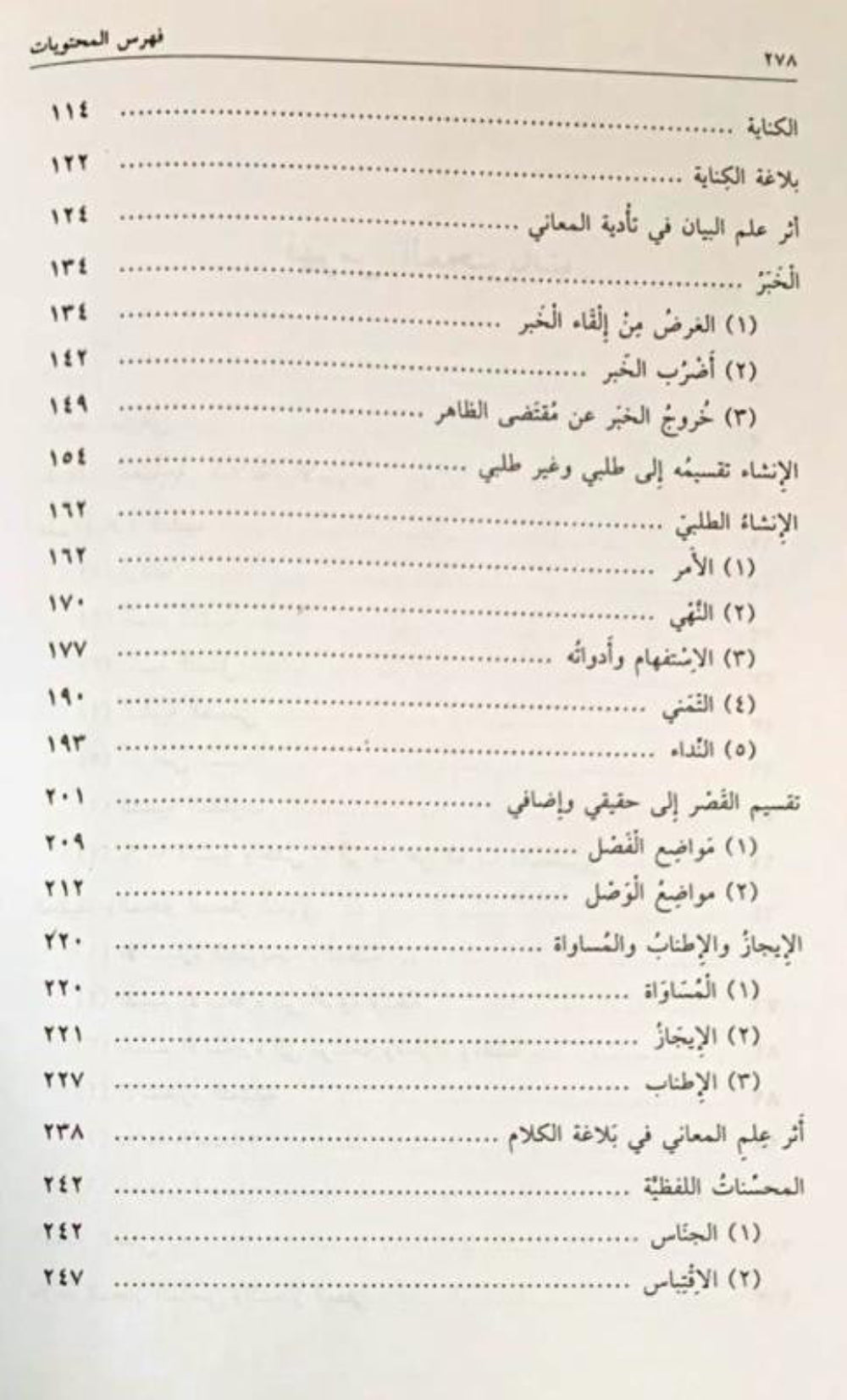
Table of Contents
Page:04
Writing
Eloquence of Metonymy (Kinaya)
The impact of the science of Bayan on conveying meanings.
Declarative Statement (Al-Khabar)
(1) The purpose of delivering a declarative statement (2) Types of declarative statements
(3) Deviation of the declarative statement from the apparent requirement.
Creative Statement (Al-Insha') and its division into demand-based and non-demand-based
Demand-based Creative Statement
(1) Imperative (Al-Amr)
(2) Prohibition (Al-Nahy)
(3) Interrogation and its tools (4) Optative (Al-Tamanni)
(5) Vocative (Al-Nida')
Division of Restriction (Al-Qasr) into real and relative (1) Positions of Separation (Fasl)
(2) Positions of Connection (Wasl)
Conciseness, Prolixity, and Equivalence
(1) Equivalence (Al-Musawah)
(2) Conciseness (Al-Ijaz)
(3) Prolixity (Al-Itnab)
The impact of the science of Al-Ma'ani on the eloquence of speech.
Verbal Embellishments (Al-Muhassinat al-Lafziyya)
(1) Pun (Al-Jinas)
(2) Quotation (Al-Iqtibas)
Table of Contents
الناشر
Al Maktabatul Ilmiyah
مؤلف
- مصطفى أمين
الشحن والتوصيل
نقوم بشحن الطلبات مباشرة من مستودعاتنا في المملكة المتحدة والولايات المتحدة الأمريكية، ونقدم خيارات شحن متعددة لتناسب احتياجاتك. نحن نشحن بفخر إلى جميع أنحاء العالم.
عمليات التسليم في المملكة المتحدة (من مستودع المملكة المتحدة):
يصل الشحن القياسي عادةً في غضون 3-4 أيام عمل. يستغرق التسليم السريع 2-3 أيام عمل. نهدف إلى شحن الطلبات في نفس اليوم أو يوم العمل التالي، مع توفر خيارات التوصيل في اليوم التالي حيثما ينطبق ذلك.
عمليات التسليم في الولايات المتحدة الأمريكية (من مستودع الولايات المتحدة الأمريكية):
تصل الطلبات عادةً في غضون 4-7 أيام عمل.
أوروبا (يتم الشحن من المملكة المتحدة):
يستغرق التسليم القياسي حوالي 6-10 أيام عمل، مع توفر خدمات الشحن السريع في غضون 3-5 أيام عمل.
كندا:
الوقت المقدر للتسليم هو 5-10 أيام عمل.
الشحن في جميع أنحاء العالم:
تصل الطلبات الدولية بشكل عام في غضون 5-20 يوم عمل، اعتمادًا على الوجهة وطريقة الشحن المختارة.
للحصول على جداول زمنية دقيقة للتسليم بناءً على موقعك، يرجى الاتصال بنا عبر البريد الإلكتروني وسيقدم فريقنا معلومات مفصلة ومخصصة لعنوانك.
صفحات العينة - المحتوى
Page:01
Al-Balagha Al-Wadiha
Al-Bayan, Al-Ma'ani, and Al-Badi'
Al-Balagha Al-Wadiha for Secondary Schools
According to the modern curriculum approved by the Ministry of Education
Authored by Ali Al-Jarim and Mustafa Amin
Al-Maktaba Al-Ilmiyya, Beirut - Lebanon
Page:02
Table of Contents
Foreword
Authors' Introduction
Introduction: Eloquence, Rhetoric, Style. Science of Bayan (Eloquence): Simile (1) Its Pillars
(2) Divisions of Simile.
(3) Representative Simile
(4) Implicit Simile (5) Purposes of Simile ......
(6) Inverted Simile
(7) Eloquence of Simile and some of what has been transmitted from the Arabs and modernists
Literal and Figurative meaning. Linguistic Metaphor (1) Explicit and Implicit Metaphor (2) Division of Metaphor into Original and Derivative
(3) Division of Metaphor into Supported, Abstract, and Absolute
(4) Representational Metaphor.
(5) Eloquence of Metaphor
(6) Synecdoche
Rational Metaphor
Eloquence of Synecdoche and Rational Metaphor
Page:03
Table of Contents
(3) Rhymed Prose (Saj'). Semantic Embellishments (1) Pun (Tawriya)
(2) Antithesis (Tibaq)
(3) Juxtaposition (Muqabala)
(4) Poetic Reason (Husn al-Ta'lil)
(5 & 6) Confirmation of Praise via Denigration and vice versa
(7) The Wise Style (Uslub al-Hakim)
Secondary School Certificate Examination Questions for the Second Section
(1) First Round Questions
(2) Second Round Questions
Table of Contents
Page:04
Writing
Eloquence of Metonymy (Kinaya)
The impact of the science of Bayan on conveying meanings.
Declarative Statement (Al-Khabar)
(1) The purpose of delivering a declarative statement (2) Types of declarative statements
(3) Deviation of the declarative statement from the apparent requirement.
Creative Statement (Al-Insha') and its division into demand-based and non-demand-based
Demand-based Creative Statement
(1) Imperative (Al-Amr)
(2) Prohibition (Al-Nahy)
(3) Interrogation and its tools (4) Optative (Al-Tamanni)
(5) Vocative (Al-Nida')
Division of Restriction (Al-Qasr) into real and relative (1) Positions of Separation (Fasl)
(2) Positions of Connection (Wasl)
Conciseness, Prolixity, and Equivalence
(1) Equivalence (Al-Musawah)
(2) Conciseness (Al-Ijaz)
(3) Prolixity (Al-Itnab)
The impact of the science of Al-Ma'ani on the eloquence of speech.
Verbal Embellishments (Al-Muhassinat al-Lafziyya)
(1) Pun (Al-Jinas)
(2) Quotation (Al-Iqtibas)
Table of Contents
من هو Mustafa Amin؟
Mustafa Amin is a respected Islamic writer known for his clear, practical, and learner-friendly approach to Arabic language and Islamic studies. His works focus on simplifying complex grammatical and linguistic concepts, making them accessible for students, teachers, and self-learners. Mustafa Amin’s books are widely used in Islamic schools, madaris, and Arabic language courses because of his structured explanations, authentic references, and educational style. His contribution has made Arabic grammar and Islamic knowledge easier to understand for beginners as well as advanced learners.