


تزيين المعرفة بالعمل لحسين العوايشة | كتاب دراسات إسلامية
تزيين المعرفة بالعمل لحسين العوايشة | كتاب دراسات إسلامية
تفاصيل المنتج
تفاصيل المنتج
- الشيخ حسين العوايشة
- دار الهداية للنشر
- غلاف ناعم
- 14 × 22 سم
- كتب إسلامية
لم نتمكن من تحميل توفر الاستلام
كتاب "تزيين المعرفة بالعمل " لحسين العوايشة تذكيرٌ قويٌّ بأن المعرفة الإسلامية الحقة لا بد أن تقترن بالعمل الصادق. يستمد هذا الكتاب من القرآن والسنة وحكمة العلماء الأوائل، مسلطًا الضوء على التوازن بين التعلم والعمل بتعاليم الإسلام، مما يجعله دليلًا أساسيًا لطلاب العلم وطلبته.
صفحات العينة
Page:01
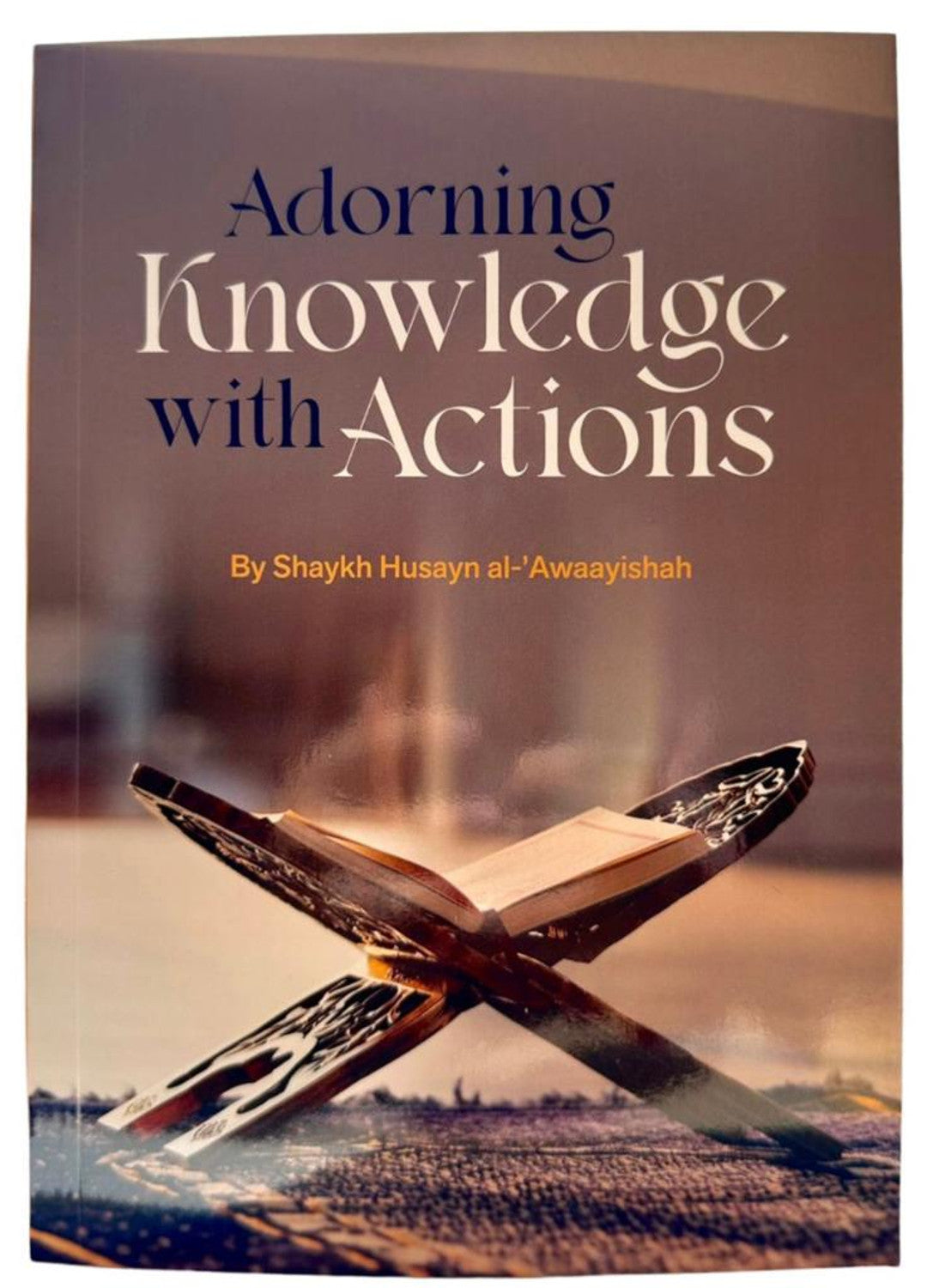
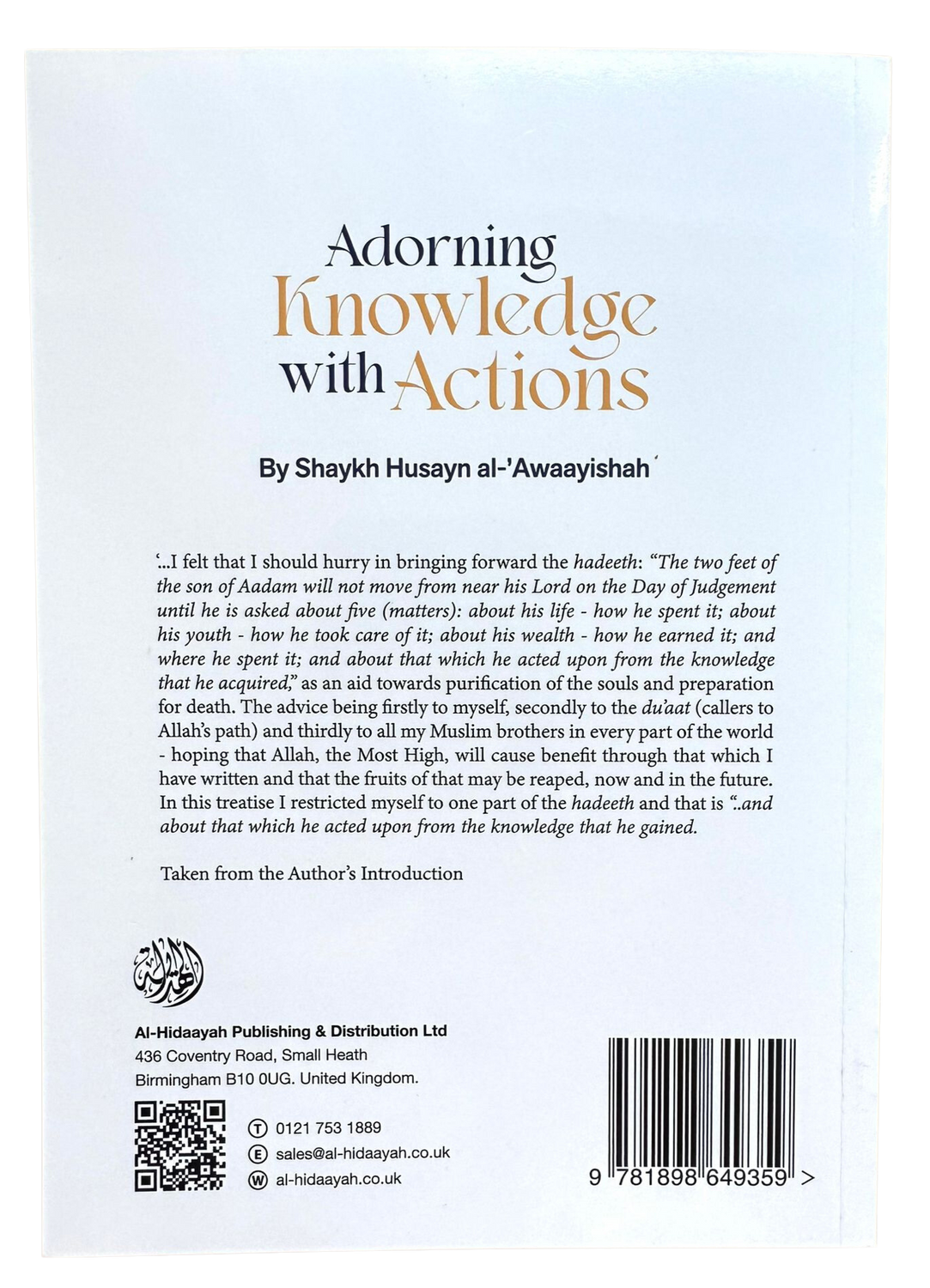
Adorning Knowledge with Actions
By Shaykh Husayn al-'Awaayishah
Page:02
British Library Cataloguing in Publication Data.
A catalogue record for this book is available from the British Library.
First Edition, 1420 AH/1999 CE
won gnimobA
Copyright 1999 by Al-Hidaayah Publishing and Distribution
All rights reserved. No part of this publication may be reproduced in any language, stored in a retrieval system or transmitted in any form
or by any means, electronic, mechanical, photocopying, recording or otherwise without the express permission of the copyright owner.
Translator's Dedication
I dedicate this book to both of my parents, may Allaah grant them good health and long life, for their patience with me.
I firmly believe that my parents did not leave off supplicat- ing for me at any time, thereby Allaah guided me to the Sunnah and caused me to learn the language of the Qur'aan. Indeed the Messenger said, "The supplication of the par- ent for his child is not neglected."
I pray to Allaah that the benefit of this book reaches all those who read it and I pray to Him the All-Mighty that the reward of this book reaches my two wonderful parents.
Page:03
Author's Introduction.
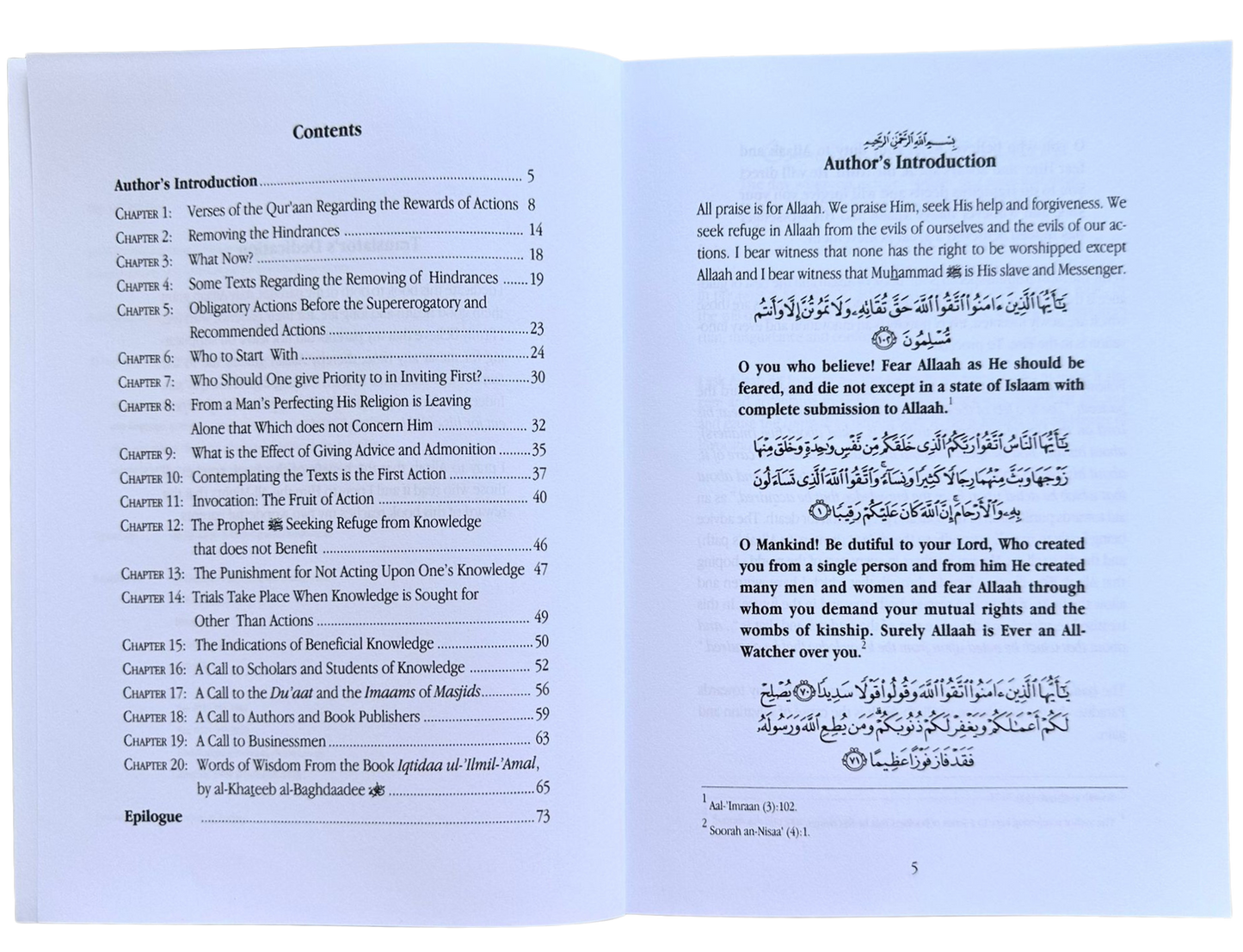
Contents
بسم الله الرحمن الرحيم
Author's Introduction
All praise is for Allaah. We praise Him, seek His help and forgiveness. We seek refuge in Allaah from the evils of ourselves and the evils of our ac- tions. I bear witness that none has the right to be worshipped except Allaah and I bear witness that Muhammad is His slave and Messenger.
CHAPTER 1: Verses of the Qur'aan Regarding the Rewards of Actions 8 CHAPTER 2: Removing the Hindrances
CHAPTER 3:
What Now?
CHAPTER 4:
Some Texts Regarding the Removing of Hindrances
CHAPTER 5: Obligatory Actions Before the Supererogatory and
Recommended Actions
CHAPTER 6: Who to Start With.
CHAPTER 7:
CHAPTER 8:
Who Should One give Priority to in Inviting First?. From a Man's Perfecting His Religion is Leaving
Alone that Which does not Concern Him
CHAPTER 9: What is the Effect of Giving Advice and Admonition CHAPTER 10: Contemplating the Texts is the First Action
CHAPTER 11: Invocation: The Fruit of Action
CHAPTER 12: The Prophet
Seeking Refuge from Knowledge
that does not Benefit.
CHAPTER 13: The Punishment for Not Acting Upon One's Knowledge 47 CHAPTER 14: Trials Take Place When Knowledge is Sought for Other Than Actions.
CHAPTER 15: The Indications of Beneficial Knowledge
CHAPTER 16: A Call to Scholars and Students of Knowledge
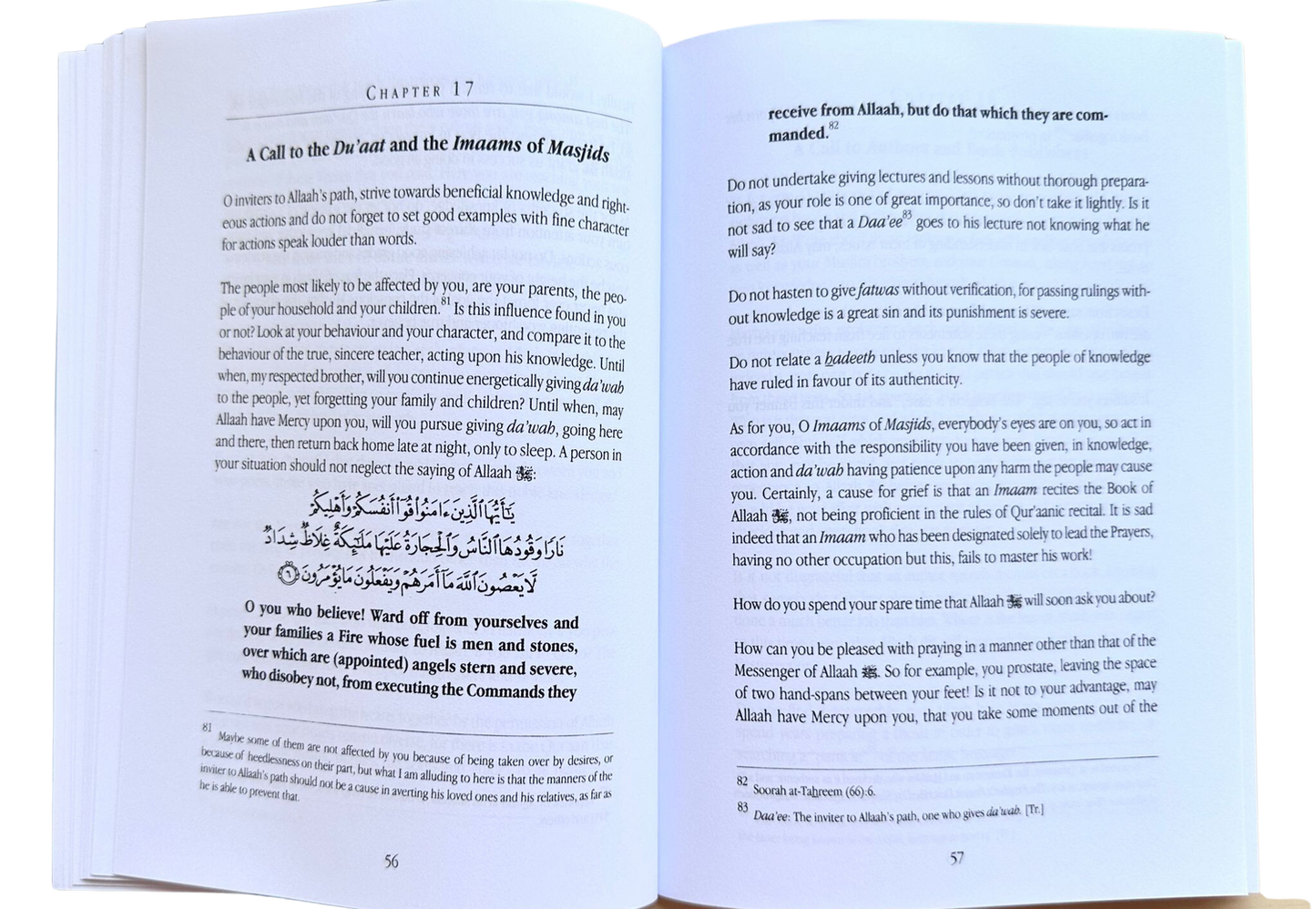
CHAPTER 17: A Call to the Du'aat and the Imaams of Masjids
CHAPTER 18: A Call to Authors and Book Publishers.
CHAPTER 19: A Call to Businessmen.
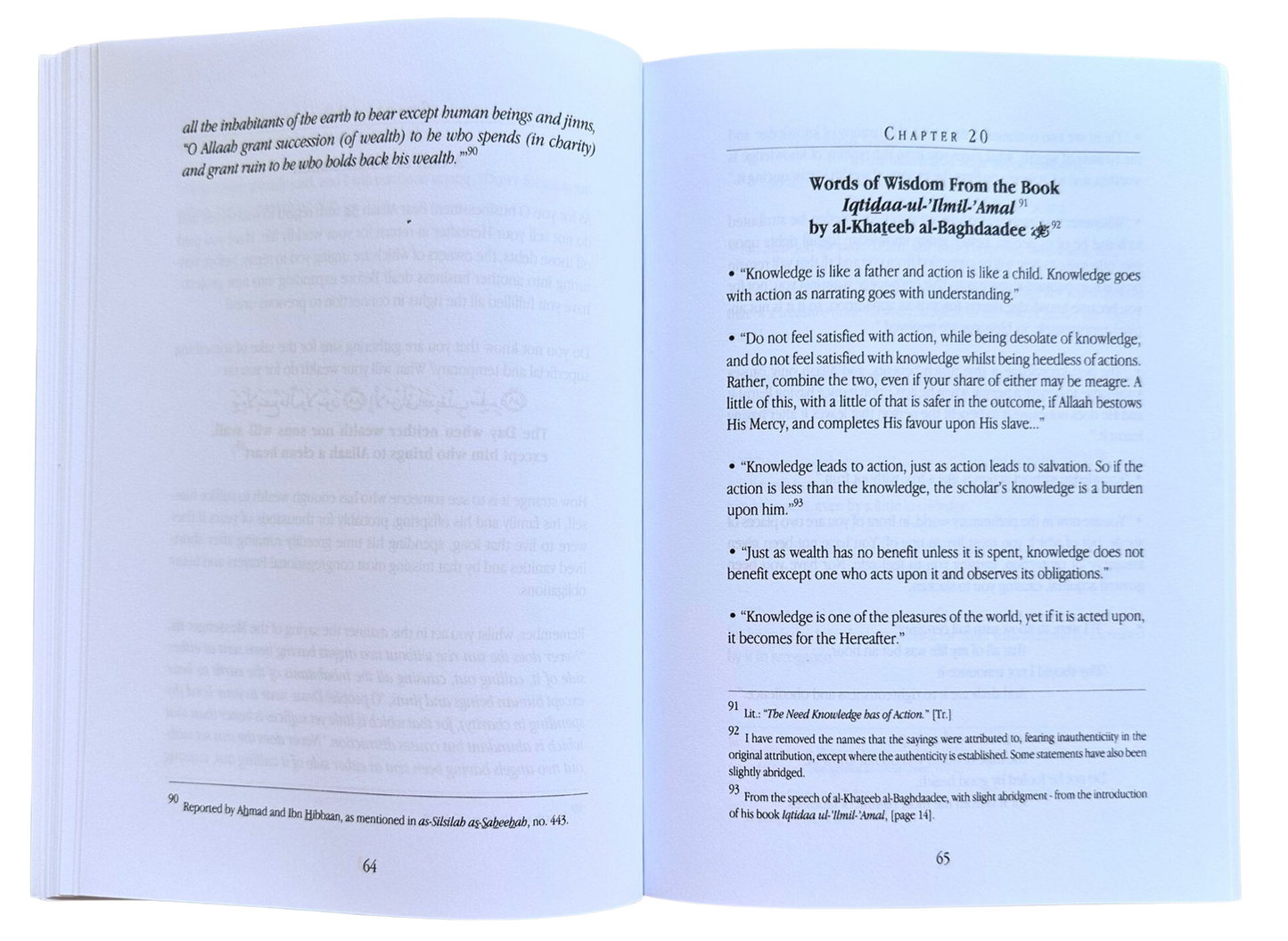
CHAPTER 20: Words of Wisdom From the Book Iqtidaa ul-'Ilmil-'Amal, by al-Khateeb al-Baghdaadee
Epilogue
يَأَيُّهَا الَّذِينَ ءَامَنُوا اتَّقُوا اللَّهَ حَقَّ تُقَائِهِ وَلَا تَمُوتُنَّ إِلَّا وَأَنتُم مُسْلِمُونَ )
O you who believe! Fear Allaah as He should be feared, and die not except in a state of Islaam with complete submission to Allaah."
يَتأَيُّهَا النَّاسُ اتَّقُوا رَبَّكُمُ الَّذِي خَلَقَكُم مِّن نَّفْسٍ وَاحِدَةٍ وَخَلَقَ مِنْهَا زَوْجَهَا وَبَثَّ مِنْهُمَا رِجَالًا كَثِيرًا وَنِسَاءً وَاتَّقُوا اللَّهَ الَّذِي تَسَاءَلُونَ بهِ وَالْأَرْحَامَ إِنَّ اللَّهَ كَانَ عَلَيْكُمْ رَقِبال
bag O Mankind! Be dutiful to your Lord, Who created you from a single person and from him He created one many men and women and fear Allaah through whom you demand your mutual rights and the wombs of kinship. Surely Allaah is Ever an All- heWatcher over you."
يَأَيُّهَا الَّذِينَ ءَامَنُوا اتَّقُوا اللَّهَ وَقُولُوا قَوْلًا سَدِيدًا يُصْلِحْ لَكُمْ أَعْمَلَكُمْ وَيَغْفِرْ لَكُمْ ذُنُوبَكُمْ وَمَن يُطِعِ اللَّهَ وَرَسُولَهُ فقد فاز فوزا عَظِيمًا الله
Aal-'Imraan (3):102.
2 Soorah an-Nisaa' (4):1
Page:04
Allaah said:
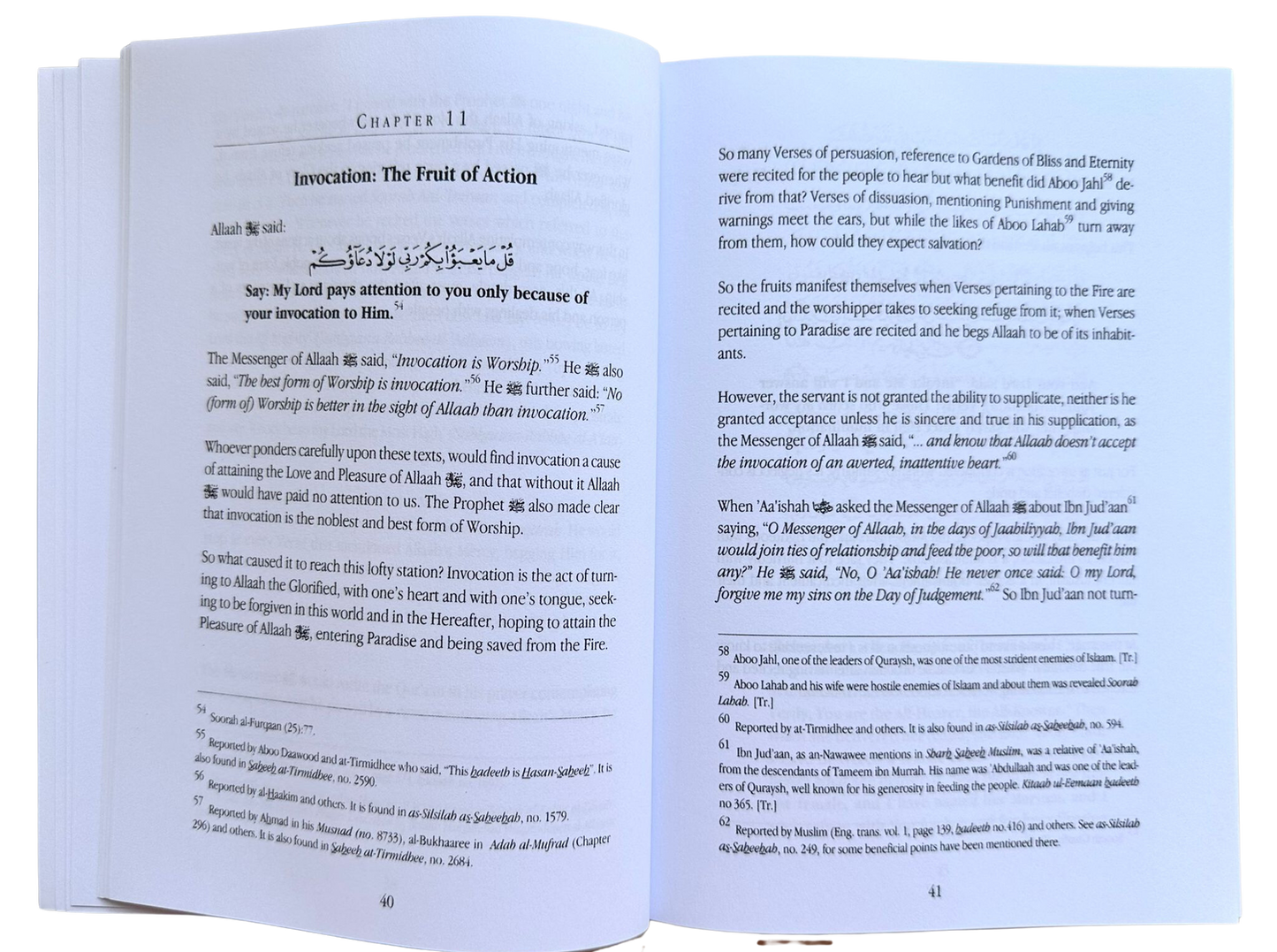
CHAPTER 11
Invocation: The Fruit of Action
قُلْ مَا يَعْبَؤُا بِكُمْ رَبِّي لَوْلَا دُعَاؤُكُمْ
Say: My Lord pays attention to you only because of your invocation to Him.
The Messenger of Allaah said, "Invocation is Worship. He also said, "The best form of Worship is invocation. 1,56 He further said: "No (form of) Worship is better in the sight of Allaah than invocation.
Whoever ponders carefully upon these texts, would find invocation a cause of attaining the Love and Pleasure of Allaah, and that without it Allaah would have paid no attention to us. The Prophet also made clear that invocation is the noblest and best form of Worship.
So what caused it to reach this lofty station? Invocation is the act of turn- ing to Allaah the Glorified, with one's heart and with one's tongue, seek- ing to be forgiven in this world and in the Hereafter, hoping to attain the Pleasure of Allaah 3, entering Paradise and being saved from the Fire.
Soorah al-Furqaan (25):77,
55 Reported by Aboo Daawood and at-Tirmidhee who said. "This hadeeth is Hasan-Sabeeh". It is also found in Sabeeh at-Tirmidhee, no. 2590.
Reported by al-Haakim and others. It is found in as-Silsilah as-Sabeehab, no. 1579.
Reported by Ahmad in his Musnad (no. 8733), al-Bukhaaree in Adab al-Mufrad (Chapter
296) and others. It is also found in Sabeeh at-Tirmidhee, no. 268-4.
So many Verses of persuasion, reference to Gardens of Bliss and Eternity were recited for the people to hear but what benefit did Aboo Jahl de- rive from that? Verses of dissuasion, mentioning Punishment and giving warnings meet the ears, but while the likes of Aboo Lahab" turn away from them, how could they expect salvation?
So the fruits manifest themselves when Verses pertaining to the Fire are recited and the worshipper takes to seeking refuge from it; when Verses pertaining to Paradise are recited and he begs Allaah to be of its inhabit-ants.
However, the servant is not granted the ability to supplicate, neither is he granted acceptance unless he is sincere and true in his supplication, as the Messenger of Allaah said, "... and know that Allaah doesn't accept the invocation of an averted, inattentive heart.
When 'Aa'ishah asked the Messenger of Allaah about Ibn Jud'aan saying, "O Messenger of Allaah, in the days of Jaabiliyyah, Ibn Jud'aan would join ties of relationship and feed the poor, so will that benefit him any?" He said, "No, O 'Aa'ishah! He never once said: O my Lord, forgive me my sins on the Day of Judgement. 62 So Ibn Jud'aan not turn-
Aboo Jahl, one of the leaders of Quraysh, was one of the most strident enemies of Islaam. [Tr.] Aboo Lahab and his wife were hostile enemies of Islaam and about them was revealed Soorab Labab. [Tr.]
Reported by at-Tirmidhee and others. It is also found in as-Silsilab as Sabeebab, no. 594.
Ibn Jud'aan, as an-Nawawee mentions in Sbarb Sabeeb Muslim, was a relative of 'Aaishah, from the descendants of Tameem ibn Murrah. His name was 'Abdullaah and was one of the lead- ers of Quraysh, well known for his generosity in feeding the people. Kitaab ul-Eemaan badeeth no 365. [Tr.]
Reported by Muslim (Eng. trans. vol. 1, page 139, hadeeth no.416) and others. See as-Silsilab as-Sabeebab, no. 249, for some beneficial points have been mentioned there.
Page:05
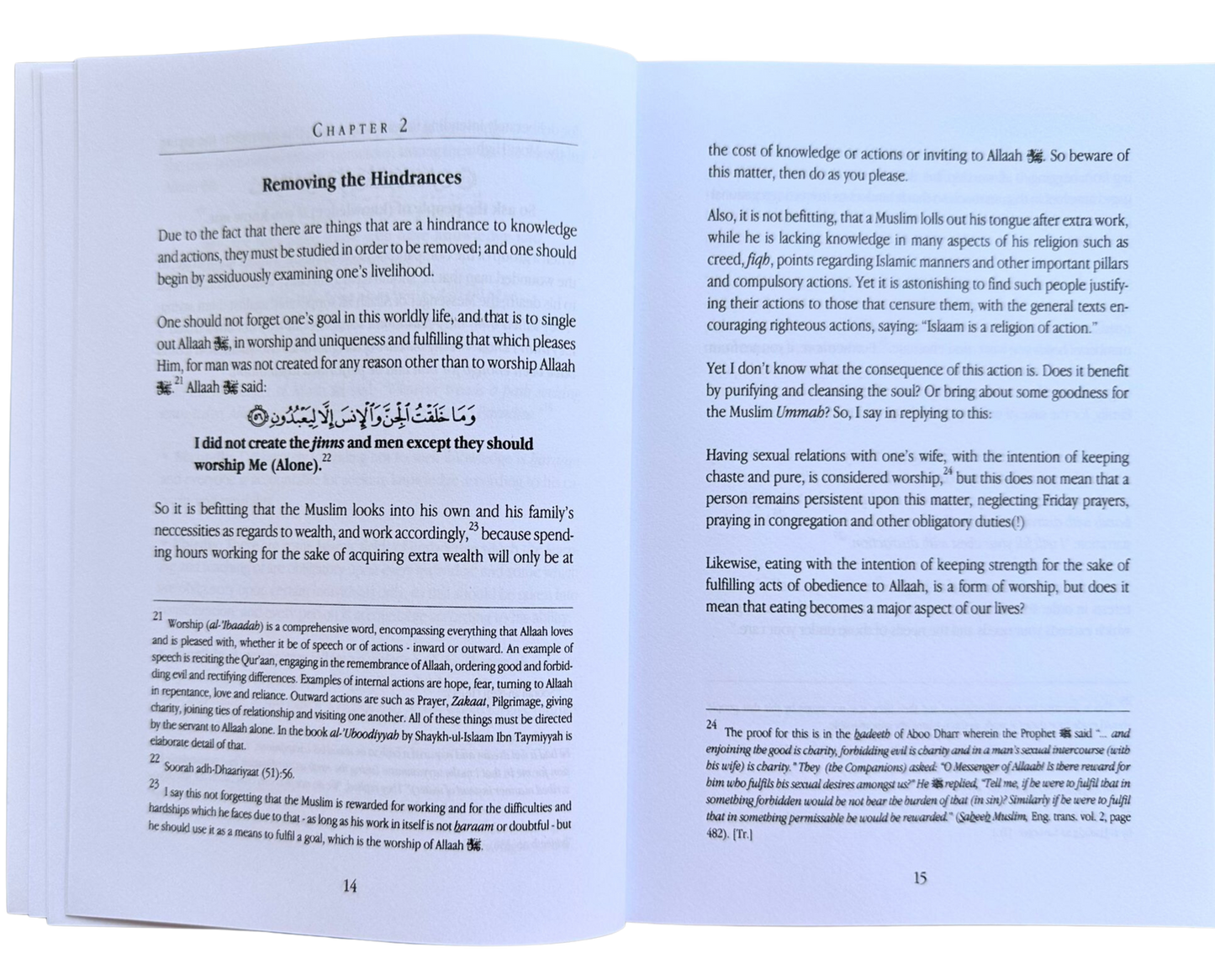
CHAPTER 2
Removing the Hindrances
Due to the fact that there are things that are a hindrance to knowledge and actions, they must be studied in order to be removed; and one should begin by assiduously examining one's livelihood.
One should not forget one's goal in this worldly life, and that is to single out Allaah 3, in worship and uniqueness and fulfilling that which pleases Him, for man was not created for any reason other than to worship Allaah Allaah 3 said:
وَمَا خَلَقْتُ الْجِنَّ وَالْإِنسَ إِلَّا لِيَعْبُدُونِ ال
I did not create the jinns and men except they should worship Me (Alone).
So it is befitting that the Muslim looks into his own and his family's neccessities as regards to wealth, and work accordingly," because spend- ing hours working for the sake of acquiring extra wealth will only be at
Worship (al-'Ibaadab) is a comprehensive word, encompassing everything that Allaah loves and is pleased with, whether it be of speech or of actions - inward or outward. An example of speech is reciting the Qur'aan, engaging in the remembrance of Allaah, ordering good and forbid- ding evil and rectifying differences. Examples of internal actions are hope, fear, turning to Allaah in repentance, love and reliance. Outward actions are such as Prayer, Zakaat, Pilgrimage, giving charity, joining ties of relationship and visiting one another. All of these things must be directed by the servant to Allaah alone. In the book al-'Uboodiyyah by Shaykh-ul-Islaam Ibn Taymiyyah is
elaborate detail of that.
Soorah adh-Dhaariyaat (51):
I say this not forgetting that the Muslim is rewarded for working and for the difficulties and hardships which he faces due to that - as long as his work in itself is not haraam or doubtful-but he should use it as a means to fulfil a goal, which is the worship of Allaah.
the cost of knowledge or actions or inviting to Allaah. So beware of this matter, then do as you please.
Also, it is not befitting, that a Muslim lolls out his tongue after extra work, while he is lacking knowledge in many aspects of his religion such as creed, fiqh, points regarding Islamic manners and other important pillars and compulsory actions. Yet it is astonishing to find such people justify- ing their actions to those that censure them, with the general texts en- couraging righteous actions, saying: "Islaam is a religion of action."
Yet I don't know what the consequence of this action is. Does it benefit by purifying and cleansing the soul? Or bring about some goodness for the Muslim Ummah? So, I say in replying to this:
Having sexual relations with one's wife, with the intention of keeping chaste and pure, is considered worship," but this does not mean that a person remains persistent upon this matter, neglecting Friday prayers, praying in congregation and other obligatory duties(!)
Likewise, eating with the intention of keeping strength for the sake of fulfilling acts of obedience to Allaah, is a form of worship, but does it mean that eating becomes a major aspect of our lives?
said... and
The proof for this is in the badeeth of Aboo Dharr wherein the Prophet enjoining the good is charity, forbidding evil is charity and in a man's sexual intercourse (with bis wife) is charity. "They (the Companions) asked: "O Messenger of Allaab! Is there reward for bim who fulfils bis sexual desires amongst us?" He replied, "Tell me, if he were to fulfil that in something forbidden would be not bear the burden of that (in sin)? Similarly if he were to fulfil that in something permissable be would be rewarded." (Sabeeb Muslim, Eng. trans. vol. 2, page 482). [Tr.]