


شرح عمدة الأحكام (من المصادر القديمة والمعاصرة) – مجلدان
شرح عمدة الأحكام (من المصادر القديمة والمعاصرة) – مجلدان
Publisher:
Dar Makkah International Publishing
Author:
بقلم الدكتور محمد الرهوان
Language:
إنجليزي
Binding:
غلاف مقوى
Size: 24 × 16 × 1 سم
لم نتمكن من تحميل توفر الاستلام
محتوى قابل للطي
وصف كتاب إسلامي
شرح كتاب "عمدة الأحكام" (بالاستناد إلى المصادر القديمة والمعاصرة) هو مجموعة شاملة من مجلدين، تقدم شرحًا مفصلاً لكتاب "عمدة الأحكام" الحديثي. يجمع هذا العمل بين الآراء الفقهية القديمة والملاحظات التفسيرية الحديثة، ليوضح الأحكام الشرعية والأدلة وآثارها الفقهية للقراء المعاصرين. يتضمن كل مجلد تحليلًا نصيًا، وإشارات إلى المراجع الأوائل، وتعليقات عملية موجهة للطلاب والمعلمين والباحثين في الحديث والفقه الإسلامي. قد يختلف تصميم الغلاف/الطبعة باختلاف عدد النسخ المطبوعة؛ ويبقى المحتوى علميًا وموثوقًا.
الناشر
Dar Makkah International Publishing
مؤلف
- بقلم الدكتور محمد الرهوان
الشحن والتوصيل
نقوم بشحن الطلبات مباشرة من مستودعاتنا في المملكة المتحدة والولايات المتحدة الأمريكية، ونقدم خيارات شحن متعددة لتناسب احتياجاتك. نحن نشحن بفخر إلى جميع أنحاء العالم.
عمليات التسليم في المملكة المتحدة (من مستودع المملكة المتحدة):
يصل الشحن القياسي عادةً في غضون 3-4 أيام عمل. يستغرق التسليم السريع 2-3 أيام عمل. نهدف إلى شحن الطلبات في نفس اليوم أو يوم العمل التالي، مع توفر خيارات التوصيل في اليوم التالي حيثما ينطبق ذلك.
عمليات التسليم في الولايات المتحدة الأمريكية (من مستودع الولايات المتحدة الأمريكية):
تصل الطلبات عادةً في غضون 4-7 أيام عمل.
أوروبا (يتم الشحن من المملكة المتحدة):
يستغرق التسليم القياسي حوالي 6-10 أيام عمل، مع توفر خدمات الشحن السريع في غضون 3-5 أيام عمل.
كندا:
الوقت المقدر للتسليم هو 5-10 أيام عمل.
الشحن في جميع أنحاء العالم:
تصل الطلبات الدولية بشكل عام في غضون 5-20 يوم عمل، اعتمادًا على الوجهة وطريقة الشحن المختارة.
للحصول على جداول زمنية دقيقة للتسليم بناءً على موقعك، يرجى الاتصال بنا عبر البريد الإلكتروني وسيقدم فريقنا معلومات مفصلة ومخصصة لعنوانك.
صفحات العينة - المحتوى
Pg:01
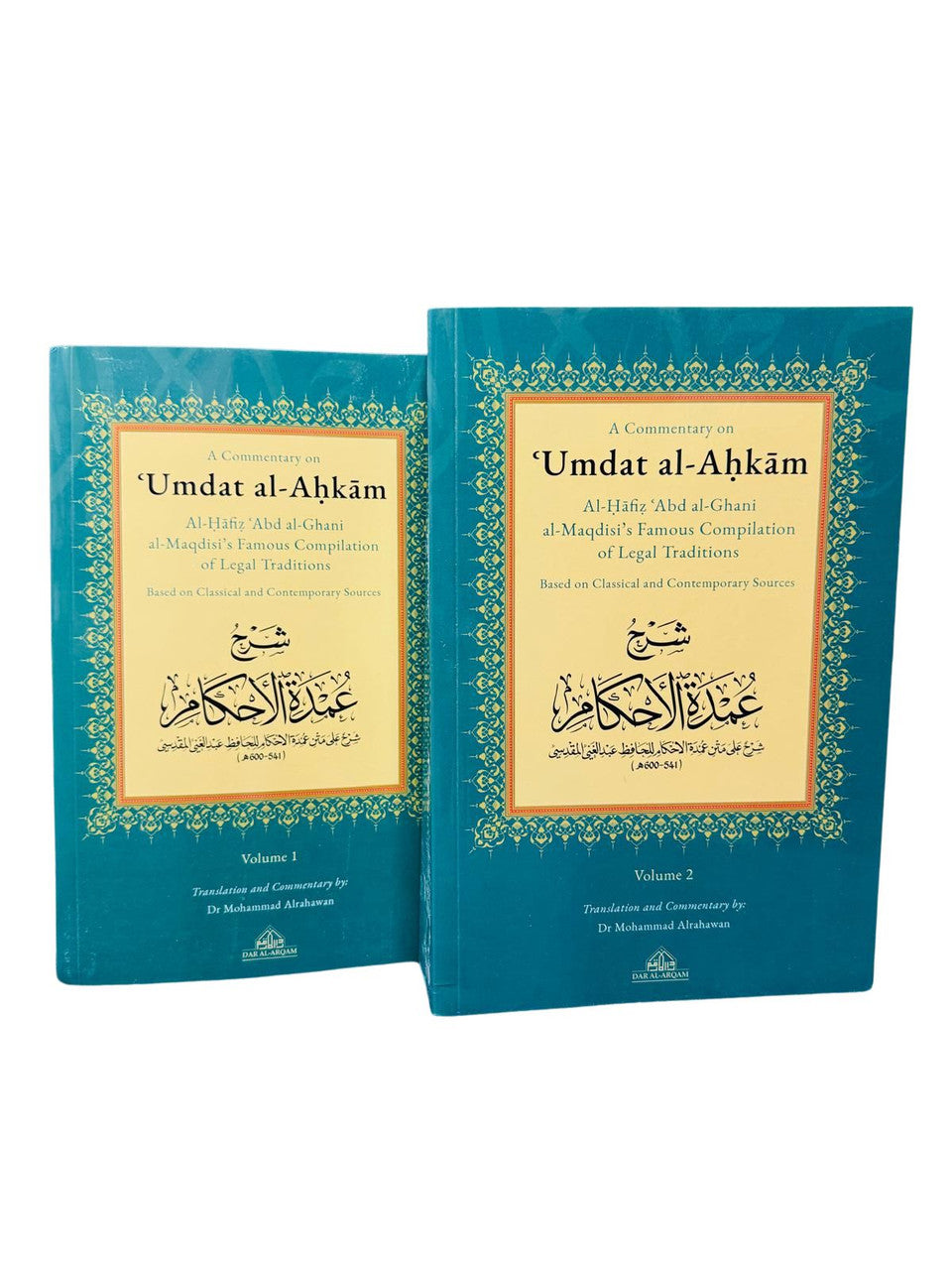
A Commentary on
'Umdat al-Ahkām
Al-Hafiz 'Abd al-Ghani al-Maqdisi's Famous Compilation of Legal Traditions
Based on Classical and Contemporary Sources
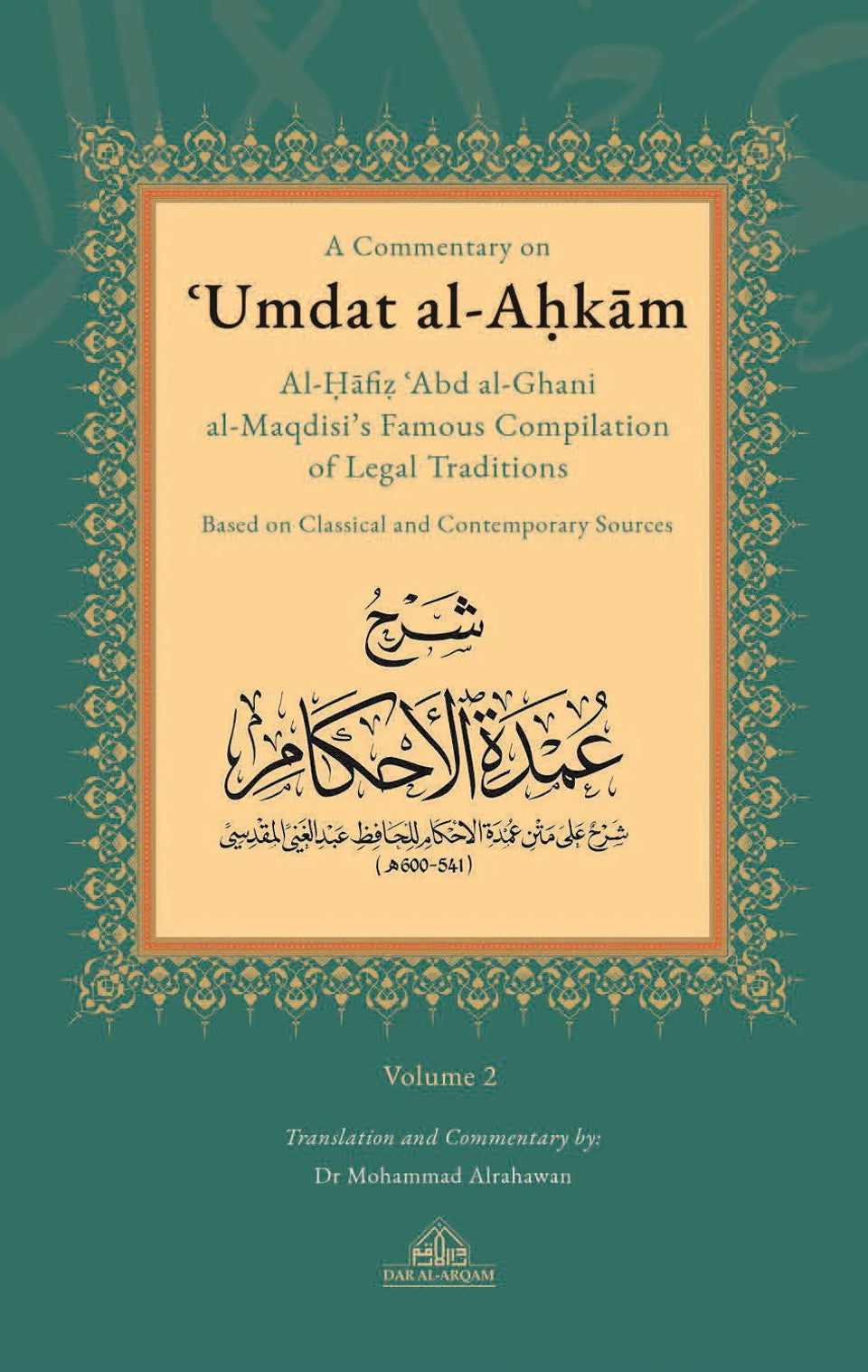
A Commentary on
'Umdat al-Ahkām
Al-Hafiz Abd al-Ghani al-Maqdisi's Famous Compilation
of Legal Traditions
Based on Classical and Contemporary Sources
عمدة الأحكام
شرع على متن عمدة الاحكام للحافظ عبد الغني المقدسي (600-541هـ)
شرخ
عمدة الأحكام
شرع على متن عمدة الاحكام للحافظ عبد الغني المقدسي
(A600-541)
Volume 1
Translation and Commentary by: Dr Mohammad Alrahawan
DAR AL-ARQAM
Volume 2
Translation and Commentary by:
Dr Mohammad Alrahawan
DAR AL-ARQAM
Pg:02
A Commentary on Umdat al-Ahkam
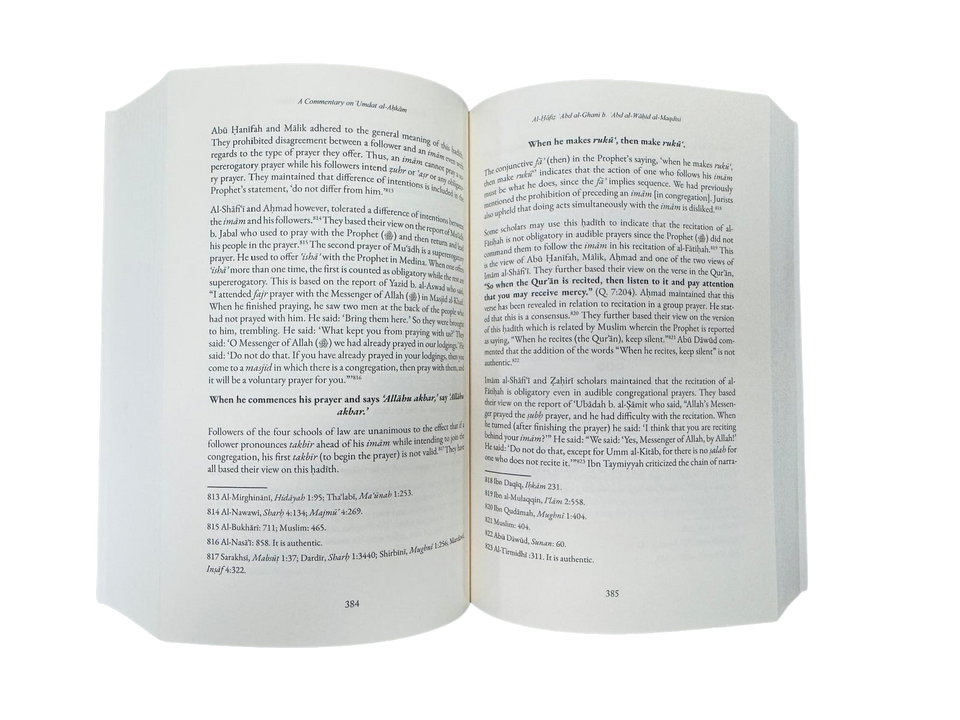
Abu Hanifah and Malik adhered to the general meaning of this ha They prohibited disagreement between a follower and an imam even wi regards to the type of prayer they offer. Thus, an imam cannot pray a pererogatory prayer while his followers intend zuhr or 'asr or any oblig ry prayer. They maintained that difference of intentions is included in the
Prophet's statement, 'do not differ from him. 813
Al-Shafi'i and Ahmad however, tolerated a difference of intentions ber the imam and his followers.814 They based their view on the report of Ma b. Jabal who used to pray with the Prophet () and then return and a his people in the prayer. 815 The second prayer of Mu'adh is a supererog prayer. He used to offer 'isha'with the Prophet in Medina. When one of 'isha'more than one time, the first is counted as obligatory while the resta supererogatory. This is based on the report of Yazid b. al-Aswad who s "I attended fajr prayer with the Messenger of Allah () in Masjid al- When he finished praying, he saw two men at the back of the people whe had not prayed with him. He said: 'Bring them here.' So they were brought to him, trembling. He said: 'What kept you from praying with us?" The said: 'O Messenger of Allah () we had already prayed in our lodgings He said: 'Do not do that. If you have already prayed in your lodgings, then you come to a masjid in which there is a congregation, then pray with them, and it will be a voluntary prayer for you."816
When he commences his prayer and says 'Allahu akbar,' say 'Allia akbar'
Followers of the four schools of law are unanimous to the effect that follower pronounces takbir ahead of his imam while intending to join the congregation, his first takbir (to begin the prayer) is not valid. They be
all based their view on this hadith.
813 Al-Mirghinani, Hidayah 1:95; Tha'labi, Mainab 1:253.
814 Al-Nawawi, Sharh 4:134; Majmu 4:269.
815 Al-Bukhari: 711; Muslim: 465.
816 Al-Nasal: 858. It is authentic.
817 Sarakhsi, Mabsit 1:37; Dardir, Sharh 1:3440; Shirbini, Mughni 1:256 Ma
Insaf 4:322.
Al-Hafiz Abd al-Ghani b. Abd al-Wahid al-Maqdisi
When he makes ruku', then make ruku.
The conjunctive fa' (then) in the Prophet's saying, 'when he makes ruku, then make ruki" indicates that the action of one who follows his imam must be what he does, since the fa' implies sequence. We had previously mentioned the prohibition of preceding an imam [in congregation]. Jurists also upheld that doing acts simultaneously with the imam is disliked, Sis Some scholars may use this hadith to indicate that the recitation of al- Fatihah is not obligatory in audible prayers since the Prophet () did not command them to follow the imam in his recitation of al-Fatihah. This is the view of Abu Hanifah, Malik, Ahmad and one of the two views of Imam al-Shafi'i. They further based their view on the verse in the Qur'an, "So when the Qur'an is recited, then listen to it and pay attention that you may receive mercy." (Q. 7:204). Ahmad maintained that this verse has been revealed in relation to recitation in a group prayer. He stat od that this is a consensus. 20 They further based their view on the version of this hadith which is related by Muslim wherein the Prophet is reported as saying, "When he recites (the Qur'an), keep silent." Abu Dawud com- mented that the addition of the words "When he recites, keep silent" is not authentic.22
Imam al-Shafi'i and Zahiri scholars maintained that the recitation of al- Fatihah is obligatory even in audible congregational prayers. They based their view on the report of 'Ubadah b. al-Ṣamit who said, "Allah's Messen- ger prayed the subh prayer, and he had difficulty with the recitation. When he turned (after finishing the prayer) he said: 'I think that you are reciting behind your imam?"" He said: "We said: "Yes, Messenger of Allah, by Allah!" He said: 'Do not do that, except for Umm al-Kitab, for there is no salab for one who does not recite it."823 Ibn Taymiyyah criticized the chain of narra-
818 Ibn Daqiq, Ihkam 231.
$19 Ibn al-Mulaqqin, Ilam 2:558. $20 Ibn Qudimah, Mughni 1:404.
821 Muslim: 404.
822 Abu Dawud, Sunan: 60.
823 Al-Tirmidhi :311. It is authentic.
Pg:03
man
A Commentary on 'Umdat al-Ahkam
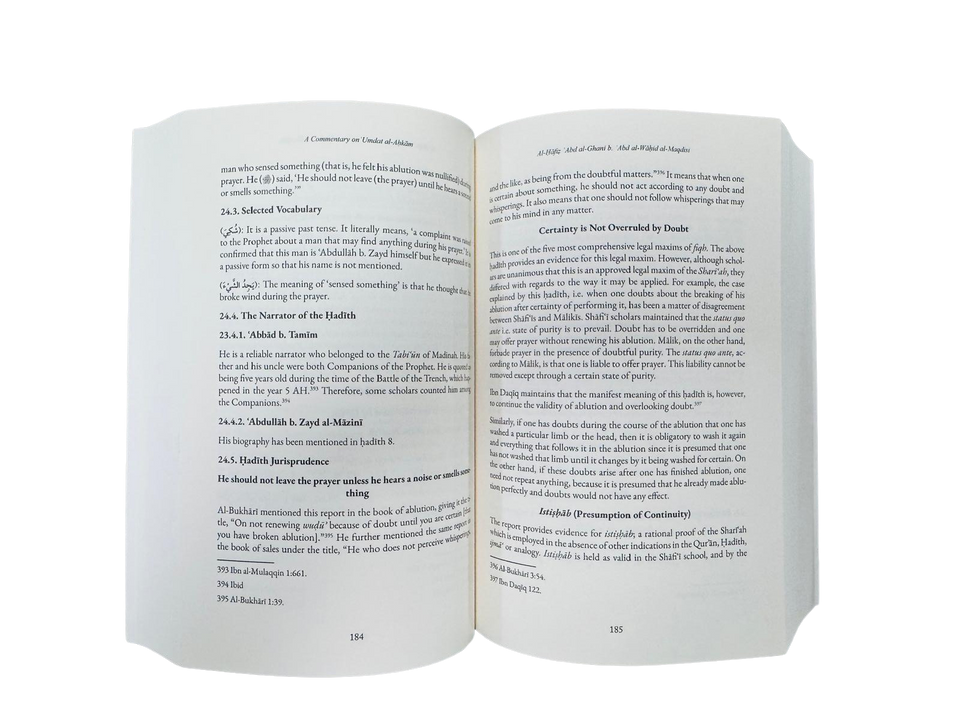
prayer. He () said, 'He should not leave (the prayer) until he hears a so n who sensed something (that is, he felt his ablution was nullified)
or smells something.""
24.3. Selected Vocabulary
(S): It is a passive past tense. It literally means, 'a complaint was rid to the Prophet about a man that may find anything during his praye confirmed that this man is 'Abdullah b. Zayd himself but he expressed a passive form so that his name is not mentioned.
(): The meaning of 'sensed something' is that he thought that broke wind during the prayer.
24.4. The Narrator of the Hadith
23.4.1. 'Abbad b. Tamim
He is a reliable narrator who belonged to the Tabi'ün of Madinah. Ha ther and his uncle were both Companions of the Prophet. He is quenda being five years old during the time of the Battle of the Trench, which b pened in the year 5 AH,393 Therefore, some scholars counted him anorg the Companions.34
24.4.2. 'Abdullah b. Zayd al-Mazinī
His biography has been mentioned in hadith 8..
24.5. Hadith Jurisprudence
He should not leave the prayer unless he hears a noise or smells son
thing
Al-Bukhari mentioned this report in the book of ablution, giving it the tle, "On not renewing wudi' because of doubt until you are certain f you have broken ablution]."395 He further mentioned the same repor the book of sales under the title, "He who does not perceive whispers
393 Ibn al-Mulaqqin 1:661.
394 lbid
395 Al-Bukhari 1:39.
Al-Hafiz 'Abd al-Ghani b. Abd al-Wahid al-Maqdisi
and the like, as being from the doubtful matters. "3% It means that when one is certain about something, he should not act according to any doubt and whisperings. It also means that one should not follow whisperings that may
come to his mind in any matter.
Certainty is Not Overruled by Doubt
This is one of the five most comprehensive legal maxims of figh. The above hadith provides an evidence for this legal maxim. However, although schol- ars are unanimous that this is an approved legal maxim of the Shari'ah, they differed with regards to the way it may be applied. For example, the case explained by this hadith, i.e. when one doubts about the breaking of his ablution after certainty of performing it, has been a matter of disagreement between Shafi'is and Mälikis. Shafi'i scholars maintained that the status quo ante i.e. state of purity is to prevail. Doubt has to be overridden and one may offer prayer without renewing his ablution. Malik, on the other hand, forbade prayer in the presence of doubtful purity. The status quo ante, ac- cording to Malik, is that one is liable to offer prayer. This liability cannot be removed except through a certain state of purity.
Ibn Daqiq maintains that the manifest meaning of this hadith is, however, to continue the validity of ablution and overlooking doubt." Similarly, if one has doubts during the course of the ablution that one has washed a particular limb or the head, then it is obligatory to wash it again and everything that follows it in the ablution since it is presumed that one has not washed that limb until it changes by it being washed for certain. On the other hand, if these doubts arise after one has finished ablution, one need not repeat anything, because it is presumed that he already made ablu- tion perfectly and doubts would not have any effect.
Istishab (Presumption of Continuity)
The report provides evidence for istishab, a rational proof of the Shariah which is employed in the absence of other indications in the Qur'an, Hadith, jma' or analogy. Istishäb is held as valid in the Shafi'i school, and by the
3% Al-Bukhari 3:54.
397 Ibn Daqiq 122.
Pg:04
A Commentary on 'Umdat al-Ahkam
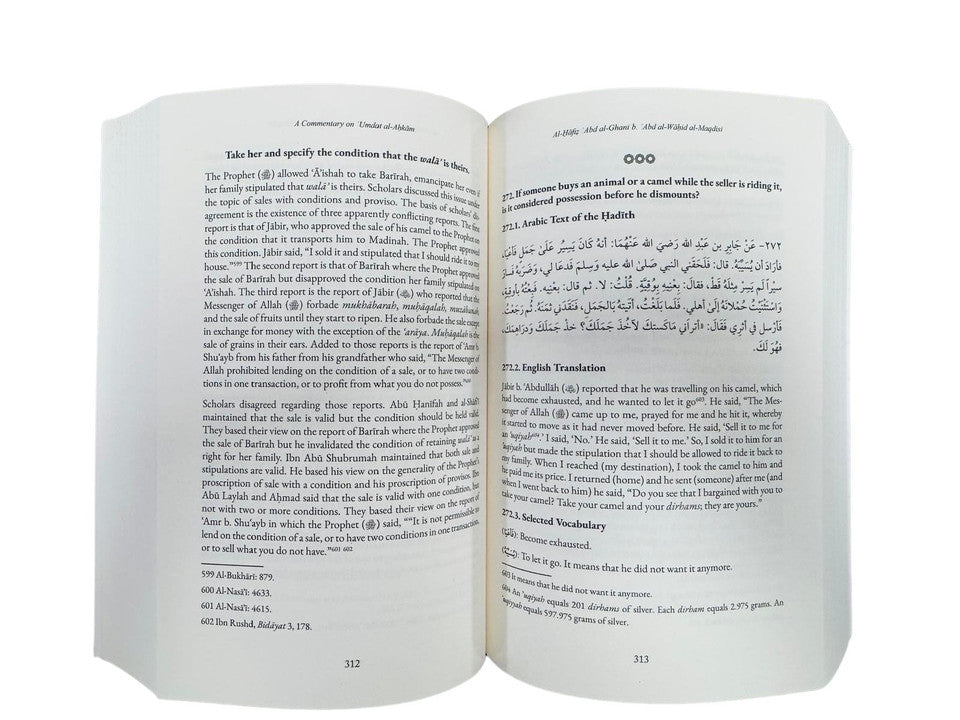
Take her and specify the condition that the wala' is theirs. The Prophet () allowed 'A'ishah to take Barirah, emancipate her even if her family stipulated that wala' is theirs. Scholars discussed this issue under the topic of sales with conditions and proviso. The basis of scholars a agreement is the existence of three apparently conflicting reports. The first report is that of Jabir, who approved the sale of his camel to the Prophet on the condition that it transports him to Madinah. The Prophet approved this condition. Jäbir said, "I sold it and stipulated that I should ride it to my
house." The second report is that of Barirah where the Prophet approved the sale of Barirah but disapproved the condition her family stipulated on 'A'ishah. The third report is the report of Jabir () who reported that the Messenger of Allah () forbade mukhabarah, muḥaqalah, muzabanak and the sale of fruits until they start to ripen. He also forbade the sale except in exchange for money with the exception of the 'araya. Muḥaqalab is the sale of grains in their ears. Added to those reports is the report of 'Amrb Shu'ayb from his father from his grandfather who said, "The Messenger of Allah prohibited lending on the condition of a sale, or to have two cond tions in one transaction, or to profit from what you do not possess." Scholars disagreed regarding those reports. Abu Hanifah and al-Shaft maintained that the sale is valid but the condition should be held valid. They based their view on the report of Barirah where the Prophet approved the sale of Barirah but he invalidated the condition of retaining wal right for her family. Ibn Abu Shubrumah maintained that both sale and stipulations are valid. He based his view on the generality of the Prophet's proscription of sale with a condition and his proscription of provisos le Abu Laylah and Ahmad said that the sale is valid with one condition, but 'Amr b. Shu'ayb in which the Prophet () said, ""It is not permissible not with two or more conditions. They based their view on the report of lend on the condition of a sale, or to have two conditions in one transaction
or to sell what you do not have."601 602
599 Al-Bukhari: 879.
600 Al-Nasa'i: 4633.
601 Al-Nasa'i: 4615.
602 Ibn Rushd, Bidayat 3, 178.
Al-Hafiz Abd al-Ghani b. Abd al-Wahid al-Maqdisi
000
272. If someone buys an animal or a camel while the seller is riding it, is it considered possession before he dismounts?
272.1. Arabic Text of the Ḥadith
۲۷۲ - عَنْ جَابِرِ بن عَبْدِ اللَّهِ رَضِيَ اللَّهُ عَنْهُمَا: أَنهُ كَانَ يَسِيرُ عَلَى جَمَلٍ فَأَعْبًا، فأَرَادَ أن يُسَيِّبَهُ. قال: فَلَحَقَني النبي صلى الله عليه وسلمَ فَدَعَا لِي، وَضَرَبَهُ فَسَارٌ سيراً لَم يَسِرُ مِثْلَهُ قَطُّ، فَقالَ: بِعْنِيهِ بِوُقِيَّةٍ. قُلْتُ : لا . ثم قال: بعْنِيه. فَبِعْتُهُ باوقية وَاسْتَنَيتُ حُمْلانَهُ إِلَى أهلي. فَلَما بَلَغْتُ أتيتهُ بالجَمَلِ ، فَنَقَدَنِي ثَمَنَهُ، ثُم رَجَعْتُ. فأرسل في أثرِي فَقَالَ: «أتراني مَاكَستكَ لأخُذَ جَمَلَكَ؟ حَذْ جَمَلَكَ وَدَرَاهِمَكَ، فهُوَ لَكَ.
272.2. English Translation
Jabir b. 'Abdullah () reported that he was travelling on his camel, which had become exhausted, and he wanted to let it go603. He said, "The Mes- senger of Allah () came up to me, prayed for me and he hit it, whereby it started to move as it had never moved before. He said, 'Sell it to me for an qiyabes I said, 'No.' He said, 'Sell it to me.' So, I sold it to him for an qiyah but made the stipulation that I should be allowed to ride it back to my family. When I reached (my destination), I took the camel to him and he paid me its price. I returned (home) and he sent (someone) after me (and when I went back to him) he said, "Do you see that I bargained with you to take your camel? Take your camel and your dirhams; they are yours."
272.3. Selected Vocabulary
(b): Become exhausted.
(): To let it go. It means that he did not want it anymore.
603 It means that he did not want it anymore.
604 An 'uqiyah equals 201 dirhams of silver. Each dirham equals 2.975 grams. An
qiyyah equals 597.975 grams of silver.
من هو By Dr. Mohammad Alrahawan؟
A Commentary on ‘Umdat al-Ahkam by Dr. Mohammad Alrahawan is a detailed two-volume study that explains one of the most important collections of Hadith related to Islamic rulings.
The author blends insights from classical scholars with contemporary understanding, making this work both authentic and relevant for today’s readers.