Page:01
Key 18: Be Content with Enough.
Key 19: Do Not Seek What Others Have
Key 20: Practice Good Manners
Key 21: Maintain Good Character.
Key 22: Keep the Details of Your Life Private.
Key 23: Mind Your Own Business.
Key 24: Be Honest and Speak the Truth.
Key 25: Reflect on Paradise.
The Keys Are in Your Hands
About the Author.
Other Books by Ismail Kamdar.
CHASING HAPPINESS
IN THE NAME OF ALLAH, MOST GRACIOUS, MOST MERCIFUL
All praise is for Allah, the Merciful, the Loving. Peace be upon His final Messenger, the mercy to this uni- verse, Muhammad, and all those who follow his way with righteousness until the end of time.
Happiness is something every human seeks. We all want to be happy. Nobody wakes up in the morning hoping to have a sad day or purposely seeks out a way to make themselves miserable. Yet too often, the paths we choose in search of happiness actually take us away from it, deeper into despair and misguidance.
The modern world is obsessed with the pursuit of happiness. Entire cultures are developed around chas- ing happiness, which seems ever elusive. It seems like no matter how free a person gets, how wealthy or famous they become, or how many possessions they pile up, happiness is still outside their grasp. It does not help that their definition of happiness is vague and subjective.
Page:02
25 Keys to a Happy Life
The right of Ismail Kamdar to be identified as the author of this work has been asserted by him in accordance with the Copyright, Design and Patent Act 1988.
No part of this publication may be reproduced, stored in a retrieval system, or transmitted in any form or by any means, electronic, mechanical, photocopying, recording or otherwise, without the prior permission of the copyright owner.
CONTENTS
Chasing Happiness...
Key 1: Live a Life of Purpose...
Key 2: Build Your Afterlife.
Key 3: Do Not Open the Door of "If Only".
Key 4: Think Good Thoughts About Allah
Key 5: Accept That Life Is a Test.
Key 6: Turn to Allah in Times of Ease and Difficulty
Key 7: Treat Your Parents Well
Key 8: Maintain Family Ties
Key 9: Be Your Spouse's Source of Peace.
Key 10: Cherish Every Moment with Your Children.
Key 11: Make Time for Yourself Too
Key 12: Spend Time in Good Company..
Key 13: Be a Part of Your Community.
Key 14: Live a Life of Contribution.
Key 15: Be Satisfied with a Hard Day's Work.
Key 16: Seek Protection from Poverty..
Key 17: Ensure Your Food and Wealth Are Halal
Page:03
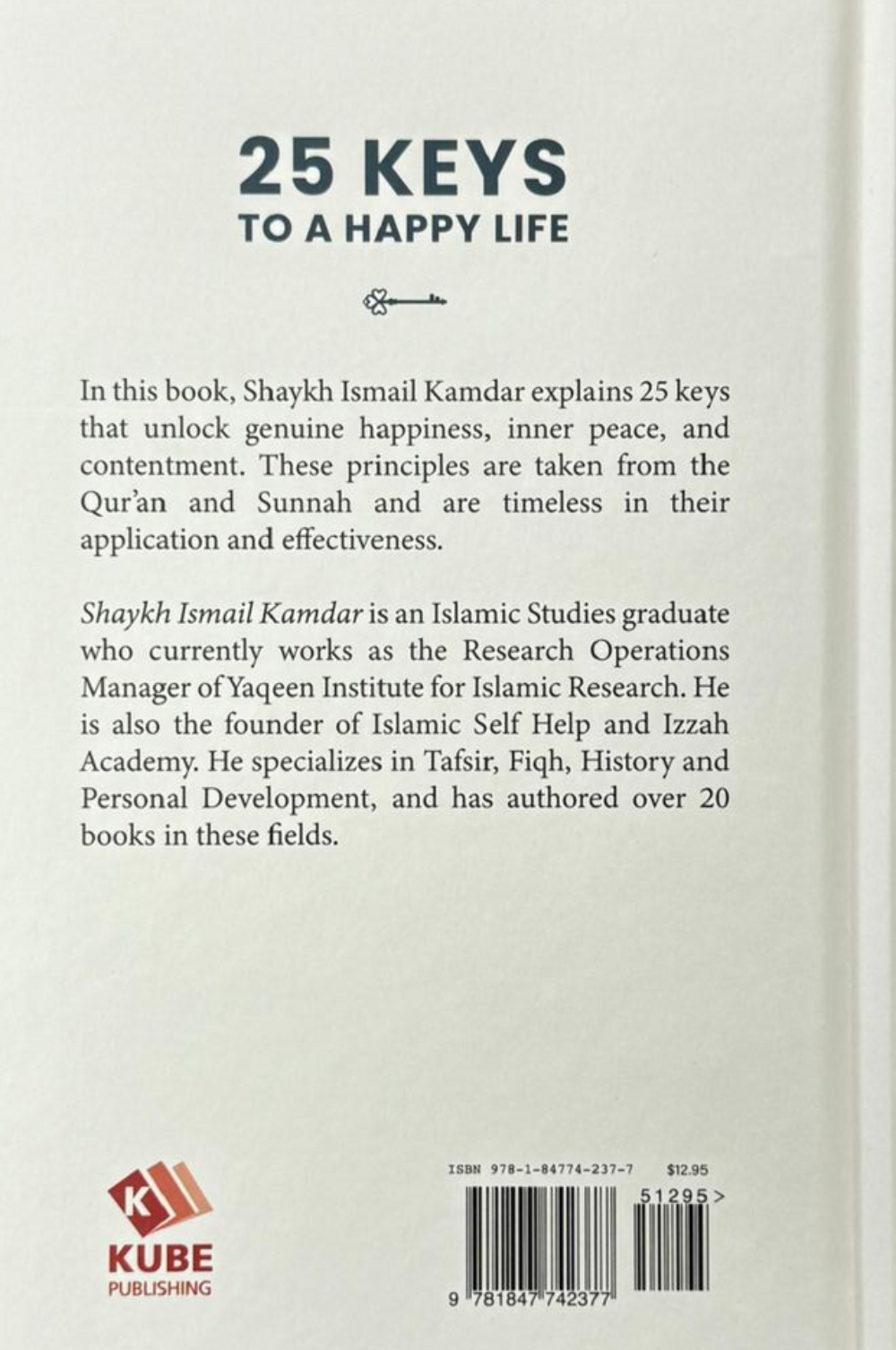
25 KEYS
TO A HAPPY LIFE
In this book, Shaykh Ismail Kamdar explains 25 keys that unlock genuine happiness, inner peace, and contentment. These principles are taken from the Qur'an and Sunnah and are timeless in their application and effectiveness.
Shaykh Ismail Kamdar is an Islamic Studies graduate who currently works as the Research Operations Manager of Yaqeen Institute for Islamic Research. He is also the founder of Islamic Self Help and Izzah Academy. He specializes in Tafsir, Fiqh, History and Personal Development, and has authored over 20 books in these fields.
Page:04
KEY TWO
BUILD YOUR AFTERLIFE
The Messenger said, "When the person dies, their deeds end except for three: ongoing charity, beneficial knowledge, or a righteous child who prays for them." (Sahih Muslim 1631)
Do not be afraid of death. For the believer, death is not the end. It is simply the end of the test, and hope- fully the beginning of eternal bliss. True happiness can only be experienced after death, when the trials of life are over, and we enter the eternal garden. This is the happiness that every Muslim strives for.
Our lives are short, and we do not know how long we have left in this world. We want our deeds to out- live us so that they continue to pile up long after we have passed away. To accomplish this, we must focus a portion of our lives on building sources of continu- ous reward. Any good deed that continues to benefit people after you pass away can be a source of continu- ous reward if your intention is pure.
In general, there are three broad categories of such deeds: charity, knowledge, and descendants. Any char- ity we give that has long-term effects on society will
BUILD YOUR AFTERUFE
continue to be a source of reward for us for as long as people benefit from it. For example, if you build a well in a community that needs one, even if people are still drinking from that well a hundred years later, you will still be rewarded for each person who benefits from it. Likewise, if we donate to orphanages, build homes for those devastated by natural disasters, build mas- jids, sponsor orphans, or establish centres to protect victims of abuse, each of these becomes a source of continuous reward for the one who contributed to it. Therefore, we must invest our extra income in sources of continuous reward to ensure that our wealth con- tinues to benefit us in the Afterlife, long after we have left this world.
The same applies to knowledge. If you teach someone anything beneficial, you are rewarded for as long as they benefit from that knowledge. Just as we focus on investing our wealth in sources of continuous charity, we must do the same for our knowledge. We can do this by developing educational media, establishing schools, universities, and libraries, writing books, teaching local children, and sponsoring the university fees of others. The more you invest in the education of others, the more sources of continuous reward you establish.
The third category of continuous reward is descend- ants who pray for us. Imagine if a hundred years after you have passed away, your grandchildren and great-grandchildren are still mentioning you by name and praying for you. Having children and raising them in a way that is pleasing to Allah is one of the best ways to invest in the Afterlife.