


At a time when misogyny and hostile attitudes towards women are plaguing Muslim communities throughout the world, Dr Jasser Auda presents a timely and vital challenge to the contentious issue of women's access to the mosque, expounding and Islamic perspective. Reclaiming The Mosque is a crucial response to the current trials facing Muslim communities, and moreover, it offers a clear and cohesive call to action that harks back tot he Islamic principles of Freedom, justice and human rights.
1
/
de
6
Reclaiming the Mosque – The Role of Women in Islam’s House of Worship (Empowering Islamic Guidance)
Reclaiming the Mosque – The Role of Women in Islam’s House of Worship (Empowering Islamic Guidance)
Publisher:
Claritas Books
Author:
Jasser Auda
Language:
English
Binding:
Soft Cover
Pages: 146
Size: 14x21cm
Prix habituel
$16.99 USD
Prix habituel
Prix promotionnel
$16.99 USD
Prix unitaire
/
par
Frais d'expédition calculés à l'étape de paiement.
Impossible de charger la disponibilité du service de retrait


Contenu réductible
Description du livre
Reclaiming the Mosque – The Role of Women in Islam’s House of Worship (Empowering Islamic Guidance)
Reclaiming the Mosque: The Role of Women in Islam’s House of Worship presents an authentic Islamic perspective on the role, rights, and responsibilities of women regarding mosque participation. This book clarifies traditional texts and scholarly views while guiding Muslims toward a balanced and respectful understanding.
From Author:
Éditeur
Claritas Books
Auteur
- Jasser Auda
Shipping and Delivery
We dispatch orders directly from our UK and USA warehouses, offering multiple shipping options to suit your needs. We proudly ship worldwide.
UK Deliveries (from UK warehouse):
Standard shipping typically arrives within 3–4 working days. Expedited delivery takes 2–3 working days. We aim to dispatch orders the same day or next working day, with next-day delivery options available where applicable.
USA Deliveries (from USA warehouse):
Orders usually arrive within 4–7 working days.
Europe (shipped from UK):
Standard delivery takes approximately 6–10 working days, with expedited services available in 3–5 working days.
Canada:
Estimated delivery time is 5–10 working days.
Worldwide Shipping:
International orders generally arrive within 5–20 working days, depending on destination and shipping method selected.
For precise delivery timelines based on your location, please contact us by email and our team will provide detailed information tailored to your address.
Exemples de pages - Contenu
Page 01
RECLAIMING THE MOSQUE
THE ROLE OF WOMEN IN ISLAM'S HOUSE OF WORSHIP
JASSER AUDA
Page 02
RECLAIMING THE MOSQUE
What does the Quran say about women and mosques?
as the "House of Allah" and the "Sacred House," and inviting. all, men and women, to visit. Allah also mentioned by name the sacred mosque in Jerusalem. The Farthest Mosque. The following are a few examples:
"Behold! We gave to Abraham the site of the Sacred House, saying: 'Associate nothing in worship with Me; and sanctify My House for those who compass it round, or stand up, or bow, or prostrate themselves therein in prayer" (22:26)
"Glory to Allah Who did take His servant for a jour ney by night from the Sacred Mosque to the Farthest Mosque." (17:1)
"Allah made the Kaba, the Sacred House, an asylum of security for people [al-nas), as also the Sacred Months." (5:97)
"Indeed, the first House of worship established for peo ple [al-nas) was that at Mecca blessed and a guid ance for the worlds." (3:96)
It is interesting to note that most of the English translators of these verses mentioned above, wrongly translate the Ara bic words referring to the dwellers and visitors of the mosque to the English words "men" or "mankind." Take for example verse 3:96 mentioned above, which refers to the visitors of the mosque with the Arabic word "al-nas." This word means "the people" in every conventional and colloquial sense of the Arabic language. However, "al-nas" is rendered "men" or "mankind" by every major translator of the Quran, including: Muhammad Asad, Sahih International, Pickthall, Yusuf Ali,
Shakir, Muhammad Sarwar, and Mohsin Khan." I am aware of one exception, Arberry, who translated "al-nas" in 3:96 as "the people." It is interesting that in verse 5:97 mentioned above. even Arberry translated "al-nas" to "men." This shows how the translators/interpreters of the Quran are influenced by their pre-assumptions and biases when it comes to the issue of women in the mosque.
However, there are two verses that urged believers to attend the mosque in which the word "rijal" was used to refer to mosque attendees:
"Such light is in mosques which Allah has ordered to be raised and that His name be mentioned there- in; exalting Him within them in the morning and the evenings. [There are] persons [rijal) whom neither commerce nor sale distracts from the remembrance of Allah and performance of prayer and giving of chari- ty (24:36-37)
"A mosque founded on righteousness from the first day is more worthy for you to stand in. Within it are per- sons [rijal) who love to purify themselves; and Allah loves those who purify themselves." (9:108)
Some exegetes misunderstood the Arabic word "rijal" (which I translated above as "persons" in these two verses). and interpreted it to mean "men", to the exclusion of women. It is to be noted that every English translation of the Quran I am aware of translated this word as "men" except for Muhammad Sarwar who chose the word "people". The commonly used but wrong interpretation/translation had a negative impact on the collective perception of Muslims, who thought that there was
Page 03
CONTENTS
1. Why this book?
2. How do we judge what is "Islamic"?
3. What does the Quran say about women and mosques? 4. What does the Sunnah say about women and mosques?
5. On what basis do some Muslims prevent women from entering mosques?
6. Did the Prophet (s) say that a woman's prayer at home is better than at the mosque?
7. Are the hadith narrations that ridicule women true? Are most women "dwellers of hell"?
8. How did the Prophet (s) design the first mosque in Medina?
9. Is there such a thing as a "men's entrance" to the mosque?
10. Are children allowed in the mosque? Where do they pray?
11. Can men and women interact in the mosque?
Page 04
CHAPTER 1 Why this book?
A few years ago, the British Channel 4 Dispatches programme aired an interesting episode about Muslim women in the UK. They investigated the role of Muslim women in London mosques and their contribution to their communities. To their shock, and my embarrassment as a viewer, it concluded that women have no role in most of the mosques they sur- veyed. This was due to the simple fact that women were not even "allowed" to enter them in the first place.
The female reporter, dressed in a conservative Muslim garment, attempted to enter dozens of mosques in London, on camera. She was told at the door, sometimes politely but of- tentimes rudely that, "No women are allowed here," or found someone at the mosque's door pointing to a sign that read: "Brothers Only".
The documentary reported that about 800 London mosques are not open to women. Mosque leaders, who agreed to be interviewed, cited "limited space" as the main reason for this. When the reporter questioned, "But why ar- en't women allowed in the available space at any time? What is the role of the mosque anyway?" she received no reply.
This documentary undoubtedly caused damage to Islam's image in the UK and around the world. To me, it was a scan-
Page 05
CHAPTER 4
What does the Sunnah say about women and mosques?
The Sunnah of the Prophet (s) includes hundreds of authentic narrations indicating women's normal presence in the mosque at all times and on all occasions at the time of the Prophet (s). The following are a few examples:
I will start with a story that Imam Bukhari narrated af- ter Aisha (r). It is the story of an African female slave who was freed by the Arab tribe that enslaved her, and eventually decided to "live" in a tent in the mosque of the Prophet (s). I am quoting the whole narration here because its details are worth reflecting upon. According to Aisha, the young African narrates:13
"A baby girl from the tribe that had enslaved me came out wearing a red leather scarf decorated with precious stones. The scarf fell from her or she placed it some- where. A bird passed by that place, saw the scarf on the ground and mistook it for a piece of meat. The bird took the scarf and flew away with it. The baby's family searched for the scarf and when they could not find it, they accused me of stealing it and started searching me aggressively. They even searched my private parts. By Al- lah, while I was being searched, the same bird returned
Page 06
RECLAIMING THE MOSQUE
THE ROLE OF WOMEN IN ISLAM'S HOUSE OF WORSHIP
JASSER AUDA
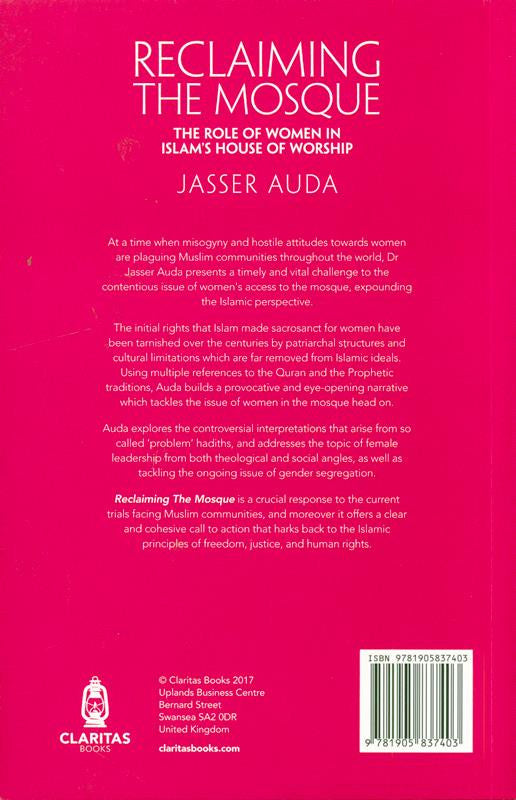
At a time when misogyny and hostile attitudes towards women are plaguing Muslim communities throughout the world, Dr Jasser Auda presents a timely and vital challenge to the contentious issue of women's access to the mosque, expounding the Islamic perspective.
The initial rights that Islam made sacrosanct for women have been tarnished over the centuries by patriarchal structures and cultural limitations which are far removed from Islamic ideals. Using multiple references to the Quran and the Prophetic traditions, Auda builds a provocative and eye-opening narrative which tackles the issue of women in the mosque head on.
Auda explores the controversial interpretations that arise from so called 'problem' hadiths, and addresses the topic of female leadership from both theological and social angles, as well as tackling the ongoing issue of gender segregation.
Reclaiming The Mosque is a crucial response to the current trials facing Muslim communities, and moreover it offers a clear and cohesive call to action that harks back to the Islamic principles of freedom, justice, and human rights.
CLARITAS BOOKS
Claritas Books 2017 Uplands Business Centre Bernard Street
Swansea SA2 ODR
Who is Jasser Auda?
The author of Reclaiming the Mosque is a respected Islamic scholar specializing in gender roles, fiqh, and mosque affairs. With deep knowledge of the Quran, Sunnah, and classical scholarship, the author provides balanced, authentic Islamic evidence to guide Muslim communities.
Customers helping others by Reviews - جزاك اللهُ خيراً
4.94 ★ (49)
Verified