


النحو الواضح للمبتدئين (النسخة الفاخرة) | أفضل كتاب في النحو العربي للطلاب والمبتدئين
النحو الواضح للمبتدئين (النسخة الفاخرة) | أفضل كتاب في النحو العربي للطلاب والمبتدئين
Publisher:
Dar Ibn Katheer
Author:
يوسف علي بدوي
Language:
الإنجليزية
Binding:
غلاف مقوى
Pages: 504
Size: 17×24 سم
لم نتمكن من تحميل توفر الاستلام


محتوى قابل للطي
وصف كتاب إسلامي
النحو الواضح للمبتدئين - الطبعة الفاخرة | أفضل كتاب في النحو العربي للطلاب والمبتدئين
النحو الواضح للمبتدئين - الطبعة الفاخرة (النحو الواضح) هو كتاب متميز في قواعد اللغة العربية صُمم لتبسيط علم النحو للمبتدئين والطلاب. يتميز هذا الإصدار الفاخر بشروحات واضحة وأمثلة عملية وتمارين، مما يساعد المتعلمين على بناء أساس قوي في اللغة العربية الفصحى ولغة القرآن الكريم.
من المؤلف:
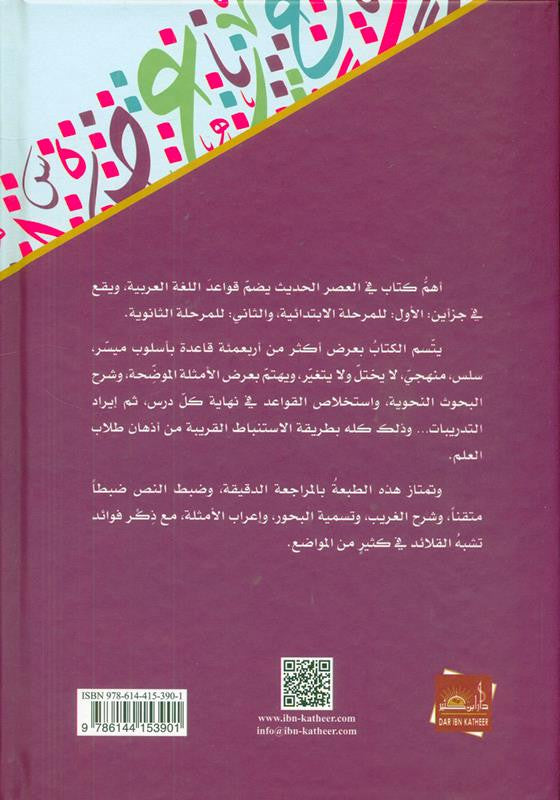
أهمُّ كتاب في العصر الحديث يضمّ قواعدَ اللغة العربية، ويقع في جزأين: الأول: للمرحلة الابتدائية، والثاني: للمرحلة الثانوية.
يتّسم الكتابُ بعرض أكثر من أربعمئة قاعدة بأسلوب ميسّر، سلس، منهجيّ، لا يختلّ ولا يتغيّر، ويهتمّ بعرض الأمثلة الموضِّحة، وشرح البحوث النحوية، واستخلاص القواعد في نهاية كلّ درس، ثم إيراد التدريبات… وذلك كله بطريقة الاستنباط القريبة من أذهان طلاب العلم.
وتمتاز هذه الطبعةُ بالمراجعة الدقيقة، وضبط النص ضبطاً متقناً، وشرح الغريب، وتسمية البحور، وإعراب الأمثلة، مع ذِكـْر فوائد تشبهُ القلائد في كثيرٍ من المواضع.
page no:01
Ali Al-Jarim and Mustafa Amin
Al-Nahw Al-Wadih (Clear Grammar)
In Arabic Language Rules
Parts 1 - 3
For Primary Level
Qabita, strange fatigue, and a productive lesson
Yousef Ali Badiwi
Dar Abrakah
page no :02
Guidelines for Teaching Methodology
(A) In Teaching Arabic Grammar
(1) The examples prepared by the teacher are written clearly on the blackboard.
(2) The student is asked to read the examples.
(3) The teacher proceeds with the discussion and deduction in the manner we explained in the book.
(4) The rules are written clearly on the blackboard after they have been deduced. (5) Similarities or contrasts between the new lesson topic and any previous lesson topic are highlighted whenever useful. (6) Students are asked to compose many sentences that apply to the definitions and rules they have deduced. It is good for the teacher to guide them to the type of these sentences so that they relate to general life affairs and subjects they are naturally inclined towards. (7) Grammar lessons are linked to composition lessons; for example, the subject of the examples in grammar lessons might sometimes be a composition topic, or students might be asked during a composition lesson to compose sentences using various rules they have previously studied.
(B) In Oral Exercise
It is good in this lesson for the teacher to prepare examples of what he wants to practice on from
(1) during/in the course of
page no:03
The Useful Sentence
Examples:
(1) The garden is beautiful.
(4) Muhammad picked a flower.
(2) The sun is rising. (5) Fish live in water.
(3) Ali smelled a rose. (6) Palm trees are numerous in the region of Egypt (1).
Discussion:
If we contemplate the first construct, we find it composed of two words, the first is "the garden" and the second is "beautiful". If we take the first word alone, which is "the garden", we do not understand anything other than a singular meaning that is not sufficient for conversation; the same applies if we take the second word alone, which is "beautiful". However, if we join one of the two words to the other in the manner shown in the construct, and say: "The garden is beautiful", we understand a complete meaning and have gained a full benefit, which is attributing beauty to the garden; therefore, this construct is called a useful sentence, and each of the two words is considered a part of this sentence. The same applies to the remaining examples.
Thus, we see that a word alone is not sufficient in conversation, and that two or more words are necessary for a person to gain a complete benefit. As for phrases like: "Stand up", "Sit", "Speak", which appear to be single words sufficient for conversation, they are not, in reality, a single word, but rather...
(1) Region of Egypt: It is the Arab Republic of Egypt.
page no:04
General Exercises
On the entire Arabic grammar curriculum for primary schools
(1) (a) Let every human strive to perform his duty.
(b) The friend would not betray his friend.
(c) People plant so they may harvest.
- Explain the meaning of the 'lam' in each of the previous examples, and mention a fourth example for another meaning of the 'lam':
(2) Mention three different positions for the use of "ma" and provide an example for each in a complete sentence. (3) Provide a nominal sentence where the subject (mubtada') and predicate (khabar) are from the Five Nouns, then prefix "layta" to it once, and "ma bariha" another time.
(4) Convert the following phrase to the singular, then to the dual, and then to the plural in both its genders: The diligent one arrived joyful.
(5) Identify every doer (fa'il) and object (maf'ul bihi) in the following two sentences:
(a) It pleases me that the boy obeys his father.
(b) It gladdened my heart that the flowers are fresh.
(6) Diacritically mark the ends of the words in the following phrase, and state the reason for the marking for the underlined words: Cairo has fame in history, and it is now the greatest city in Africa in status.
page no:05
280
Al-Nahw Al-Wadih in Arabic Language Rules - Primary Level
Positions of breaking the hamza of 'inna'
(1) Indeed, the Nile is the life of Egypt. (4) The accused said: "Indeed, I am innocent."
(2) Indeed, lying is cowardice (1). (5) Say: "Indeed, the truth is clear."
(3) Indeed, justice is the foundation of the kingdom. (6) Do not say that work is hard.
(7) I visited him whom I praise.
(8) I felt pity for her who is worthy of pity.
(9) Those whose presence pleases me have arrived.
Discussion:
Contemplate each of the previous examples; you will find that it includes 'anna' along with its subject and predicate, but you cannot place a verbal noun (masdar) in its place; therefore, the hamza of 'inna' was not fatha-voweled (opened) but kasra-voweled (broken). If you contemplate the first three examples, you see that the kasra-voweled 'inna' occurs at the beginning of the speech. If you look at the second three examples, you see it occurring after sentences whose verbs are derived from speech, which is the source (masdar).
(1) Cowardice: fear.
page no:06
The most important book in the modern era that includes Arabic language rules, consisting of two parts: the first for the primary level, and the second for the secondary level.
The book is characterized by presenting more than four hundred rules in an easy, smooth, and systematic style that does not falter or change. It focuses on presenting explanatory examples, explaining grammatical discussions, extracting rules at the end of each lesson, and then providing exercises... all through a deductive method close to the minds of students of knowledge.
This edition is distinguished by careful proofreading, precise textual editing, explanation of rare vocabulary, naming of poetic meters, parsing of examples, along with mentioning benefits—like necklaces—in many places.
الناشر
Dar Ibn Katheer
مؤلف
- يوسف علي بدوي
الشحن والتوصيل
نقوم بشحن الطلبات مباشرة من مستودعاتنا في المملكة المتحدة والولايات المتحدة الأمريكية، ونقدم خيارات شحن متعددة لتناسب احتياجاتك. نحن نشحن بفخر إلى جميع أنحاء العالم.
عمليات التسليم في المملكة المتحدة (من مستودع المملكة المتحدة):
يصل الشحن القياسي عادةً في غضون 3-4 أيام عمل. يستغرق التسليم السريع 2-3 أيام عمل. نهدف إلى شحن الطلبات في نفس اليوم أو يوم العمل التالي، مع توفر خيارات التوصيل في اليوم التالي حيثما ينطبق ذلك.
عمليات التسليم في الولايات المتحدة الأمريكية (من مستودع الولايات المتحدة الأمريكية):
تصل الطلبات عادةً في غضون 4-7 أيام عمل.
أوروبا (يتم الشحن من المملكة المتحدة):
يستغرق التسليم القياسي حوالي 6-10 أيام عمل، مع توفر خدمات الشحن السريع في غضون 3-5 أيام عمل.
كندا:
الوقت المقدر للتسليم هو 5-10 أيام عمل.
الشحن في جميع أنحاء العالم:
تصل الطلبات الدولية بشكل عام في غضون 5-20 يوم عمل، اعتمادًا على الوجهة وطريقة الشحن المختارة.
للحصول على جداول زمنية دقيقة للتسليم بناءً على موقعك، يرجى الاتصال بنا عبر البريد الإلكتروني وسيقدم فريقنا معلومات مفصلة ومخصصة لعنوانك.
صفحات العينة - المحتوى
page no:01
Ali Al-Jarim and Mustafa Amin
Al-Nahw Al-Wadih (Clear Grammar)
In Arabic Language Rules
Parts 1 - 3
For Primary Level
Qabita, strange fatigue, and a productive lesson
Yousef Ali Badiwi
Dar Abrakah
page no :02
Guidelines for Teaching Methodology
(A) In Teaching Arabic Grammar
(1) The examples prepared by the teacher are written clearly on the blackboard.
(2) The student is asked to read the examples.
(3) The teacher proceeds with the discussion and deduction in the manner we explained in the book.
(4) The rules are written clearly on the blackboard after they have been deduced. (5) Similarities or contrasts between the new lesson topic and any previous lesson topic are highlighted whenever useful. (6) Students are asked to compose many sentences that apply to the definitions and rules they have deduced. It is good for the teacher to guide them to the type of these sentences so that they relate to general life affairs and subjects they are naturally inclined towards. (7) Grammar lessons are linked to composition lessons; for example, the subject of the examples in grammar lessons might sometimes be a composition topic, or students might be asked during a composition lesson to compose sentences using various rules they have previously studied.
(B) In Oral Exercise
It is good in this lesson for the teacher to prepare examples of what he wants to practice on from
(1) during/in the course of
page no:03
The Useful Sentence
Examples:
(1) The garden is beautiful.
(4) Muhammad picked a flower.
(2) The sun is rising. (5) Fish live in water.
(3) Ali smelled a rose. (6) Palm trees are numerous in the region of Egypt (1).
Discussion:
If we contemplate the first construct, we find it composed of two words, the first is "the garden" and the second is "beautiful". If we take the first word alone, which is "the garden", we do not understand anything other than a singular meaning that is not sufficient for conversation; the same applies if we take the second word alone, which is "beautiful". However, if we join one of the two words to the other in the manner shown in the construct, and say: "The garden is beautiful", we understand a complete meaning and have gained a full benefit, which is attributing beauty to the garden; therefore, this construct is called a useful sentence, and each of the two words is considered a part of this sentence. The same applies to the remaining examples.
Thus, we see that a word alone is not sufficient in conversation, and that two or more words are necessary for a person to gain a complete benefit. As for phrases like: "Stand up", "Sit", "Speak", which appear to be single words sufficient for conversation, they are not, in reality, a single word, but rather...
(1) Region of Egypt: It is the Arab Republic of Egypt.
page no:04
General Exercises
On the entire Arabic grammar curriculum for primary schools
(1) (a) Let every human strive to perform his duty.
(b) The friend would not betray his friend.
(c) People plant so they may harvest.
- Explain the meaning of the 'lam' in each of the previous examples, and mention a fourth example for another meaning of the 'lam':
(2) Mention three different positions for the use of "ma" and provide an example for each in a complete sentence. (3) Provide a nominal sentence where the subject (mubtada') and predicate (khabar) are from the Five Nouns, then prefix "layta" to it once, and "ma bariha" another time.
(4) Convert the following phrase to the singular, then to the dual, and then to the plural in both its genders: The diligent one arrived joyful.
(5) Identify every doer (fa'il) and object (maf'ul bihi) in the following two sentences:
(a) It pleases me that the boy obeys his father.
(b) It gladdened my heart that the flowers are fresh.
(6) Diacritically mark the ends of the words in the following phrase, and state the reason for the marking for the underlined words: Cairo has fame in history, and it is now the greatest city in Africa in status.
page no:05
280
Al-Nahw Al-Wadih in Arabic Language Rules - Primary Level
Positions of breaking the hamza of 'inna'
(1) Indeed, the Nile is the life of Egypt. (4) The accused said: "Indeed, I am innocent."
(2) Indeed, lying is cowardice (1). (5) Say: "Indeed, the truth is clear."
(3) Indeed, justice is the foundation of the kingdom. (6) Do not say that work is hard.
(7) I visited him whom I praise.
(8) I felt pity for her who is worthy of pity.
(9) Those whose presence pleases me have arrived.
Discussion:
Contemplate each of the previous examples; you will find that it includes 'anna' along with its subject and predicate, but you cannot place a verbal noun (masdar) in its place; therefore, the hamza of 'inna' was not fatha-voweled (opened) but kasra-voweled (broken). If you contemplate the first three examples, you see that the kasra-voweled 'inna' occurs at the beginning of the speech. If you look at the second three examples, you see it occurring after sentences whose verbs are derived from speech, which is the source (masdar).
(1) Cowardice: fear.
page no:06
The most important book in the modern era that includes Arabic language rules, consisting of two parts: the first for the primary level, and the second for the secondary level.
The book is characterized by presenting more than four hundred rules in an easy, smooth, and systematic style that does not falter or change. It focuses on presenting explanatory examples, explaining grammatical discussions, extracting rules at the end of each lesson, and then providing exercises... all through a deductive method close to the minds of students of knowledge.
This edition is distinguished by careful proofreading, precise textual editing, explanation of rare vocabulary, naming of poetic meters, parsing of examples, along with mentioning benefits—like necklaces—in many places.
من هو Yusuf Ali Badaiwi؟
Yusuf Ali Badaiwi is an Arabic language scholar, editor, and educator known for his contributions to Arabic grammar studies and educational Islamic literature. He is recognized for reviewing, editing, and simplifying classical Arabic grammar works to make them more accessible for students, researchers, and learners of the Arabic language. His scholarly efforts focus on improving Arabic linguistic understanding through structured explanations and educational resources.